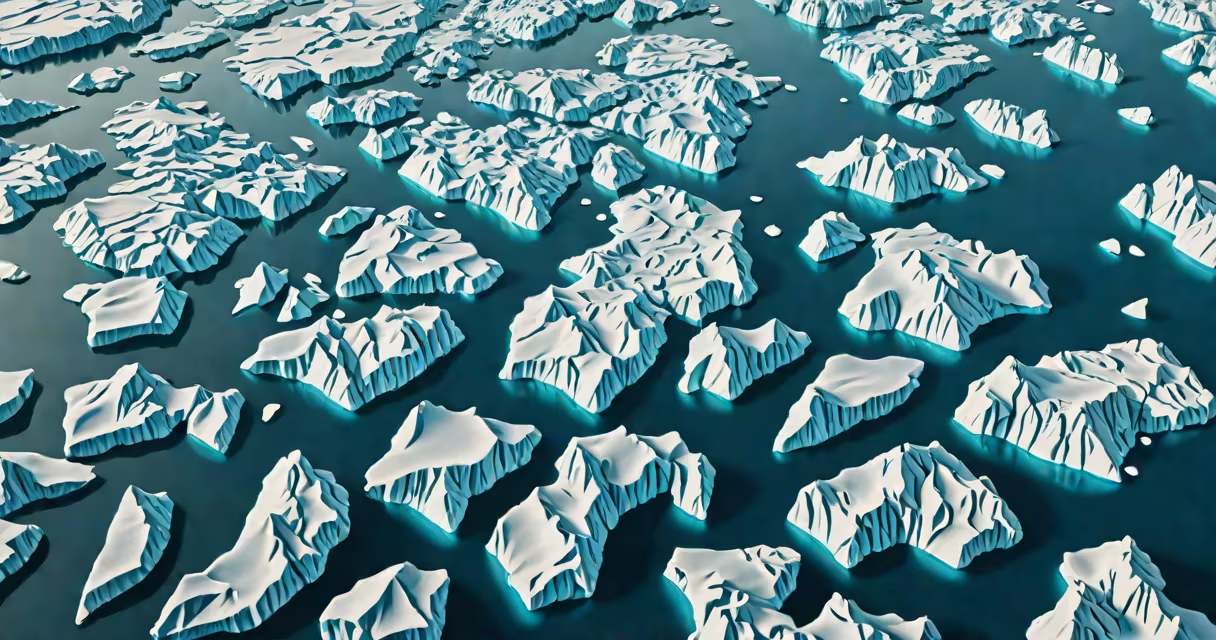
If the Earth's ice caps melted completely, global sea levels would rise by approximately 60 meters (197 feet), submerging most major coastal cities and reshaping continental coastlines. This scenario involves the complete loss of the Greenland and Antarctic ice sheets, which together hold enough frozen water to raise oceans.
The process would unfold over centuries, but current rates of ice loss suggest irreversible changes are already underway. The Greenland ice sheet alone contains enough water to raise sea levels by 7.4 meters (24 feet), while Antarctica's ice holds 58 meters (190 feet) of potential sea level rise. These figures come from NASA's Ice Sheet Mass Balance Interferometry (IMBIE) project, which tracks ice volume changes using satellite data.
Melting ice doesn't just add water to the ocean-it alters ocean circulation patterns. Freshwater from melting ice reduces salinity in polar regions, weakening the Atlantic Meridional Overturning Circulation (AMOC), a key driver of global heat distribution. A slowdown in AMOC could trigger cooling in Western Europe despite global warming, according to research published in *Nature Climate Change*.
Ice cap melting occurs through surface runoff, basal melting beneath glaciers, and calving-where large chunks break off and fall into the ocean. In Greenland, warmer air temperatures increase surface melting. In Antarctica, warm ocean currents erode ice shelves from below, destabilizing inland glaciers.
For example, the Thwaites Glacier in West Antarctica is currently losing about 50 billion tons of ice annually. If it collapses, it could trigger a chain reaction across the West Antarctic Ice Sheet, accelerating sea level rise. Scientists estimate that once Thwaites reaches a critical threshold, its retreat becomes unstoppable-even if global emissions were reduced to zero.
Glacial melt also contributes to albedo feedback. Ice reflects sunlight (high albedo), but darker water and exposed land absorb more heat. As ice disappears, more solar energy is absorbed, increasing local temperatures and accelerating further melting. This cycle is well documented in Arctic sea ice decline, where summer minimum extent dropped from an average of 7 million km² in the 1980s to under 4 million km² in recent years, per the National Snow and Ice Data Center (NSIDC).
Not all ice contributes equally to sea level rise. Glaciers and ice sheets differ in structure, location, and response time. The table below outlines the primary contributors:
| Source | Location | Sea Level Rise Potential | Key Risk Factor |
|---|---|---|---|
| Greenland Ice Sheet | Arctic | 7.4 meters (24 ft) | Surface melting accelerated by warm air |
| West Antarctic Ice Sheet | Antarctica | 3.3 meters (11 ft) | Basal melting from warm ocean currents |
| East Antarctic Ice Sheet | Antarctica | 58 meters (190 ft) | Stable but vulnerable if warming exceeds 2°C |
| Mountain Glaciers | Global | 0.3 meters (1 ft) | Fastest-melting due to elevation and exposure |
Mountain glaciers-like those in the Himalayas or Andes-contribute less to total sea level rise but have immediate regional consequences. For example, the retreat of the Gangotri Glacier in India threatens freshwater supplies for over 100 million people who rely on glacial-fed rivers during dry seasons.
Coastal zones face the most direct impact. Cities such as Miami, Jakarta, Dhaka, Shanghai, and Lagos lie below 10 meters in elevation. Even a 1-meter rise-projected by 2100 under moderate emissions scenarios-would displace 150 million people globally, according to the World Bank's 2020 report on climate migration.
Low-lying island nations are especially vulnerable. The Maldives, with an average elevation of 1.5 meters, could become uninhabitable within decades. In Tuvalu, residents already experience saltwater intrusion into freshwater aquifers during high tides, affecting drinking water and agriculture.
A lesser-known consequence is the disruption of marine ecosystems. Cold-water species like Antarctic krill depend on sea ice for breeding grounds. Loss of ice reduces their habitat, affecting entire food chains. Whales, seals, and penguins rely on krill populations, which in turn influence fish stocks and commercial fishing zones.
Many assume that melting sea ice (like Arctic ice floes) directly raises sea levels. This is incorrect. Sea ice floats and displaces water equal to its volume-so when it melts, it doesn't change ocean levels. Only land-based ice-glaciers and ice sheets-adds new water to the ocean.
Another myth is that ice cap melting happens slowly and predictably. In reality, ice loss accelerates nonlinearly. For example, between 2002 and 2020, Greenland lost an average of 279 gigatons of ice per year. That rate doubled from 2002 to 2012 and increased again after 2012, indicating a threshold effect rather than steady decline.
Some believe that engineering solutions like artificial ice dams could reverse the trend. However, the scale is beyond current technological feasibility. A proposal to build a dam across the Bering Strait to reduce warm Pacific inflow into the Arctic was modeled in 2017, but researchers concluded it would require 100 times the annual global steel production and cost over $1 trillion-making it impractical.
In July 2019, 12.5 billion tons of ice melted from Greenland in just 10 days. Satellite data from NASA's GRACE mission showed a sudden drop in mass, equivalent to filling 5 million Olympic swimming pools. This event contributed to a 0.5 mm rise in global sea levels over the month.
Local effects included increased river flooding in southern Greenland and changes in freshwater flow into the North Atlantic. Scientists noted that the melt occurred not from record-high temperatures but from prolonged low-pressure systems that funneled warm air over the ice sheet-a rare atmospheric pattern that may become more frequent with climate change.
Even partial melting has cascading effects. In 2021, a study in *Science Advances* found that Greenland's meltwater altered the salinity of the Labrador Sea, slowing down deep ocean convection. This weakened the AMOC by 15% compared to pre-industrial levels, a shift that could persist for decades.
The full collapse of the ice caps is not imminent-but the trajectory is clear. Even limiting warming to 1.5°C above pre-industrial levels, as outlined in the Paris Agreement, still risks significant ice loss. The Intergovernmental Panel on Climate Change (IPCC) projects that sea levels could rise by 0.5 to 1 meter by 2100 under current policies, with higher rises likely if emissions continue unchecked.
Understanding what would happen if the ice caps melted is not speculative-it's based on physical laws, observational data, and climate models. The changes aren't hypothetical. They're measurable, ongoing, and accelerating. The sooner societies adapt, the fewer lives and assets will be at risk.