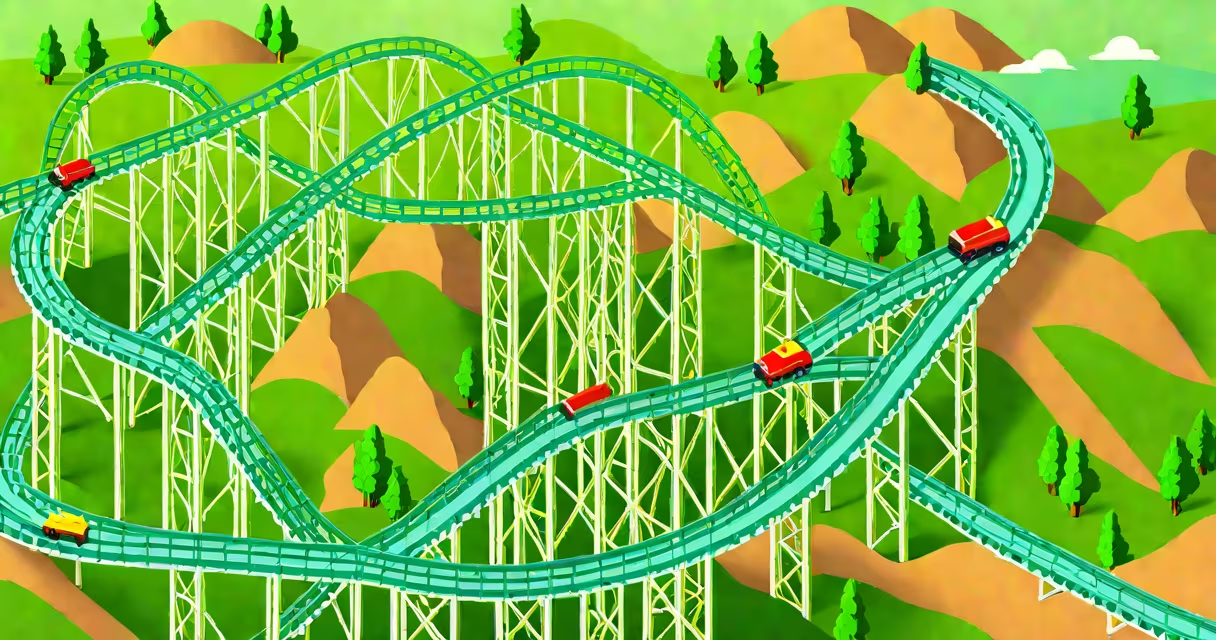
The roller coaster energy conservation problem examines how gravitational potential energy converts into kinetic energy during a ride, while accounting for real-world losses due to friction and air resistance. This model assumes ideal conditions where mechanical energy is conserved, but actual rides show measurable energy loss.
Energy conservation in physics states that total mechanical energy-sum of potential and kinetic energy-remains constant in isolated systems without non-conservative forces. On a roller coaster, height determines potential energy, and speed determines kinetic energy. As the car climbs, potential energy increases and kinetic energy decreases. As it descends, the opposite happens.
A 1,200 kg roller coaster car starts at rest at a height of 60 meters. Using the formula for gravitational potential energy, PE = mgh, where g = 9.8 m/s², the initial potential energy is 1,200 × 9.8 × 60 = 705,600 joules. At the bottom of the first drop, assuming no energy loss, all this potential energy converts to kinetic energy. Solving KE = ½mv² gives v = √(2×705,600 / 1,200) ≈ 37.0 m/s (about 83 mph).
In reality, friction between wheels and track, air resistance, and sound dissipate energy. A real roller coaster at the bottom may reach only 32 m/s. That's 614,400 joules of kinetic energy-90,000 joules lost. These losses are unavoidable and must be accounted for in design.
| Stage | Potential Energy (J) | Kinetic Energy (J) | Total Mechanical Energy (J) |
|---|---|---|---|
| Top of first hill (ideal) | 705,600 | 0 | 705,600 |
| Bottom of first hill (ideal) | 0 | 705,600 | 705,600 |
| Bottom of first hill (real) | 0 | 614,400 | 614,400 |
Many students misunderstand the roller coaster energy conservation problem as a perfect conversion. But the term "conservation" in physics refers to total energy being constant in closed systems. Real roller coasters are open systems-energy escapes as heat and sound. The problem isn't flawed; it's a teaching tool to show the difference between ideal models and physical reality.
One non-obvious fact: even if a roller coaster has no brakes, it cannot return to its original height after a single drop unless energy is added. This is because each pass through the system loses energy. To reset the train, motors or launch systems must supply additional energy-common in modern coasters like Kingda Ka, which uses a hydraulic launch to push cars from 0 to 128 mph in 3.5 seconds.
Another common confusion: people think energy is "used up." Energy isn't destroyed-it transforms. Friction turns mechanical energy into thermal energy. A roller coaster car's wheels and axles warm slightly during descent. This heat disperses into the environment. The total energy remains constant, but usable mechanical energy decreases.
I once observed a student misapply the conservation principle during a lab. They calculated the speed at the bottom using only potential energy, then measured the actual speed. The discrepancy was large. After reviewing the setup, we found the track had worn grooves that increased rolling resistance. This real-world deviation is why engineers include safety margins and test prototypes under load.
The roller coaster energy conservation problem is not just a classroom exercise. It reflects core principles in engineering and physics. Every ride design must balance excitement with safety, ensuring energy losses don't compromise structural integrity or passenger comfort. Engineers use simulations based on energy conservation to predict performance, adjust track profiles, and verify that braking systems can handle residual energy.
When analyzing the roller coaster energy conservation problem, remember that conservation means total energy stays the same in a closed system. In practice, systems lose energy. The challenge lies in modeling those losses accurately. Without accounting for friction and drag, predictions fail. That's why the problem is both foundational and practical.