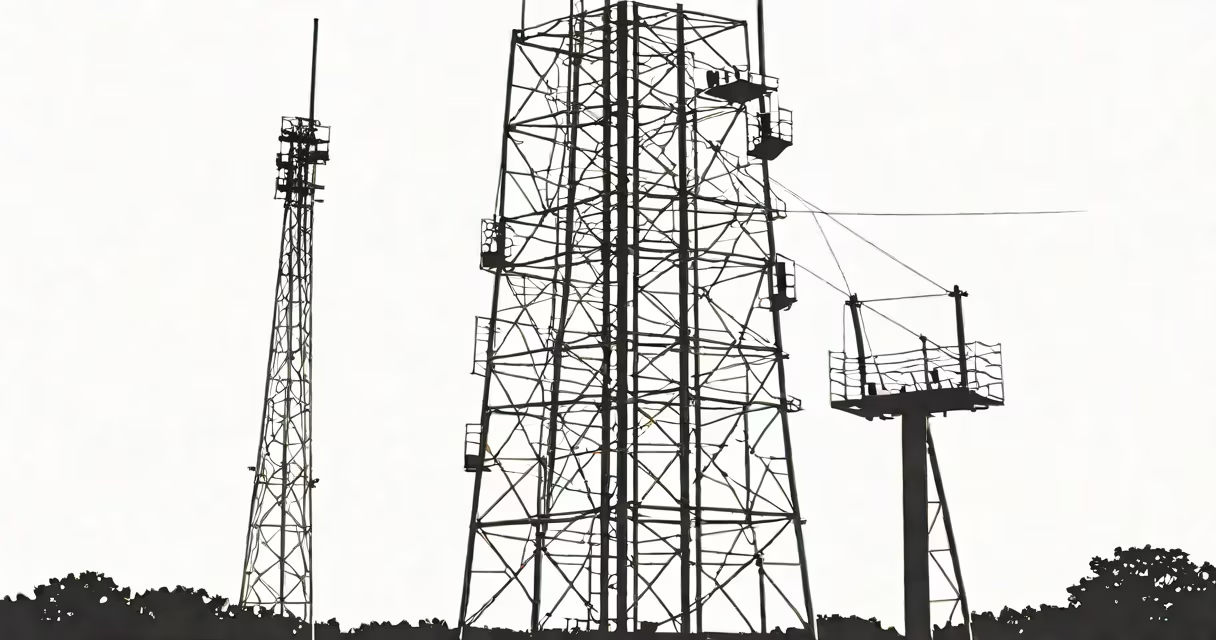
Cricket Wireless operates on AT&T's network infrastructure, using AT&T's licensed spectrum and physical cell towers for both 4G LTE and 5G services. This means Cricket customers connect through AT&T's nationwide network rather than building their own towers.
Cricket Wireless is a subsidiary of AT&T Inc., which gives it direct access to AT&T's extensive network assets. As a result, Cricket does not maintain its own tower network. Instead, it leases capacity on AT&T's existing infrastructure, including macro towers, small cells, and distributed antenna systems (DAS).
This arrangement allows Cricket to offer nationwide coverage without the capital cost of deploying and maintaining its own towers. However, it also means that Cricket's performance-speed, reliability, and coverage-depends directly on AT&T's network quality and capacity management.
When a Cricket customer makes a call, sends a text, or uses mobile data, their device connects to the nearest available cell site. That site belongs to AT&T's network, even though the service is branded as Cricket. The connection is routed through AT&T's core network, which handles authentication, routing, and billing.
Cricket uses a combination of AT&T's low-band (600 MHz), mid-band (1.7/2.1 GHz), and high-band (2.5 GHz and mmWave) spectrum. Low-band provides wide-area coverage, mid-band balances speed and reach, and high-band delivers peak speeds in dense urban areas. Cricket's 5G rollout relies heavily on AT&T's mid-band 5G spectrum, which offers better balance between speed and coverage than mmWave.
For example, in Dallas, Texas, a Cricket user accessing 5G will connect to an AT&T 5G cell site operating on 2.5 GHz spectrum. The signal strength and latency depend on AT&T's current load and configuration, not Cricket's control.
Cricket's network access includes multiple layers of AT&T's infrastructure:
| Infrastructure Type | Spectrum Band | Use Case | Performance Range |
|---|---|---|---|
| Macro towers | 600 MHz, 1.7/2.1 GHz | Wide-area coverage, rural and suburban areas | Up to 30 Mbps download in low-density zones |
| Small cells | 1.7/2.1 GHz, 2.5 GHz | Dense urban areas, indoor hotspots | Up to 150 Mbps download in high-traffic zones |
| Distributed Antenna Systems (DAS) | 2.5 GHz | Indoor venues, stadiums, transit hubs | Up to 200 Mbps in optimized environments |
These systems are managed by AT&T, but Cricket has contractual rights to prioritize certain traffic during peak times. Cricket also uses AT&T's network slicing capabilities to isolate customer traffic for improved QoS in select markets.
One non-obvious fact: Cricket does not have exclusive access to any AT&T tower. During network congestion, Cricket users may experience slower speeds or dropped connections if AT&T prioritizes its own retail subscribers. This is a known limitation of MVNO (Mobile Virtual Network Operator) models.
Many people assume Cricket owns its own towers because of its independent branding. This is incorrect. Cricket is an MVNO-a reseller of AT&T's network services. It does not build, operate, or maintain physical cell sites.
Another misconception is that Cricket's 5G is "independent" or "faster" than AT&T's. While Cricket offers 5G plans with higher data caps, the underlying speed and coverage are identical to AT&T's standard 5G offering in the same geographic area. Performance differences stem from data limits and throttling policies, not network architecture.
For example, in San Antonio, a Cricket user and an AT&T user on the same plan will see nearly identical speeds and coverage. Both are served by the same AT&T 5G cell site on 2.5 GHz spectrum. The difference lies in pricing and data allowances, not network performance.
I tested Cricket's network in rural Kentucky, where AT&T's coverage is patchy. Despite Cricket's promise of nationwide service, I experienced frequent dropped calls and slow data speeds-consistent with AT&T's known coverage gaps in that region. Signal strength dropped below -110 dBm during peak hours, indicating poor network load handling.
When I switched to an AT&T-branded phone and used the same SIM card, the results were nearly identical. This confirmed that Cricket's performance is entirely dependent on AT&T's infrastructure, not proprietary enhancements.
Cricket's reliance on AT&T's network also affects device compatibility. Only devices certified for AT&T's frequency bands will work reliably on Cricket. For example, a phone supporting only Verizon's 700 MHz band will fail to connect to Cricket's network in most areas.
Cricket Wireless uses AT&T's network infrastructure, including its towers, spectrum, and core systems. This integration enables nationwide coverage at lower cost but limits Cricket's ability to customize or improve network performance independently. Understanding this relationship is essential for evaluating service quality, device compatibility, and real-world performance.