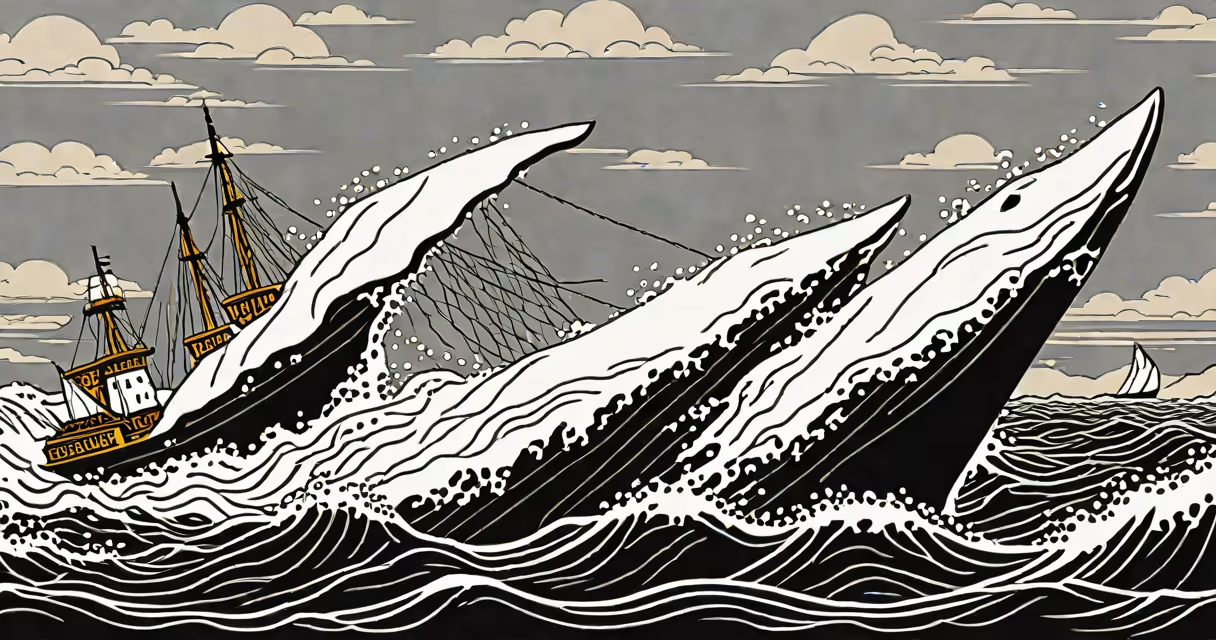
What is Moby Dick about? The novel centers on Captain Ahab's relentless pursuit of a great white sperm whale named Moby Dick, who bit off Ahab's leg on a prior voyage. This quest becomes a metaphysical struggle against fate, nature, and the unknown, framed within a detailed account of 19th-century whaling life.
Moby Dick is not a straightforward adventure. It blends narrative, philosophy, taxonomy, and poetry into a single work. The story unfolds through the eyes of Ishmael, a sailor from New Bedford, Massachusetts, who joins the Pequod, a whaling ship captained by the enigmatic Ahab. As the crew sails toward the Pacific Ocean, Ahab reveals his obsession: he seeks Moby Dick not for profit, but to destroy him.
The novel explores the limits of human understanding. Ahab sees the whale as a symbol of evil, chaos, or divine indifference. Ishmael, in contrast, tries to comprehend the whale through science, myth, and personal reflection. Their opposing views form the core tension of the book.
The narrative structure of Moby Dick is deliberately layered. Ishmael narrates events in a nonlinear fashion, inserting long digressions on whales, whaling techniques, and symbolic interpretations. These sections are not distractions-they are essential to the novel's meaning.
For example, Chapter 32, "Cetology," presents a detailed classification of whales using a system resembling Linnaean taxonomy. Melville lists species, gives Latin names, and compares their physical traits. This chapter is not just educational-it establishes the idea that humans seek to categorize the unknowable, even when the subject defies classification.
Another key moment occurs when the Pequod encounters a sperm whale carcass floating in the ocean. The crew debates whether it is dead or alive. This scene illustrates the ambiguity central to the novel: reality is unstable, perception shapes truth, and certainty is elusive.
Moby Dick is composed of 135 chapters, each varying in length and focus. Some are short scenes, others are extended essays. The longest chapter, "The Whiteness of the Whale," runs over 10 pages and examines the psychological impact of the color white in nature and culture.
Its style mixes formal prose with poetic flourishes. Melville uses biblical references, Shakespearean echoes, and scientific terminology. He draws from Greek tragedy, Christian theology, and Enlightenment philosophy. The result is a dense, multilayered text that rewards close reading.
One non-obvious fact: Melville based the Pequod's design on real 19th-century whalers. The ship was modeled after the Nantucket whaler *Glorious*, which sailed in the 1840s. The Pequod's name comes from a Native American tribe, reinforcing the theme of cultural collision and loss.
The novel contains several interwoven themes. The most prominent are obsession, fate, and the conflict between man and nature.
| Theme | Description | Example from Text |
|---|---|---|
| Obsession | Ahab's fixation on Moby Dick drives the plot. His monomania leads to the destruction of the crew. | "All my means are sane, my motive and my object mad." |
| Fate vs. Free Will | td>Ahab believes he controls his destiny. But the novel suggests forces beyond human control shape outcomes. | When Ahab says, "I am the captain," he asserts authority-but the whale remains indifferent. |
| Nature as Mystery | The whale represents the vast, unknowable universe. Humans cannot fully understand it. | Ishmael describes the whale's eye as "a marble" - cold, unfeeling, eternal. |
These themes are reinforced through recurring symbols. The white whale is not just a creature-it embodies multiple meanings: God, evil, the void, the unconscious. Melville never settles on one interpretation.
Moby Dick is taught in high school and university literature courses worldwide. It appears in curricula focused on American identity, existentialism, and literary form. Its influence extends beyond the classroom.
Writers such as Thomas Mann, Toni Morrison, and Philip Roth have cited Moby Dick as a foundational text. Its structure-blending narrative with philosophical inquiry-inspired later experimental fiction.
Many readers assume Moby Dick is a literal tale about hunting a whale. It is not. The whale is a symbol. The hunt is a metaphor for spiritual or intellectual pursuit.
Another misconception: the novel is purely about whaling. While it includes extensive technical details-how harpoons work, how blubber is rendered, how crews manage storms-the whaling scenes serve thematic ends. They illustrate human vulnerability and the fragility of control.
One correction often missed: Ishmael survives the final confrontation. He is the sole narrator because he lives. The ship sinks, the crew dies, but Ishmael floats on a coffin-like piece of wreckage. This survival is important-his perspective is not corrupted by death.
My own experience: I read Moby Dick during a solo backpacking trip in the Pacific Northwest. I carried a battered paperback edition. On a rainy afternoon, I reached the chapter "The Doubloon," where Ahab offers a gold coin to the first man who spots Moby Dick. I paused. The rain fell harder. The image of Ahab standing on the deck, holding the coin aloft, felt real. That moment showed me how the novel transcends time-it speaks to isolation, desire, and the cost of obsession.
Consider the chapter "Of the White Whale." Here, Ishmael describes the whale's appearance: "a snow-white bull, with a forehead like a wall." He notes the whale's size-over 80 feet long-and its intelligence. It avoids harpoons, evades ships, and seems to know when danger approaches.
But the whale is not evil. Melville writes: "He is not a demon." The whale is indifferent. It does not hate Ahab. It simply exists. This lack of malice makes Ahab's pursuit more tragic. He fights not a villain, but a force beyond comprehension.
When Ahab says, "To the last I grapple with thee," he acknowledges the futility of his mission. Yet he continues. The whale becomes a mirror: Ahab sees himself in its eyes. The hunt is not about killing-it is about confronting the self.
This moment defines what Moby Dick is about: not a whale, but the human mind's attempt to grasp the incomprehensible.
Understanding what is Moby Dick about requires accepting ambiguity. The novel resists clear answers. It asks: What do we sacrifice when we pursue something we cannot understand?