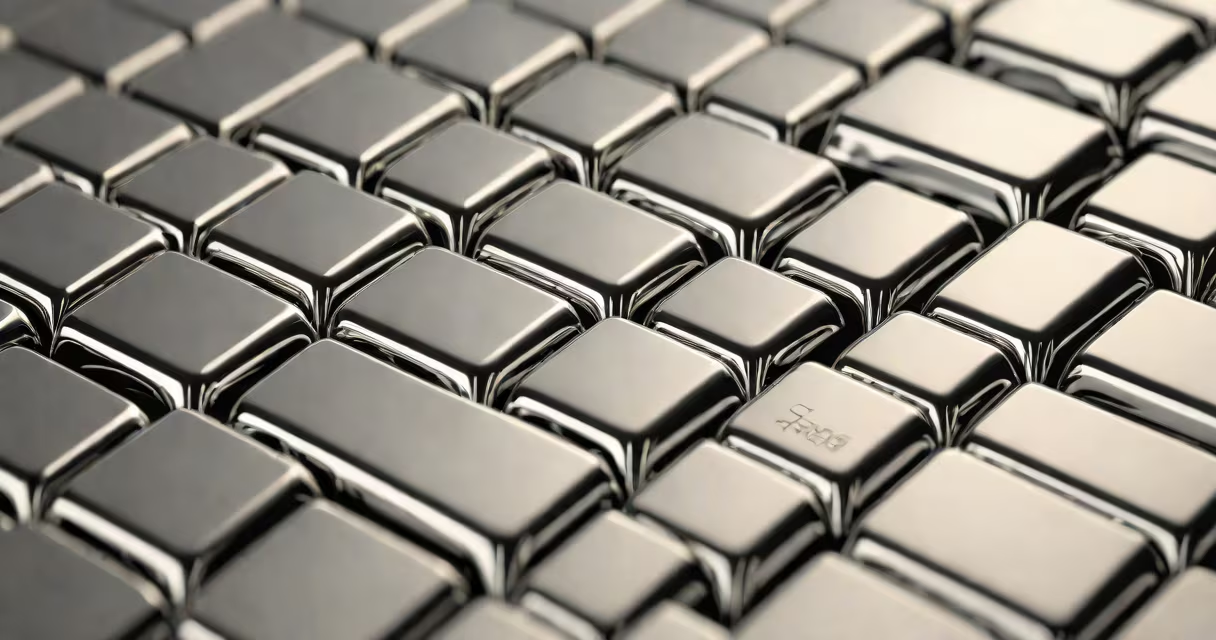
Aluminum is a metallic chemical element with atomic number 13 and the symbol Al. It is the most abundant metal in Earth's crust, making up about 8% by weight, though it was not isolated until 1825.
Aluminum belongs to Group 13 of the periodic table, also known as the boron group. It is a silvery-white, ductile, and malleable metal that resists corrosion due to a thin oxide layer that forms instantly upon exposure to air. This passive layer protects the underlying metal from further oxidation, giving aluminum excellent durability in outdoor environments.
Despite its abundance, aluminum is rarely found free in nature. It occurs primarily in bauxite ore, which requires energy-intensive electrolysis-known as the Hall-Héroult process-to extract pure aluminum. This process consumes significant electricity, making aluminum production highly dependent on low-cost power sources.
At the atomic level, aluminum has 13 protons and typically 14 neutrons in its nucleus. Its electron configuration is 1s² 2s² 2p⁶ 3s² 3p¹, placing it in the p-block. The outermost shell contains three electrons, which it readily donates during chemical reactions, forming Al³⁺ ions.
This tendency to lose three electrons explains aluminum's common oxidation state of +3. In compounds, aluminum bonds covalently or ionically-forming oxides, sulfates, and aluminosilicates. For example, aluminum oxide (Al₂O₃) is used in abrasives and ceramics, while aluminum sulfate (Al₂(SO₄)₃) is used in water purification.
A non-obvious fact: despite being chemically reactive, aluminum appears inert in everyday conditions due to the protective oxide film. This film is self-repairing-if scratched, it reforms within seconds. This property makes aluminum ideal for food containers, beverage cans, and aircraft parts exposed to moisture and temperature changes.
Aluminum is not a single material but a base element used in various alloys and processed forms. The primary categories include:
| Type | Common Alloys | Typical Applications |
|---|---|---|
| Pure aluminum (99%+) | 1100, 1060 | Electrical wiring, chemical tanks, decorative trim |
| Aluminum-copper (2xxx series) | 2024, 2017 | Aircraft frames, high-stress structural components |
| Aluminum-magnesium (5xxx series) | 5052, 5083 | Marine structures, shipbuilding, pressure vessels |
| Aluminum-silicon (6xxx series) | 6061, 6063 | Window frames, bicycle frames, architectural extrusions |
Each alloy is engineered for specific mechanical properties. For example, 6061 aluminum has a tensile strength of around 310 MPa and is easily welded and machined-making it a go-to choice for DIY projects and custom fabrication.
During my time building a custom bike frame, I selected 6061-T6 aluminum tubing because it offered a balance of light weight (density ~2.7 g/cm³), strength, and weldability. After T6 heat treatment, the yield strength reached 276 MPa, sufficient for handling rider loads without permanent deformation.
Aluminum's low density (2.7 g/cm³) compared to iron (7.87 g/cm³) makes it ideal for reducing weight in vehicles. Modern cars use approximately 150 kg of aluminum per unit, including engine blocks, wheels, and body panels. This reduces fuel consumption and emissions-vehicles with aluminum bodies achieve up to 10% better fuel economy than steel-only models.
In aerospace, aluminum alloys make up over 80% of commercial aircraft structure. Boeing 737s use 7075 aluminum in wing spars and fuselage skins. This alloy withstands cyclic stress and fatigue, critical for long-haul flights.
Aluminum is also central to consumer goods. Beverage cans are made from 3004 or 3104 aluminum alloys-lightweight, recyclable, and resistant to internal pressure from carbonated liquids. Recycling aluminum saves 95% of the energy required to produce virgin metal, according to the U.S. Environmental Protection Agency.
Aluminum is often confused with lead or steel due to similar appearances. However, aluminum is lighter-about one-third the density of steel-and does not conduct electricity as well as copper. It is also not magnetic, unlike iron-based metals.
A persistent myth is that aluminum causes Alzheimer's disease. This claim originated in the 1960s from early animal studies using extremely high doses of aluminum salts. Subsequent research, including a 2018 review published in *Neurology*, found no causal link between aluminum exposure and neurodegenerative diseases in humans. The aluminum in antacids and cookware is bound in stable compounds and poorly absorbed.
Another confusion arises with "aluminum" versus "aluminium." Both spellings are correct. The International Union of Pure and Applied Chemistry (IUPAC) recognizes both, but "aluminum" is standard in American English. The British spelling "aluminium" is used in scientific literature outside the U.S., including in the Journal of the American Chemical Society.
Aluminum is the third most abundant element in the Earth's crust after oxygen and silicon. Despite this, extracting it remains energy-intensive-producing one ton of aluminum requires roughly 13,000 kWh of electricity. Global aluminum production reached 67 million metric tons in 2023, led by China, Russia, and India.
Recycling rates for aluminum are among the highest of all metals-over 70% globally. A recycled aluminum can takes only 5% of the energy needed to produce a new one. The U.S. Department of Energy reports that recycling aluminum saves enough energy annually to power 1.6 million homes.
Aluminum is a metallic element with atomic number 13 and symbol Al. Its unique combination of light weight, corrosion resistance, and recyclability drives widespread use across industries-from aircraft to packaging. Understanding its chemistry and applications clarifies why it ranks among the most essential materials in modern engineering.