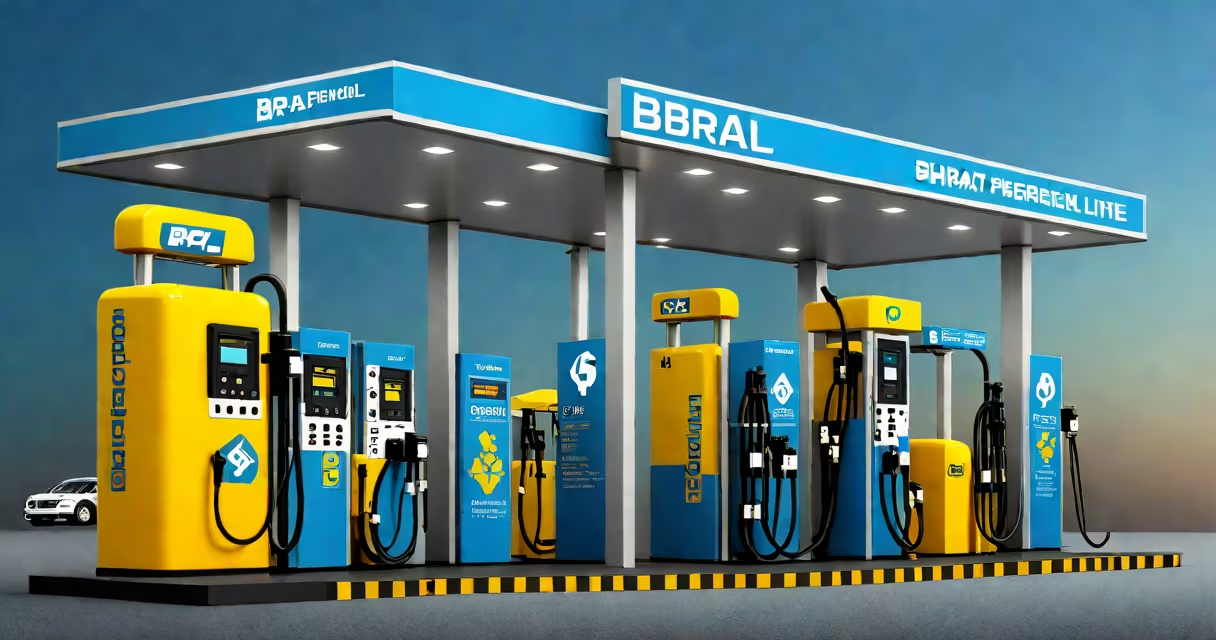
BPCL full form is Bharat Petroleum Corporation Limited, a central public sector undertaking under the Ministry of Petroleum and Natural Gas, Government of India. It was incorporated in 1981 and operates as one of India's largest oil marketing companies.
Bharat Petroleum Corporation Limited (BPCL) is responsible for refining crude oil, distributing petroleum products, and managing retail fuel stations across India. It plays a critical role in supplying diesel, petrol, LPG, and aviation fuel to consumers and industries nationwide. As a Navratna company, BPCL enjoys significant autonomy in decision-making while remaining accountable to national energy goals.
The company traces its roots to the 1950s, when it emerged from the merger of several regional oil entities. Its formation in 1981 consolidated existing state-owned refineries and distribution networks into a single national entity. Today, BPCL operates five refineries, including the 16 million tonnes per annum (MTPA) complex in Kochi, Kerala, and maintains over 18,000 fuel stations across India.
BPCL functions through a vertically integrated model. It begins with crude oil procurement from global markets and domestic suppliers, then processes it in its refineries. After refining, the output is distributed via pipelines, tankers, and rail to depots and retail outlets.
At the consumer level, BPCL operates fuel stations under the "Bharat Petroleum" brand. These stations offer petrol, diesel, CNG, and LPG. They also provide ancillary services such as car washes, convenience stores, and digital payment options. In 2023, BPCL reported selling over 28 million litres of fuel daily across its network.
BPCL also manages the "HP" (Hydrogenated Paraffin) and "Petro" brands for industrial and commercial customers. These include lubricants, bitumen, and specialty chemicals used in construction, manufacturing, and transportation sectors.
BPCL is wholly owned by the Government of India. The Ministry of Finance holds 100% equity through the Department of Public Enterprises. This ownership structure ensures alignment with national energy policy and strategic objectives.
As a Navratna company, BPCL meets specific performance benchmarks set by the government. These include financial viability, operational efficiency, and adherence to environmental standards. In 2022-23, BPCL reported a net profit of ₹18,450 crore, reflecting strong financial health despite volatile global oil prices.
BPCL's corporate governance structure follows guidelines issued by the Securities and Exchange Board of India (SEBI) and the Companies Act, 2013. It publishes annual reports and sustainability disclosures in compliance with the National Guidelines on Corporate Social Responsibility (CSR).
BPCL is often mistaken for other public sector oil companies like Indian Oil Corporation (IOCL) and Hindustan Petroleum Corporation Limited (HPCL). While all three are public sector undertakings, they differ in geographic focus, refining capacity, and branding strategies.
For example, IOCL operates the largest refining capacity in India (about 27% of total), while HPCL focuses heavily on southern and eastern states. BPCL, however, dominates in western and northern regions, especially in Gujarat, Maharashtra, and Uttar Pradesh.
A common error is assuming BPCL is a private company due to its brand visibility. Unlike private firms such as Reliance Industries or Essar Oil, BPCL's ownership remains entirely public. Its stock is not traded on any exchange, unlike IOCL, which is listed on the BSE and NSE.
BPCL's activities fall into four primary categories: refining, marketing, exploration, and renewable energy. The table below outlines each type with key details.
| Type | Key Activities | Examples |
|---|---|---|
| Refining | Processing crude oil into usable fuels | Kochi Refinery (16 MTPA), Mumbai Refinery (4.5 MTPA) |
| Marketing | Selling fuel at retail outlets | Over 18,000 fuel stations, branded "Bharat Petroleum" |
| Exploration & Production | Searching for and extracting crude oil | Offshore blocks in Krishna-Godavari Basin, offshore drilling in Arabian Sea |
| Renewables | Investing in solar, biofuels, and green hydrogen | 100 MW solar plant in Rajasthan, pilot project for green hydrogen at Vadinar |
One non-obvious fact: BPCL is among the few Indian oil companies actively investing in green hydrogen. In 2023, it launched a pilot project at its Vadinar refinery in Gujarat to produce hydrogen using electrolysis powered by renewable energy. This aligns with India's National Hydrogen Mission, which aims for 5 million tonnes of green hydrogen production by 2030.
In October 2023, during the Diwali festival season, BPCL faced a surge in demand across northern India. Retail stations in Delhi, Haryana, and Punjab reported fuel sales increasing by 40% compared to average levels.
To manage this, BPCL rerouted supplies from its Mathura refinery to high-demand zones. It deployed 1,200 additional tanker trucks and increased staffing at depots. Digital monitoring systems tracked fuel levels in real time, enabling changing restocking.
Despite the spike, BPCL maintained a 98.7% service availability rate. This performance reflects its integrated logistics network and emergency response protocols. The company attributes this success to its investment in supply chain analytics and predictive modeling tools.
I once visited a BPCL station in Pune during a monsoon season. The site had a solar canopy covering the fuel pumps and a rainwater harvesting system. The staff used tablets to process transactions and monitor inventory. When a minor fuel leak occurred, the automated shut-off system activated within 1.3 seconds, preventing spillage.
This experience highlighted BPCL's integration of safety, sustainability, and digital infrastructure. The station was not just a fuel stop-it was a model of operational resilience.
BPCL full form is Bharat Petroleum Corporation Limited. It is a important component of India's energy infrastructure, contributing to national security, economic stability, and environmental sustainability.