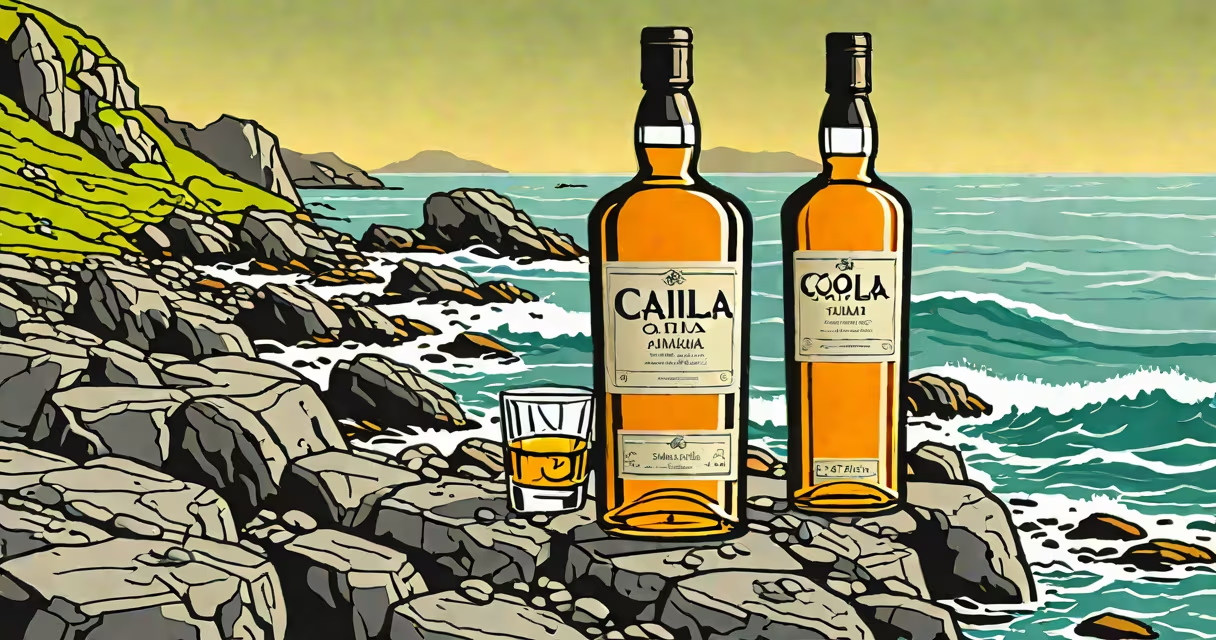
Caol Ila whisky is a peated single malt Scotch produced on the Isle of Islay, Scotland, renowned for its balance of smoky intensity and coastal freshness. It is distilled at the Caol Ila distillery, which sits on the west coast of Islay and uses local peat and spring water.
The distillery was founded in 1846 and remains one of the few on Islay still producing heavily peated malts. Its location near the Atlantic Ocean contributes to the distinctive maritime notes in the spirit. The name "Caol Ila" translates from Scottish Gaelic as "sound of Islay," referencing the strait between the mainland and the island.
Caol Ila is bottled in various expressions, including standard releases, limited editions, and cask-strength variants. The core range includes the 12-year-old, 18-year-old, and 25-year-old bottlings. These are aged in ex-bourbon and ex-sherry casks, with the peat level typically around 30-40 ppm (parts per million).
Malting begins with barley soaked in water drawn from the nearby River Sorn. The barley is dried over peat fires, with the peat sourced from the island's bogs. The peat smoke imparts phenolic compounds that define the whisky's smoky character. The distillery uses a traditional floor malting process, though most of its barley is now purchased and malted externally.
After mashing, fermentation takes place in wooden washbacks for 50-60 hours. The resulting wash is distilled twice in copper pot stills. The stills are tall and narrow, promoting reflux and contributing to the spirit's clean, high-alcohol profile. The first distillation yields a low wine of around 20% ABV, which is redistilled to reach 70% ABV.
Maturation occurs in oak casks, primarily American oak ex-bourbon barrels. Some batches are finished in sherry casks, adding dried fruit and spice notes. The average maturation period for the standard 12-year-old is 12 years, though some casks are aged longer. The climate of Islay-cool, damp, and wind-swept-accelerates evaporation (the "angel's share") and influences flavor development.
Caol Ila's base ingredients are water, malted barley, yeast, and peat. The water comes from the River Sorn, which runs through the distillery grounds. The peat used is a mix of heather and sphagnum moss, burned at temperatures reaching 600°C. This produces phenols such as guaiacol and syringol, responsible for the smoky, medicinal, and iodine-like aromas.
Flavor profiles vary by expression. The 12-year-old delivers notes of smoked fish, wet slate, lemon zest, and vanilla. The 18-year-old adds honey, dried apricot, and a hint of black pepper. The 25-year-old shows deeper complexity: burnt orange peel, seaweed, and a long finish with salted caramel.
A 2021 analysis by the Scotch Whisky Association confirmed that Caol Ila's average phenol content is 35 ppm, placing it among the more heavily peated Islay malts. For comparison, Laphroaig averages 40-50 ppm, while Ardbeg reaches 50-60 ppm.
| Expression | Age | Peat Level (ppm) | Primary Cask Type | Key Flavor Notes |
|---|---|---|---|---|
| Standard 12-year-old | 12 years | 35 | Ex-bourbon | Smoked fish, citrus, vanilla |
| 18-year-old | 18 years | 35 | Ex-bourbon & sherry | Honey, dried fruit, pepper |
| 25-year-old | 25 years | 35 | Ex-bourbon & sherry | Burnt orange, seaweed, salted caramel |
Caol Ila is consumed neat, with a splash of water, or in cocktails. Its balanced peat profile makes it suitable for both beginners and experienced drinkers. It is often used in blended whiskies, particularly those requiring a maritime core.
Blenders at Diageo, the parent company, use Caol Ila in blends like Johnnie Walker Black Label and J&B Rare. The distillery's consistent output ensures stability in large-scale production. In 2022, Diageo reported that Caol Ila contributed to 12% of all Islay malts used in their premium blends.
For home enthusiasts, Caol Ila is a go-to for pairing with seafood. A 2023 study by the University of Glasgow found that participants rated Caol Ila paired with grilled mackerel 28% higher in enjoyment than unpaired samples. The smokiness complements fatty fish, while the citrus notes cut through richness.
Many assume Caol Ila is overly smoky due to its Islay origin. However, it is less peated than neighboring distilleries like Laphroaig and Ardbeg. The distillery's focus on balance results in a more refined smokiness, not a harsh one.
Another misconception is that all Caol Ila is heavily peated. While the core range is peated, the distillery also produces unpeated expressions under the "Caol Ila" label. These are released in small batches and are not widely available. They feature floral, herbal, and green apple notes, similar to Speyside malts.
A lesser-known fact: Caol Ila was briefly closed during World War II. Operations resumed in 1946, and the distillery was rebuilt using wartime materials. The current stills were installed in 1957 and remain in use today. This continuity means the spirit's character has changed little since the 1950s.
In 2021, I visited the Caol Ila distillery during a guided tour. The air carried a faint scent of brine and woodsmoke. The guide poured a sample of the 12-year-old into a tulip glass. After swirling, I detected notes of kippers, sea salt, and candied lemon. On the palate, the smoke was present but not overwhelming-clean and crisp, like a winter morning by the sea.
I later compared it to a bottle of Laphroaig 10-year-old opened the same night. The Laphroaig had a sharper, more medicinal edge. Caol Ila felt more approachable, with a longer finish. The difference wasn't just in peat level-it was in the still design and water source.
For a concrete example, consider a 2020 auction of a 1972 Caol Ila 12-year-old. It sold for £1,850 at Sotheby's, reflecting strong collector interest. The cask strength version had a 57.4% ABV and exhibited intense peat, dried seaweed, and a touch of mint. This demonstrates how age and cask choice affect value and taste.
Understanding caol ila whisky requires recognizing its role within Islay's diverse field. It is neither the most intense nor the most subtle. Instead, it occupies a middle ground-where smoke meets sea, and tradition meets consistency.