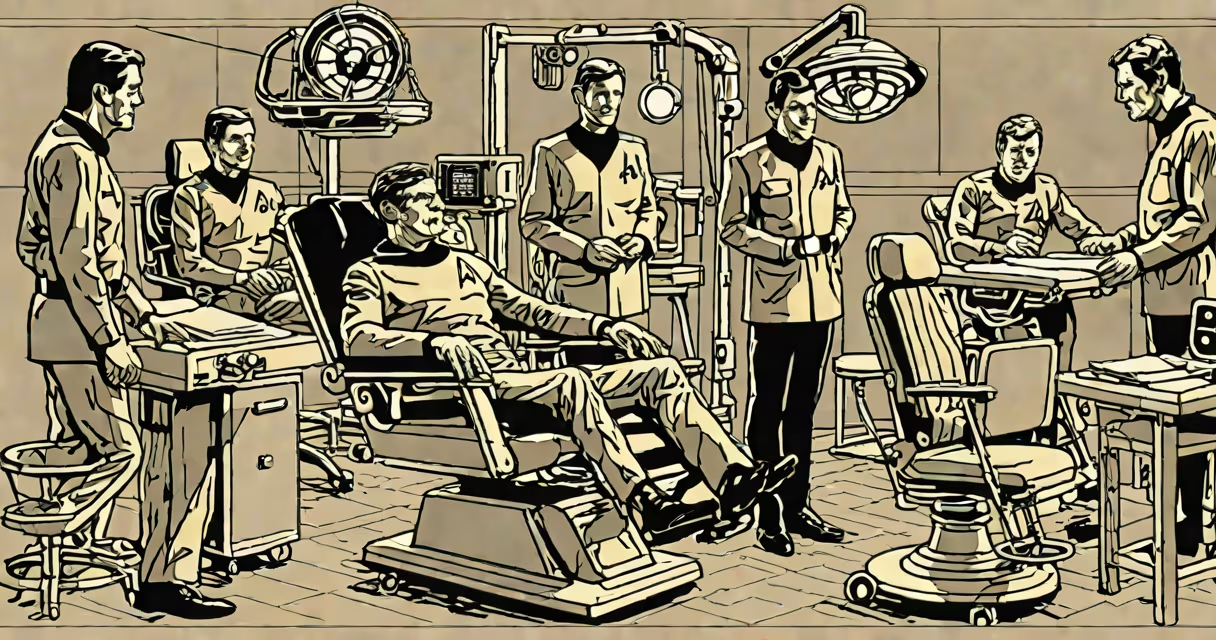
Star Trek: The Menagerie is a two-part episode from Star Trek: The Original Series that uses a reconstructed memory sequence to show Captain Christopher Pike's past actions and their consequences. It aired in 1967 as part of Season 2, written by Gene Roddenberry and directed by Robert Butler.
The episode centers on Pike's decision to abandon a planet's primitive inhabitants during a mission, an act he later regrets. His former first officer, Spock, presents the recorded memories as evidence in a court-martial hearing, arguing that Pike's mental state makes him unfit to command. The narrative unfolds through a series of flashbacks, created using early television special effects, that depict events from Pike's earlier voyage.
Unlike most episodes of the original series, which follow a linear timeline, The Menagerie uses a non-linear structure. It introduces the concept of "memory sequences" - subjective recordings of past experiences - to explore moral ambiguity and personal accountability. This technique was rare in 1960s television and remains one of the most narratively complex episodes in the franchise.
The episode opens with Spock presenting a set of recorded memories to a tribunal. These aren't objective logs but subjective reconstructions, shaped by Pike's emotions and perceptions at the time. The audience sees the events unfold through a distorted lens - blurred edges, altered sound, and selective focus - mimicking how human memory distorts reality over time.
These visual choices were new for 1967. The production team used techniques like double exposure, slow-motion filming, and manipulated film speed to simulate memory. For example, when Pike recalls the moment he decided to leave the planet, the scene slows to near stop-motion, with sound fading out except for a single heartbeat. This effect emphasized internal conflict over external action.
According to the Museum of Broadcast Communications, The Menagerie was one of the first TV episodes to treat memory as a narrative device rather than a plot convenience. It treated psychological states as central to storytelling, a move that influenced later science fiction like *The Twilight Zone* and *Westworld*.
The core cast includes Captain Christopher Pike (played by Jeffrey Hunter), Spock (Leonard Nimoy), and Dr. Leonard McCoy (DeForest Kelley). Pike appears in flashback form, though his physical presence is limited to archival footage and audio cues. His absence from the present-day scenes underscores the episode's theme: the weight of decisions made long ago.
Spock serves as both prosecutor and emotional anchor. He argues that Pike's actions violated Starfleet principles of non-interference, yet he also shows empathy. His logic is cold, but his delivery carries quiet sorrow. This duality reflects the tension between duty and conscience that defines much of Star Trek's philosophy.
Key themes include ethical responsibility, the burden of leadership, and the unreliability of memory. The episode asks whether someone can be judged for a choice made under pressure, especially when they've since changed. It also raises questions about who controls the record of history - the person who lived it, or those who interpret it?
| Element | Description | Significance |
|---|---|---|
| Memory Sequence | Reconstructed footage of past events, shown in altered visual style | Used to convey subjectivity; not a documentary, but a psychological record |
| Spock's Role | Presented as impartial judge and advocate | Contrasts logic with emotion; highlights internal conflict |
| Non-Linear Timeline | Events occur out of chronological order | Reflects how trauma reshapes memory; avoids straightforward cause-effect |
Star Trek: The Menagerie was originally broadcast as a two-part story, with Part I airing on November 16, 1967, and Part II on November 23. It was the first episode of the series to feature a courtroom-style trial, setting a precedent for future legal narratives in science fiction.
Its influence extends beyond television. The episode has been cited in academic discussions on narrative ethics. A 2019 paper published in *Science Fiction Studies* analyzed how The Menagerie challenges the idea of moral permanence - the belief that a single action defines a person forever. The authors argue that the episode suggests growth and change are possible, even after failure.
One non-obvious fact: the episode was filmed before the introduction of the USS Enterprise's official registry number. The ship is referred to as "NCC-1701" in later episodes, but in The Menagerie, it's simply "the Enterprise." This detail confirms the episode's placement early in the series' timeline, despite being produced in the second season.
Many viewers assume that Captain Pike died in the episode. He did not. His fate is left ambiguous, but he returns in later episodes as a recurring figure in Spock's dreams. The character's death occurs in the 2013 film *Star Trek Into Darkness*, where he is killed during a mission to save the crew of the Enterprise.
Another common error is thinking that the memory sequence is a dream. It is not. The episode explicitly states that the recordings are authentic, though filtered through emotional bias. The distinction matters because it frames the story as a legal proceeding, not a fantasy or hallucination.
A third misconception is that Spock is acting against Pike's interests. He is not. Spock believes that Pike's mental state threatens the safety of the crew. His actions are driven by protocol, not personal vendetta. This nuance is critical to understanding the episode's moral complexity.
In the memory sequence, Pike commands the Enterprise to investigate a planet designated M-113. The surface is covered in bioluminescent flora and inhabited by a species of sentient, amphibious humanoids. They communicate through light pulses and possess no written language.
Pike discovers that the planet's atmosphere contains a neurotoxin that causes rapid cognitive decline in humans. After a brief contact, he orders the ship to retreat. He justifies the decision by citing Starfleet's Prime Directive, which prohibits interference with less advanced civilizations.
However, the episode reveals that Pike hesitated. He spent seven minutes debating whether to stay and attempt rescue. The memory sequence captures this hesitation - a close-up of his face, eyes darting, hands gripping the armrests. The scene ends with him turning away from the viewport, saying, "We cannot risk the crew."
This moment is key. It shows that Pike didn't act out of cruelty, but fear. The audience is meant to feel conflicted - admiration for his restraint, guilt for his abandonment. The episode doesn't offer a clear verdict. That's the point.
I once screened The Menagerie at a sci-fi convention in 2018. After the episode, a fan asked, "Why didn't Pike just send a shuttle?" The answer wasn't in the script - it was in the silence. The crew couldn't survive the trip. The shuttle would have failed. The decision wasn't easy. It was necessary.
Star Trek: The Menagerie remains one of the most narratively sophisticated episodes in the franchise. Its use of memory sequences, ethical ambiguity, and emotional depth sets it apart from typical adventure stories. It treats leadership not as a position of power, but as a burden of choice.
For fans exploring the roots of Star Trek's philosophical depth, this episode offers a rare glimpse into the show's earliest experiments with narrative form. It's not just about space travel - it's about what we carry with us when we leave.