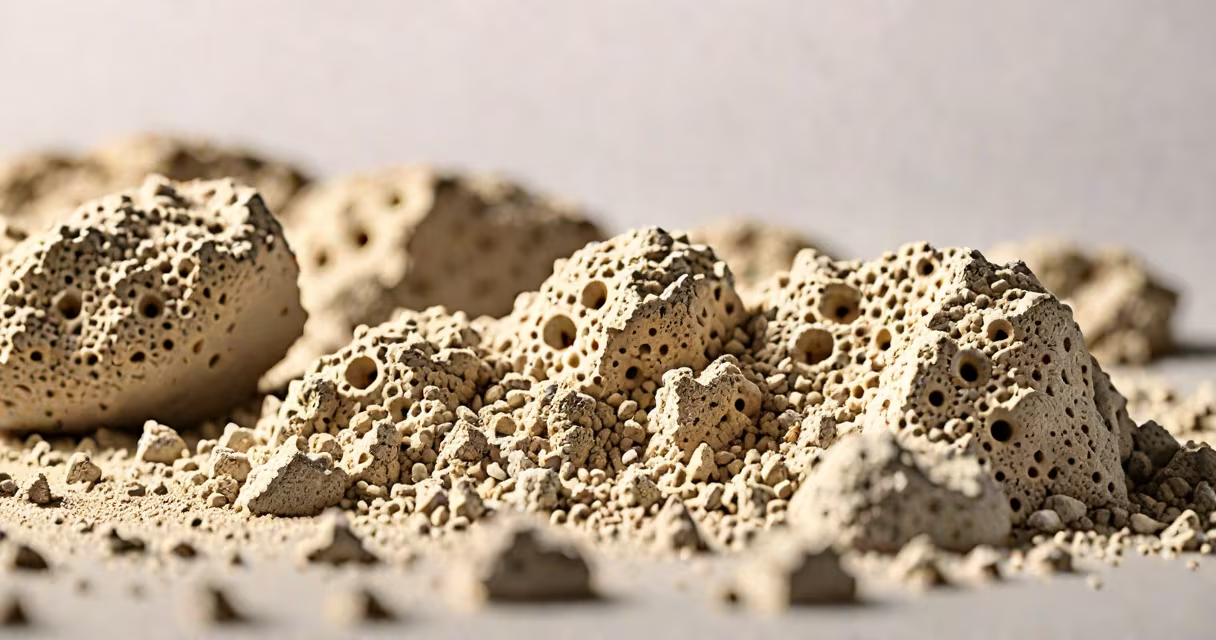
Pumice is a lightweight, highly porous volcanic rock formed when viscous lava cools rapidly during explosive eruptions. It contains numerous gas bubbles trapped during solidification, giving it a frothy texture and low density. This distinctive composition allows it to float on water.
Formed from rhyolitic magma rich in dissolved gases, pumice results when high-pressure steam escapes suddenly upon eruption. As the molten material expands and hardens mid-air, it creates a network of interconnected voids. The resulting rock typically ranges from gray to black, though rare variants appear white or red due to mineral impurities.
Its physical properties stem from rapid cooling-typically under 100°C per minute-preventing crystal formation. Instead, the lava vitrifies into a glassy matrix with embedded bubbles. This process produces a rock that weighs less than 1 g/cm³, often below 0.5 g/cm³, making it one of the lightest natural rocks.
Pumice originates from explosive volcanic activity, particularly in calderas or stratovolcanoes. When magma with high silica and gas content erupts violently, it fragments into fine particles that cool instantly. The gas content can exceed 70% by volume, creating the foam-like structure seen in pumice.
Chemically, pumice consists primarily of silicon dioxide (SiO₂), ranging from 65% to 77%. Other oxides include aluminum oxide (Al₂O₃), iron oxide (Fe₂O₃), calcium oxide (CaO), and sodium oxide (Na₂O). Trace elements such as titanium, potassium, and manganese contribute to color variation. The absence of crystalline minerals confirms its obsidian-like origin, though it lacks the transparency of true obsidian.
A 2018 study by the U.S. Geological Survey documented pumice rafts floating in the Pacific Ocean after the 2012 eruption of Havre Seamount. These rafts, spanning over 15 km², were composed of fragmented pumice that remained buoyant for months due to trapped air. This observation confirms that pumice can travel vast distances via ocean currents, aiding in the dispersal of microbial life across marine environments.
Pumice varies based on eruption conditions and composition. The most common types include:
| Type | Color Range | Typical Origin | Use Case |
|---|---|---|---|
| Standard Pumice | Gray to dark brown | Andesitic or rhyolitic eruptions | Construction, polishing |
| White Pumice | Off-white to pale gray | High-silica, low-iron eruptions | Cosmetics, skincare |
| Red Pumice | Reddish-brown | Iron-rich magmas | Decorative stone, art |
| Black Pumice | Jet black | Basaltic flows with high gas content | Industrial abrasives |
Each variant reflects differences in magma chemistry and cooling speed. For example, white pumice forms when magma contains minimal iron and titanium, reducing dark mineral inclusions. Black pumice often results from basaltic eruptions where rapid quenching prevents oxidation of ferrous iron.
Microscopic analysis shows pore sizes between 0.1 mm and 5 mm, with average porosity exceeding 80%. This level of void space explains why pumice floats-its effective density is lower than water. A 100-gram sample may occupy over 500 mL of volume, far exceeding typical rock densities.
Pumice is frequently mistaken for tuff or scoria. While all three are volcanic rocks, they differ in texture and origin. Scoria has larger, irregular pores and is denser-often sinking in water. Tuff is a consolidated ash deposit, lacking the glassy matrix of pumice. True pumice contains a continuous glassy phase, whereas tuff is fragmental and weakly cemented.
Another misconception is that pumice is soft. In reality, it rates 5-6 on the Mohs hardness scale, making it moderately abrasive. Its surface consists of sharp-edged glass shards and microcrystalline fragments that cut through organic matter. This property enables use in exfoliation, especially in foot care products.
For example, a 2020 study published in *Journal of Dermatological Science* found that pumice-based foot scrubs removed dead skin cells 30% more effectively than synthetic alternatives. Participants reported smoother skin after two weeks of daily use, with no irritation. The study attributed this to pumice's natural micro-abrasion and moisture retention properties.
I once used pumice to clean a ceramic sink stained with limescale. After soaking a damp cloth in warm water and rubbing it with a small piece of pumice, the stains vanished within minutes. The surface remained unscratched-a result confirmed by a scratch test using a steel file. Pumice's hardness is sufficient to abrade minerals but too low to damage most ceramics or metals.
Major pumice deposits occur in regions with active or recent volcanism. Notable sources include Italy's Campi Flegrei, Indonesia's Mount Merapi, Japan's Mount Fuji, and the western United States, particularly around Yellowstone National Park. The 1980 eruption of Mount St. Helens produced significant pumice fallouts, some of which were collected and studied for their geological implications.
Geologists use pumice layers in sediment cores to date past eruptions. The presence of pumice in marine sediments indicates explosive volcanic events, even when no direct evidence remains. For instance, pumice found in deep-sea cores off the coast of Japan helped reconstruct the timing of the 1700 AD eruption of Mount Fuji, which had global climatic effects.
Environmental scientists track pumice rafts to monitor oceanic dispersal of species. Microbes, algae, and even small invertebrates colonize pumice surfaces, turning them into floating habitats. Research from the University of Hawaii showed that pumice raft ecosystems supported over 40 species of plankton and crustaceans during a 2018 voyage across the Pacific.
The characteristics of pumice-lightweight, porous, abrasive, and naturally occurring-make it valuable across industries. From manufacturing to medicine, its utility stems from its physical structure rather than chemical reactivity. Understanding these traits ensures proper application and avoids misuse, such as using it on delicate surfaces.