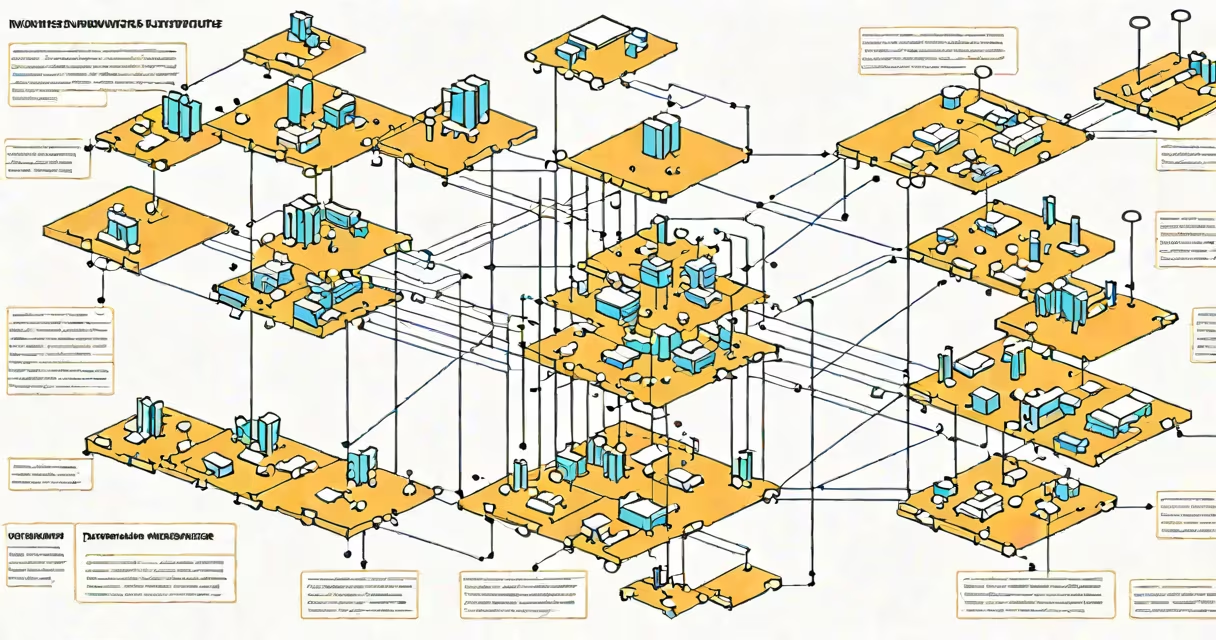
A matrix organisational structure is a hybrid management system where employees report to both a functional manager and a project manager simultaneously. This setup enables cross-functional collaboration while maintaining departmental expertise. It is commonly used in large, complex organisations managing multiple concurrent projects.
Unlike traditional hierarchical models, the matrix structure creates overlapping authority. Employees belong to a functional department-such as engineering or marketing-but also join temporary project teams based on specific goals. This dual accountability allows for efficient resource sharing across departments and faster adaptation to shifting priorities.
For example, at a global tech firm, a software developer may report to the head of engineering (functional) while also working under a product manager leading a new app launch (project). The developer's performance is evaluated by both leaders, and their time is allocated between ongoing maintenance tasks and project-specific deliverables.
Each employee has two supervisors: one responsible for technical development and career progression (functional), and another focused on project timelines, budgets, and outcomes (project leader). Decisions require coordination between both managers, especially when conflicting demands arise.
Communication flows through formal channels such as weekly syncs, shared dashboards, and integrated project management tools. For instance, a team using Asana or Jira tracks progress across both functional and project milestones. Weekly status meetings include both functional leads and project leads to align priorities.
Conflict resolution mechanisms are built into the process. If a functional manager assigns a task during a critical phase of a project, the project lead can escalate the issue through a predefined approval workflow. At a multinational pharmaceutical company, such conflicts were resolved via a steering committee composed of senior leaders from both divisions.
Matrix structures vary in formality and balance of power. The most common types are weak, balanced, and strong matrices, differentiated by which manager holds primary authority.
| Type | Project Manager Authority | Functional Manager Authority | Best For |
|---|---|---|---|
| Weak Matrix | Low | High | Stable operations with minor project changes |
| Balanced Matrix | Moderate | Moderate | Projects requiring equal input from both sides |
| Strong Matrix | High | Low | Time-sensitive, high-stakes initiatives |
Most large-scale infrastructure projects use a strong matrix. A construction firm building a bridge across a river assigned full decision-making power to the project manager, who coordinated engineers, environmental consultants, and local regulators. Functional managers provided technical guidance but did not override project timelines.
Some organisations adopt a "virtual matrix" where teams are geographically dispersed and connected digitally. Remote teams at a cloud services provider used Slack and Zoom to maintain alignment across time zones, with each member reporting to both a regional manager and a product owner in a different country.
Many assume the matrix structure increases confusion because of dual reporting. While this risk exists, research from the Harvard Business Review shows that clarity improves when roles and responsibilities are documented in a RACI matrix (Responsible, Accountable, Consulted, Informed).
Another myth is that the matrix is only suitable for large enterprises. In reality, small firms with multiple clients or products can implement a simplified version. A boutique design agency with five employees uses a matrix to assign staff to client campaigns while maintaining a core team for branding and strategy.
One overlooked challenge is burnout. A 2021 study by McKinsey & Company found that 43% of employees in matrix environments reported higher stress levels due to competing demands. The study recommended setting clear boundaries and limiting overlapping project assignments to no more than two per person.
General Electric (GE) implemented a matrix structure across its industrial divisions in the early 2000s. Engineers reported to both division heads (e.g., aviation or healthcare) and project leads managing specific equipment upgrades. This allowed GE to scale innovation across sectors while preserving technical depth.
At NASA, the Mars Rover missions relied on a matrix model. Scientists from the Jet Propulsion Laboratory reported to both their research departments and mission control teams. This ensured that scientific integrity was maintained while meeting strict launch deadlines and safety standards.
During the 2016 Rio Olympics, the event organisers used a matrix structure to manage logistics. Staff from transportation, security, and hospitality departments were reassigned to task forces focused on athlete transport, venue access, and emergency response. Each task force had a lead from operations and a representative from the relevant function.
Use a matrix structure when your organisation runs multiple interdependent projects, requires rapid cross-departmental collaboration, or operates in a changing environment. It excels in industries like aerospace, IT, consulting, and healthcare, where expertise must be shared across initiatives.
It is less effective in stable, routine environments. A manufacturing plant producing standard parts with minimal variation may find the matrix adds unnecessary complexity. In such cases, a functional or divisional structure offers clearer accountability.
I once observed a startup using a matrix during a product pivot. Two engineers were split between improving the existing app (functional) and building a new AI feature (project). After six weeks, one engineer left due to role ambiguity. The team later adopted a clearer RACI chart and reduced overlapping duties to one per person. Performance improved within two months.
Organisations considering a matrix should assess leadership readiness, communication infrastructure, and conflict resolution protocols. Without these, the structure risks creating silos despite its intended integration.