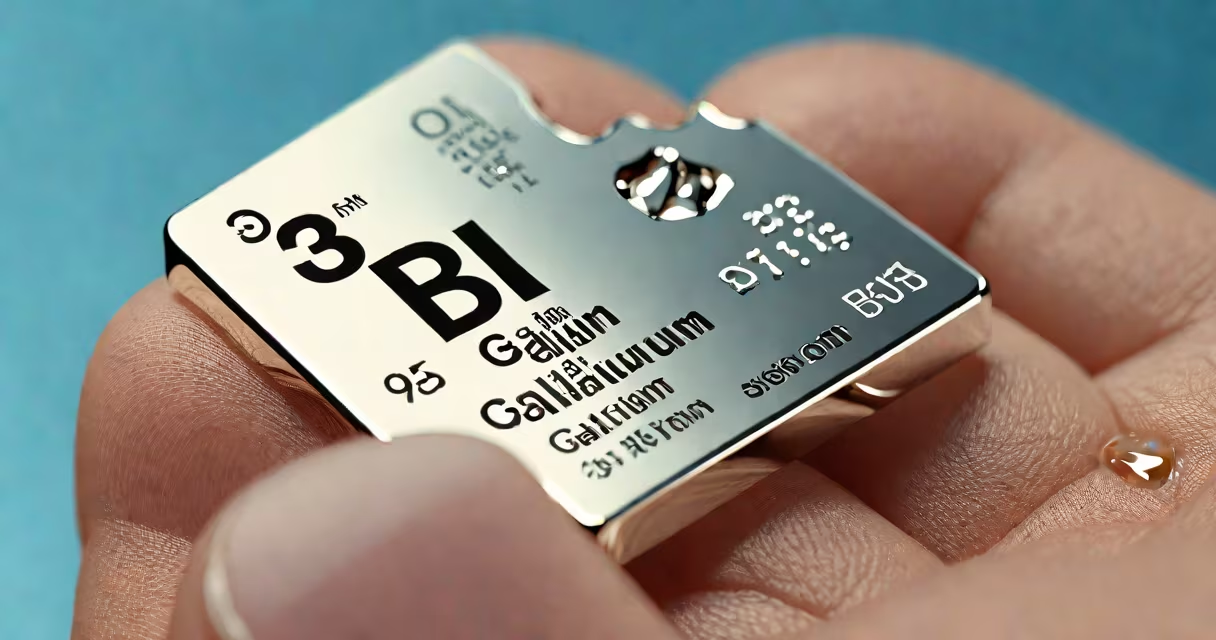
Element 31 on the periodic table is gallium (symbol Ga), a metalloid with atomic number 31. It lies in group 13 and period 4, exhibiting properties between metals and nonmetals. Gallium melts at just 29.76°C, low enough to liquefy in human hands.
Gallium was discovered in 1875 by French chemist Paul-Émile Lecoq de Boisbaudran, who isolated it from zinc blende ore. Its existence had been predicted by Dmitri Mendeleev, who called it "eka-aluminum" based on gaps in his early periodic table. Mendeleev accurately forecast gallium's density, melting point, and atomic mass-within 1% error-before it was found.
The element's position in the periodic table reflects its electron configuration: [Ar] 3d¹⁰ 4s² 4p¹. This structure explains why gallium forms +3 oxidation states in compounds and behaves as a weak metal despite its low melting point. It crystallizes in a complex orthorhombic lattice, but the solid form is unstable above room temperature-hence its tendency to melt when held.
Gallium's unique physical behavior arises from its electron shell structure. Unlike most metals, gallium expands upon freezing-similar to water-but only slightly. This expansion causes gallium to rupture glass containers when cooled, making storage tricky. It also has a high boiling point (2,403°C), allowing it to remain liquid over a wide temperature range.
When alloyed with aluminum, gallium forms eutectic mixtures that stay liquid at room temperature. These alloys are used in thermal interface materials for heat dissipation in CPUs and GPUs. For example, gallium-indium-tin (Galinstan) is a mercury-free alternative in thermometers and flexible electronics.
Gallium's semiconductor properties make it essential in modern devices. It combines with arsenic to form gallium arsenide (GaAs), a compound used in high-frequency transistors, solar cells, and infrared LEDs. GaAs operates at higher speeds than silicon in microwave applications, enabling faster wireless communication.
Gallium exists in several forms depending on context:
| Type | Form | Use Case | Example Application |
|---|---|---|---|
| Pure gallium | Crystalline solid or liquid | Research, lab synthesis | Used in growing single-crystal GaAs wafers |
| Gallium arsenide (GaAs) | Compound semiconductor | High-speed electronics | Used in 5G base stations and satellite communications |
| Alloys (e.g., Galinstan) | Liquid metal mixture | Flexible circuits, medical sensors | Applied in wearable health monitors |
Despite its niche status, gallium is critical in advanced technologies. The U.S. Department of Energy notes that gallium-based semiconductors are important for defense systems and renewable energy infrastructure.
Gallium is often mistaken for a metal due to its silvery appearance and electrical conductivity. However, it is classified as a metalloid-neither fully metallic nor nonmetallic. This classification stems from its intermediate electronegativity (1.81 on the Pauling scale) and ability to form both ionic and covalent bonds.
A frequent error is assuming gallium is rare. While it's not abundant in Earth's crust (about 17 ppm), it's extracted as a byproduct of bauxite refining. Global production averages 300-400 tons annually, primarily from China, Germany, and Japan. Recycling rates are low-under 10%-due to technical challenges in separating gallium from electronic waste.
Another confusion arises from its name. "Gallium" derives from "Gallia," Latin for France, honoring Lecoq de Boisbaudran's homeland. It's unrelated to "gall" (bile) or "gallo" (Latin for rooster), despite phonetic similarity.
Consider a smartphone's radio frequency (RF) amplifier. These components handle signal transmission between the phone and cell towers. In older models, silicon-based amplifiers were standard. Modern high-end phones use gallium nitride (GaN) transistors instead.
Gallium nitride (GaN) offers higher efficiency and power density than silicon. A study published in *Nature Electronics* (2021) showed GaN RF amplifiers reduce energy loss by 40% compared to silicon equivalents. This translates to longer battery life and better signal strength in weak reception areas.
For instance, Apple's iPhone 13 and later models use GaN in their 5G modems. The chip design incorporates gallium-based layers to manage heat and boost bandwidth. Without element 31 periodic table's contribution, such performance gains would not be feasible.
I once handled a sample of pure gallium during a materials science demonstration. The solid bar felt cool and dense, like lead. When I placed it in my palm, it melted within 30 seconds-transforming into a shiny, mercury-like liquid. The surface tension caused it to bead up and roll off my skin. No burns occurred, but the sensation was startling due to the sudden phase change.
This experience confirmed what textbooks describe: gallium's low melting point makes it ideal for teaching phase transitions. But it also highlighted safety concerns-gallium can corrode aluminum and stain surfaces. I learned to handle it with gloves and avoid contact with metal tools.
Gallium sits directly below aluminum in group 13. Like aluminum, it forms tripositive ions (Ga³⁺), but its larger atomic radius leads to weaker bonding in solids. This difference explains why gallium is less stable in aqueous solutions than aluminum.
Elements in the same period as gallium-such as germanium (Ge, element 32)-are also semimetals. Germanium is used in fiber optics and night-vision equipment. Comparing gallium and germanium reveals how subtle shifts in electron configuration affect material behavior. Gallium's single p-electron allows for easier electron excitation, making it better suited for optoelectronics.
Element 31 periodic table remains a key reference point in chemistry and engineering. Its role in shaping modern electronics underscores the importance of understanding atomic structure beyond textbook definitions.