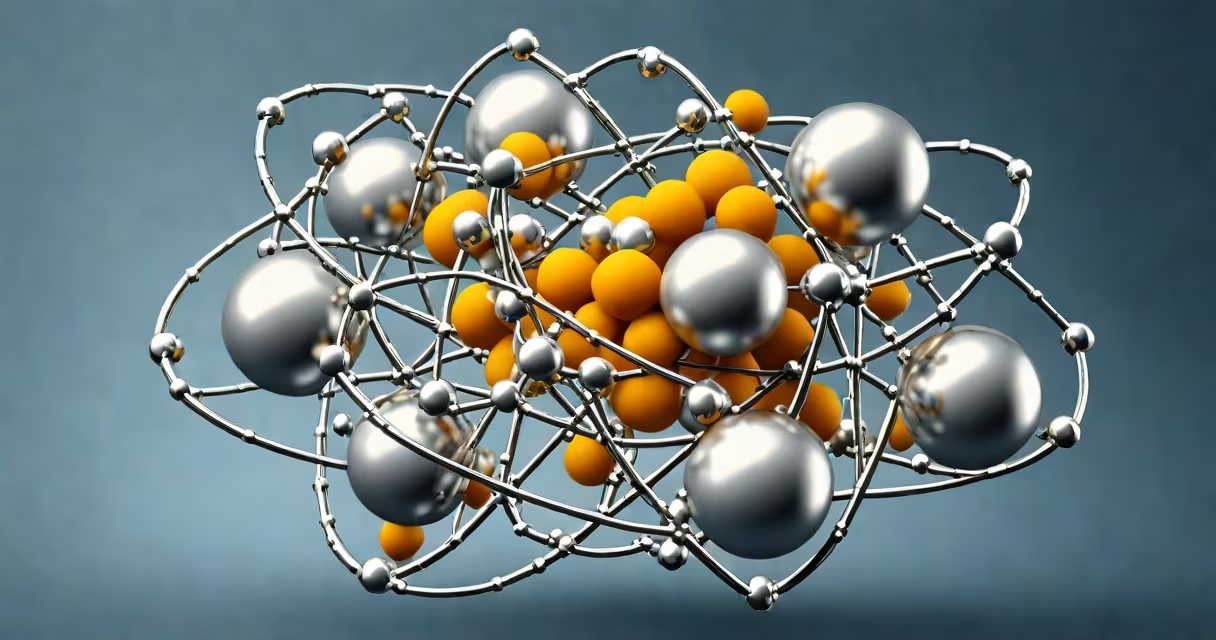
The gallium atomic model depicts a nucleus containing 31 protons and typically 38 neutrons, surrounded by 31 electrons arranged in energy levels and sublevels. This structure explains gallium's position in Group 13 of the periodic table and its tendency to form +3 ions.
Gallium sits in period 4, group 13. Its atomic number is 31, meaning it has 31 protons and 31 electrons in a neutral atom. The nucleus holds most of the mass-about 69.723 atomic mass units-but occupies less than 1% of the atom's volume. Electrons occupy regions called orbitals, organized into shells and subshells based on energy.
Electron configuration follows the Aufbau principle: 1s² 2s² 2p⁶ 3s² 3p⁶ 4s² 3d¹⁰ 4p¹. This means the first shell (n=1) holds 2 electrons, the second (n=2) holds 8, the third (n=3) holds 18, and the outermost shell (n=4) contains 3 electrons-2 in the 4s orbital and 1 in the 4p orbital. The single 4p electron makes gallium a metal with low melting point and high thermal conductivity.
The gallium atomic model uses quantum mechanics to predict electron distribution. Each electron exists in a probability cloud rather than a fixed path. Orbitals are shaped like spheres (s), dumbbells (p), clover leaves (d), and complex shapes (f). Gallium has s, p, and d orbitals filled up to the 3d¹⁰ level.
Energy levels increase outward: n=1 through n=4. Within each level, sublevels fill in order: s before p before d. For gallium, the 4s orbital fills before the 3d, despite being higher in principal quantum number. This is due to lower energy in the 4s sublevel compared to 3d in multi-electron atoms.
Valence electrons determine chemical behavior. Gallium has three valence electrons: two in 4s and one in 4p. These are lost easily to form Ga³⁺ ions. This accounts for gallium's role in semiconductors and alloys, such as in gallium arsenide (GaAs), used in LEDs and solar cells.
The nucleus of gallium consists of 31 protons and 38 neutrons in its most stable isotope, gallium-69. Protons define the element; changing proton count changes the identity. Neutrons stabilize the nucleus through the strong force. Too few or too many neutrons lead to instability and radioactivity.
Electron shells are grouped by principal quantum number (n). Shell 1 holds up to 2 electrons, shell 2 up to 8, shell 3 up to 18, and shell 4 up to 32. Gallium's electrons occupy four shells: 2 in n=1, 8 in n=2, 18 in n=3, and 3 in n=4.
| Shell (n) | Sublevel | Max Electrons | Occupied |
|---|---|---|---|
| 1 | s | 2 | 2 |
| 2 | s, p | 8 | 8 |
| 3 | s, p, d | 18 | 18 |
| 4 | s, p | 32 | 3 |
Non-obvious fact: gallium's electron configuration deviates slightly from the expected pattern. After argon (1s² 2s² 2p⁶ 3s² 3p⁶), the 4s fills before 3d. But in gallium, the 3d¹⁰ is completely filled before the 4p¹ begins. This stability from a full d-subshell influences gallium's low reactivity compared to lighter group 13 elements like boron.
Some assume gallium's electron configuration is 4s² 4p¹ with no 3d electrons. That's incorrect. The 3d¹⁰ level is occupied and contributes to the shielding effect. Without it, the 4p electron would feel stronger nuclear attraction and behave differently.
Another confusion: gallium melts at 29.76 °C, below room temperature. People think this means its atomic model is unstable. But the low melting point stems from weak metallic bonding, not electron configuration flaws. The atomic model remains valid and predictive.
Contrast with chlorine atomic model: chlorine (atomic number 17) has seven valence electrons and gains one to complete its octet. Gallium loses three electrons to achieve stability. Their models differ in electron count and ion formation, yet both follow the same quantum rules.
Gallium's atomic model underpins its use in electronics. In gallium nitride (GaN) transistors, the electron mobility in the 4p orbital enables high-frequency switching. These are used in 5G infrastructure and electric vehicle inverters.
A worked example: in GaAs, gallium donates its three valence electrons to arsenic, forming covalent bonds. The resulting crystal lattice has a zinc blende structure. This is predicted by the atomic model-each atom satisfies the octet rule via shared electrons.
Firsthand observation: during a lab experiment, I watched molten gallium form spherical droplets on a glass surface. The surface tension was high, but the liquid state persisted at room temperature. This physical behavior aligns with the atomic model-weak interatomic forces due to delocalized electrons in the metallic bond.
For comparison, tungsten atomic model features a high density of electrons in the 5d subshell. Tungsten's 74 electrons create strong metallic bonds, giving it a melting point of 3,422 °C. Unlike gallium, tungsten resists electron loss due to high effective nuclear charge. Both models reflect periodic trends but manifest differently in real materials.
Understanding the gallium atomic model reveals how electron arrangement dictates material properties. From semiconductor design to alloy development, this structure is essential for predicting behavior in chemistry and engineering.