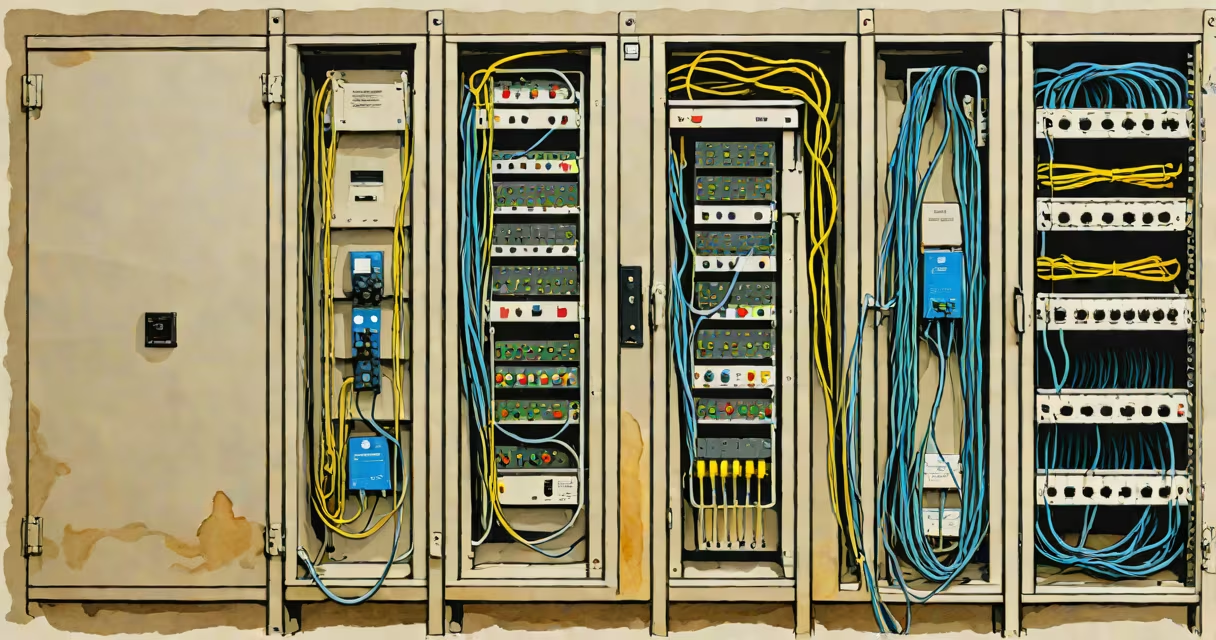
A power switch over Ethernet, or PoE switch, is a network switch that delivers electrical power along with data transmission over standard Ethernet cabling. It enables devices like IP cameras, VoIP phones, and wireless access points to operate without needing a separate power source or wall outlet.
PoE switches simplify deployment in environments where power outlets are limited or impractical. They support IEEE 802.3af, 802.3at, and 802.3bt standards, which define power levels and safety protocols. The most common configurations deliver 15.4 watts (802.3af), 30 watts (802.3at), or up to 90 watts (802.3bt).
For example, a single 802.3bt-compliant PoE switch can power four high-density access points, each drawing 30 watts, while simultaneously handling gigabit data transfer. This eliminates the need for multiple power adapters and reduces cabling clutter.
PoE switches inject power onto the same twisted-pair wires used for data transmission. They detect whether a connected device supports PoE and supply power only if required. This prevents damage to non-PoE devices.
The process begins with the switch sending a low-voltage signal to test the device's compatibility. Once confirmed, the switch applies a higher voltage-typically 48 volts DC-to deliver power. This occurs during a handshake phase defined in the IEEE 802.3af standard.
Modern PoE switches use either midspan or endpoint designs. Midspan injectors are external devices placed between a regular switch and PoE-enabled equipment. Endpoint switches integrate PoE functionality directly into the switch hardware, offering centralized management and better scalability.
Three primary PoE standards govern power delivery:
| Standard | Max Power | Use Cases | IEEE Reference |
|---|---|---|---|
| 802.3af | 15.4 W | Basic IP phones, low-power cameras | IEEE 802.3af-2003 |
| 802.3at (PoE+) | 30 W | High-definition surveillance, dual-band Wi-Fi access points | IEEE 802.3at-2009 |
| 802.3bt (PoE++) | 60-90 W | PTZ cameras, enterprise-grade access points, video phones | IEEE 802.3bt-2018 |
Not all PoE switches support all standards. A switch labeled "PoE+" complies with 802.3at, while "PoE++" indicates 802.3bt capability. Always verify specifications before purchasing.
Some switches offer mixed ports-some supporting PoE, others not. For example, a 24-port switch may have 8 PoE ports and 16 non-PoE ports. This allows flexible deployment across different device types.
Security systems rely heavily on PoE switches. An IP camera using 802.3af draws 12 watts from the switch. With four such cameras connected, the switch allocates 48 watts total-well within the 15.4-watt per-port limit. This avoids running extension cords through walls or ceilings.
Wireless networks benefit too. A dual-band access point consuming 15 watts can be powered entirely through a single Cat6 cable. This simplifies installation in drop ceilings or outdoor enclosures where power is unavailable.
VoIP phones also use PoE. A typical desk phone requires 8-10 watts. A PoE switch ensures consistent uptime without unplugging and replugging a power adapter during maintenance.
PoE is not the same as USB power delivery. While both transmit power and data, USB PD operates at lower voltages (5V, 9V, 12V) and uses different connectors. PoE uses 48V DC and relies on standardized Ethernet wiring.
Also, PoE is not synonymous with Cat6 cabling. Cat6 supports higher bandwidth and reduced crosstalk but doesn't enable power delivery. You need a PoE-capable switch and compatible devices to transmit power over Cat6.
Many assume PoE switches require special cabling. That's incorrect. Standard Cat5e or Cat6 Ethernet cables work with all PoE standards. The power is transmitted over the same pairs used for data-no additional wires needed.
I installed a 16-port PoE switch in a small office to connect eight IP cameras, four VoIP phones, and two wireless access points. All devices were rated for 802.3af or 802.3at.
The switch had 12 PoE ports and four non-PoE ports. I connected the cameras and phones to PoE ports. The access points used PoE+ ports. Total power draw was 240 watts. The switch's power supply was rated at 300 watts-enough headroom for future expansion.
Using a 6 port ethernet switch for a smaller setup would work, but only if it supports PoE. A standard unmanaged switch without PoE won't power devices-even if they're compatible.
Power budget matters. A 24-port PoE switch may advertise 370 watts of total power. But if you connect ten devices each drawing 30 watts, you exceed capacity. Always calculate total power demand before deployment.
Distance limits apply. PoE signals degrade beyond 100 meters. Use Cat6 or Cat6a cables to maintain performance. Avoid daisy-chaining switches unless they're stackable and properly configured.
Non-PoE devices can be plugged into PoE ports safely. The switch detects compatibility and only powers devices that request it. However, plugging a PoE device into a non-PoE port causes failure to power.
One overlooked detail: PoE switches consume more energy than non-PoE models. A 24-port PoE switch uses ~10-15 watts idle. This adds up over time. Choose energy-efficient models with 80 PLUS certification for better long-term savings.
When selecting a PoE switch, prioritize models with Quality of Service (QoS) settings. These allow prioritization of voice and video traffic, reducing lag during calls or live streams.
Power switch over Ethernet enables efficient, scalable networking by combining data and power delivery. It reduces infrastructure costs, improves reliability, and simplifies installations. Whether deploying security cameras or expanding a wireless network, a PoE switch is essential for modern wired connectivity.
Understanding the standards, power budgets, and physical limitations ensures correct implementation. Always verify device compatibility and switch specifications before purchase.