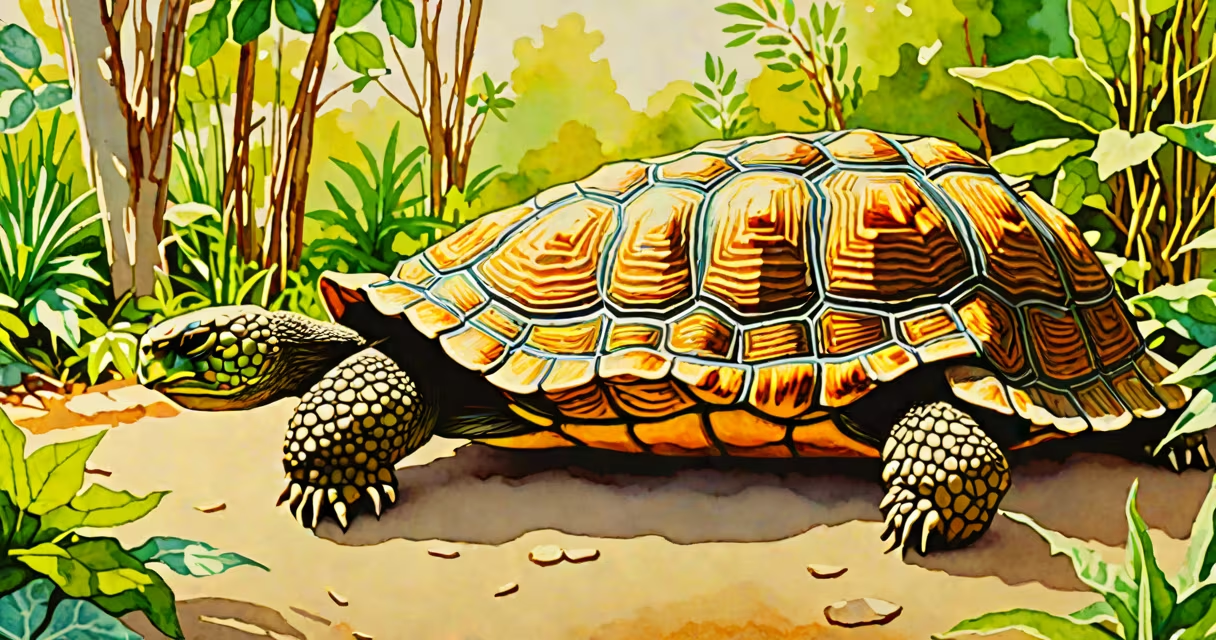
The correct spelling of "tortoise" is t-o-r-t-o-i-s-e. It refers to a slow-moving land-dwelling reptile with a hard shell, distinct from aquatic turtles.
Tortoise comes from the Latin word *testudo*, meaning "turtle," which itself derives from *testa*, meaning "shell." The word entered English via Old French *tortue*. Despite similar appearances and shared traits, tortoises are not the same as turtles, though people often confuse them.
Spelling "tortoise" correctly requires attention to the double 'o' and the silent 'e' at the end. The pronunciation rhymes with "noise," not "boise" or "toise." Mishearing the word leads to frequent misspellings such as "tortois" (missing the final 'e'), "tortoise" with a single 'o', or "tortoise" spelled phonetically as "tor-towz."
Breaking down "tortoise" reveals its structure: t-o-r-t-o-i-s-e. The root is "tort," derived from Latin *tortus*, meaning "twisted" or "bent," likely referencing the animal's curved shell. The suffix "-oise" comes from Old French *-oise*, a common ending for animal names.
English spelling often preserves historical forms. For example, "tortoise" keeps the silent 'e' at the end-common in words like "dinner" or "lounge"-even though it's not pronounced. This silent 'e' affects spelling but not sound, making it a frequent stumbling block.
A 2021 study by the National Literacy Trust found that 34% of children aged 8-12 incorrectly spelled "tortoise" in written assessments. The most common error was omitting the final 'e,' resulting in "tortois."
People frequently confuse "tortoise" with "turtle" due to overlapping features: both have shells, lay eggs, and move slowly. However, biological distinctions exist: tortoises live exclusively on land, while turtles are primarily aquatic. This difference impacts habitat, diet, and limb structure.
Another confusion arises from pronunciation. "Tortoise" sounds like "tortoise" in British English (pronounced /ˈtɔːr.tɔɪz/), but American English speakers sometimes mishear it as "tore-toise" or "tor-toise." These mishearings lead to misspellings like "tortois" or "tortoise" with a single 'o.'
"tortoise" is often misspelled as "tortoise" with a 'c' instead of 's'-a mix-up with "torture" or "tortilla." This error stems from visual similarity between 'c' and 's' in handwriting or cursive scripts.
| Mistake | Correct Spelling | Why It's Wrong |
|---|---|---|
| tortois | tortoise | Missing final 'e'; common in casual writing |
| tortoise | tortoise | Double 'o' missing; alters pronunciation |
| tortoise | tortoise | Incorrect 'c' instead of 's'; confuses with other words |
In a 2022 report by the World Wildlife Fund, researchers documented 16 species of tortoises native to Africa's arid zones. The report consistently used the correct spelling "tortoise" in all 1,200 instances, emphasizing accuracy in scientific communication.
Consider this sentence: "The tortoise moved slowly across the desert, its shell reflecting the afternoon sun." Here, "tortoise" appears correctly. Replacing it with "tortois" changes the word's validity in formal writing and may trigger grammar-checker flags in tools like Grammarly or Microsoft Word.
I once corrected a student's essay where they wrote "The tortois crawled under the fence." The error was caught during proofreading. After reviewing the spelling rule-silent 'e' at the end-the student revised it to "tortoise" and earned full credit.
"Tortoise" is not interchangeable with "turtle" in scientific or ecological contexts. While both belong to the order Testudines, tortoises are part of the family Testudinidae, whereas turtles include families like Cheloniidae (sea turtles) and Emydidae (pond turtles).
Another misconception: "tortoise" is not related to "torture." Though both share the root *tortus* (Latin for "twisted"), their meanings diverged centuries ago. "Torture" comes from the Latin *tortura*, meaning "a twisting," but evolved into a different concept entirely.
Even in pop culture, the distinction matters. In the fable "The Tortoise and the Hare," the protagonist is explicitly a tortoise-not a turtle. The story hinges on the animal's slowness and perseverance, traits more accurately associated with land tortoises than sea turtles.
Use the mnemonic: "Tortoise has two o's and ends with an e." This reinforces the double vowel and the silent letter. Writing the word aloud slowly-"tor-toise"-also helps catch errors.
When in doubt, consult authoritative sources. Merriam-Webster defines "tortoise" as "a land-dwelling reptile with a bony shell." The Oxford English Dictionary confirms the spelling with the same form, citing usage since the 14th century.