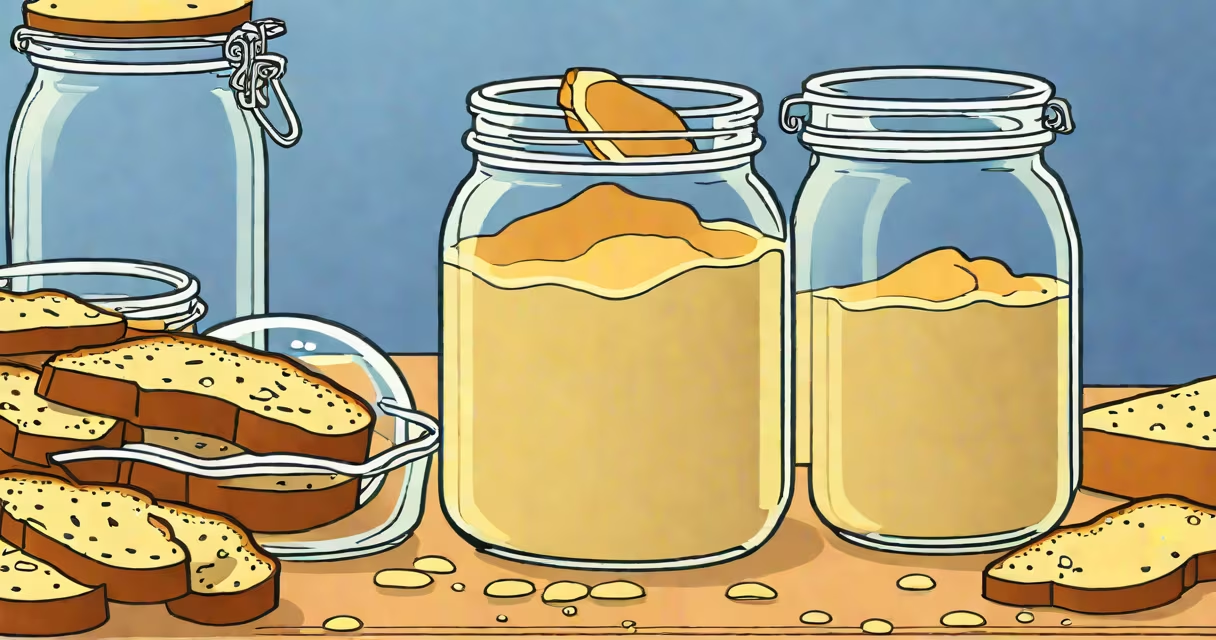
Starting bread begins with cultivating a living sourdough starter-a fermented mixture of flour and water that captures wild yeast and lactic acid bacteria. This biological culture ferments dough, enabling leavening without commercial yeast. The process takes 5 to 10 days and requires daily attention.
A sourdough starter is not a recipe-it's a living organism. It develops through regular feedings, where fresh flour and water are added to maintain microbial activity. Once established, it becomes the foundation for sourdough bread, which has a tangy flavor and chewy crumb. The starter grows stronger over time, reaching peak fermentation readiness within 4 to 6 hours after feeding.
The core principle: wild microbes in flour and air colonize the starter. Lactobacilli produce acidity, while Saccharomyces and other yeasts generate carbon dioxide. These gases create air pockets in dough, causing it to rise. Without a starter, bread lacks structure and flavor complexity. Commercial yeast provides faster results but doesn't deliver the same depth.
When you mix flour and water, enzymes in the flour break down starches into sugars. Wild yeast cells from the environment land on the mixture and begin consuming those sugars. As they metabolize, they release carbon dioxide and ethanol. Lactic acid bacteria ferment sugars too, producing acids that lower pH and inhibit spoilage.
After 12 hours, the starter swells and develops bubbles. By day 3, it typically doubles in volume and emits a vinegary, slightly sweet smell. This indicates active fermentation. If it smells rotten or moldy, discard and restart. A healthy starter should have a consistent texture-thick enough to hold shape but fluid enough to pour.
Feed the starter every 12 to 24 hours during the initial phase. Use equal parts by weight: 100 grams of flour and 100 grams of water. Discard half before each feeding to prevent overcrowding. Overfeeding leads to weak fermentation; underfeeding causes acid buildup and collapse.
Begin with unbleached all-purpose or whole wheat flour. Whole wheat contains more nutrients and wild microbes, speeding up starter development. Use filtered or bottled water if your tap water is chlorinated-chlorine kills microbes. Avoid distilled water, which lacks minerals needed for microbial growth.
Use a clean glass or plastic container with a wide mouth. Avoid metal, which can react with acids. A 1-liter jar is ideal. Cover loosely with a lid or cloth secured with a rubber band. Airflow prevents mold while allowing gas exchange.
For example: On Day 1, mix 100g whole wheat flour and 100g water. Stir until smooth. Let sit at room temperature (68-75°F) for 24 hours. By Day 2, stir in 100g flour and 100g water. Repeat daily. By Day 5, expect visible bubbles and a rise of 1.5x volume. The starter is ready to bake with when it reliably rises and falls over 4-6 hours.
| Day | Initial Mix | Feeding Schedule | Expected Signs |
|---|---|---|---|
| 1 | 100g flour + 100g water | None | Cloudy liquid, slight foam |
| 2 | Discard half, add 100g flour + 100g water | Every 12-24 hrs | Bubbles forming, faint sourness |
| 3 | Same | Same | Volume doubles, strong aroma |
| 4-5 | Same | Same | Consistent rise/fall cycle |
Many beginners give up too early. A starter may appear inactive on Day 2 or 3. This is normal. Fermentation depends on ambient temperature and local microbial diversity. Warmer environments speed up development. Cold kitchens delay it.
If the starter sinks after feeding, it's underfed. Increase feeding frequency. If it smells like nail polish remover, it's producing acetone-overfermentation. Reduce feeding intervals or refrigerate it temporarily. Refrigeration slows metabolism and extends shelf life.
Some assume starters must be maintained forever. They don't. Once stable, store in the fridge and feed weekly. Bring to room temperature 12 hours before baking. A single starter can last decades. The San Francisco sourdough starter, for example, has been active since 1849.
"How to start bread" does not mean mixing flour, water, and instant yeast. That's quick bread or sandwich loaf preparation. Sourdough requires patience and microbiology. It's not a shortcut. The starter is the engine; the dough is the vehicle.
Also, a starter is not a substitute for yeast in all recipes. Some bakers try to use it in enriched doughs (like brioche) and fail. The low pH of a mature starter inhibits yeast activity in high-sugar or high-fat recipes. Use commercial yeast instead for those.
One non-obvious fact: starter strength varies by season. Summer starters ferment faster due to higher temperatures. Winter starters slow down. Adjust feeding times accordingly. A 2021 study by the American Society for Microbiology confirmed that seasonal fluctuations affect microbial composition in home starters, altering rise times by up to 30%.
I started my own starter in late October. Using 100g whole rye flour and 100g filtered water, I stirred daily. By Day 3, bubbles formed. By Day 5, it doubled in volume within 5 hours. I kept it at 70°F in a kitchen corner away from drafts.
On Day 6, I tested it: dropped a spoonful into water. It floated. That meant it had enough gas production to leaven dough. I used it to make a basic sourdough boule. The crust cracked open with a crisp snap. The crumb was open and airy. The flavor was complex-tangy, nutty, slightly sweet.
This success wasn't luck. It came from consistency. I fed it every 12 hours, discarded half, and monitored temperature. I didn't skip days. I trusted the process.
Once your starter is active, you can begin baking. A simple recipe uses 500g flour, 330g water, 100g starter, and 10g salt. Autolyse for 30 minutes, then fold every 30 minutes for 2 hours. Shape, rest 1 hour, then bake at 475°F with steam for 25 minutes.