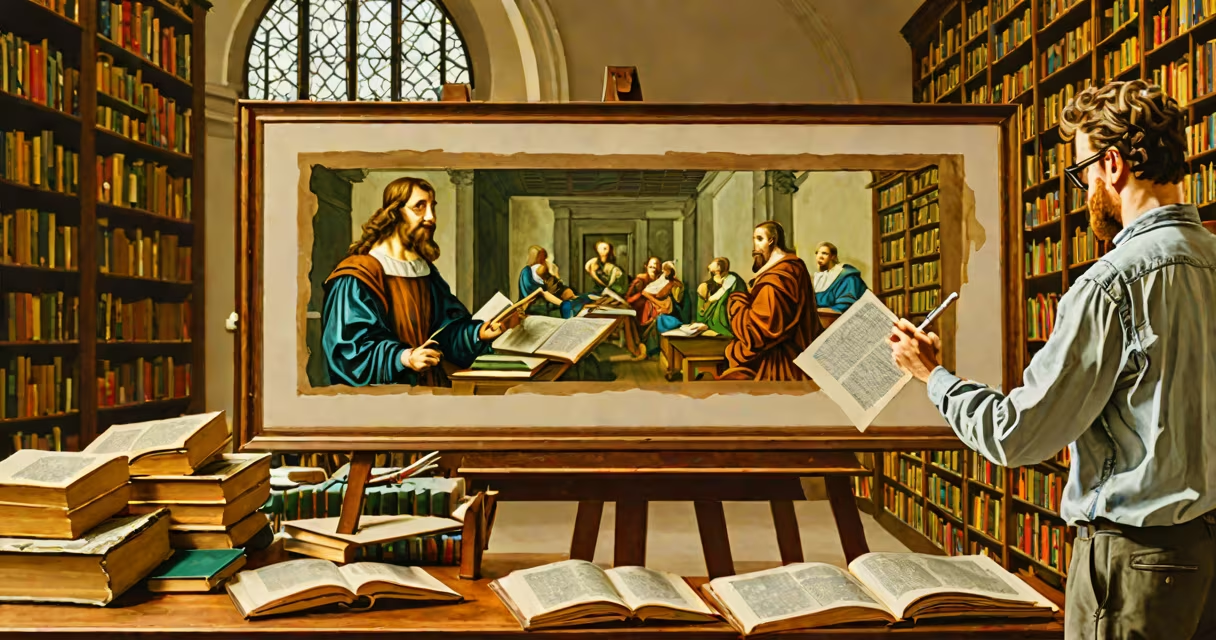
Studying art history involves systematically examining visual artworks through their historical context, formal elements, cultural meanings, and stylistic evolution using research, close observation, and critical interpretation. This process combines visual analysis, archival investigation, and theoretical frameworks to understand how and why art was created across time and regions.
Art history is not about memorizing artists' names or dates. It's about asking questions: Who made this? Why did they make it this way? What did it mean to its original audience? How has its meaning changed over time? These inquiries form the core of how to study art history effectively.
Effective study begins with direct observation. Examine the artwork's composition, color palette, materials, scale, and iconography. Ask: What do the figures do? What symbols appear? How does the artist use light and space?
Next, place the work in context. Identify the period, geographic region, religion, political climate, and social class associated with its creation. For example, a 15th-century Italian altarpiece reflects the dominance of Catholic doctrine, patronage by wealthy families, and advances in perspective drawing.
Finally, engage with scholarly interpretations. Read peer-reviewed articles from journals like *The Art Bulletin* or *Journal of the Warburg and Courtauld Institutes*. Cross-reference findings with museum catalogues such as those from the Metropolitan Museum of Art or the British Museum's online collection.
There are four primary approaches used in academic art history:
| Method | Description | Example |
|---|---|---|
| Formal analysis | Focuses on visual elements: line, shape, color, texture, composition. | Analyze how Van Gogh's brushstrokes in *Starry Night* convey emotional turbulence. |
| Contextual analysis | Places art within historical, religious, economic, or political settings. | Explain how Nazi Germany banned "degenerate art" to control public perception. |
| Iconographic analysis | Decodes symbolic imagery and recurring themes. | Interpret the serpent in Bosch's *Garden of Earthly Delights* as a Christian allegory of temptation. |
| Postmodern/postcolonial critique | Challenges dominant narratives and examines power structures in art production and display. | Reassess colonial-era African masks displayed in Western museums as sacred objects, not decorative artifacts. |
Each method builds on the last. A complete study doesn't rely on one approach alone. For instance, understanding Michelangelo's *David* requires formal analysis (idealized anatomy), contextual analysis (Florentine republicanism), iconography (David as a symbol of civic virtue), and postcolonial critique (how Western institutions have framed the statue as a universal ideal).
Art history is taught in universities worldwide, particularly in departments of fine arts, humanities, and museum studies. It's also essential for curators, conservators, auction house specialists, and educators.
Museums use art historical research to authenticate works, assign provenance, and design exhibitions. The Getty Research Institute maintains a database of over 1.2 million records on artists, artworks, and institutions to support attribution and conservation decisions.
For students, studying art history develops visual literacy, analytical reasoning, and cross-cultural understanding. According to the American Historical Association, graduates with art history degrees report strong performance in jobs requiring critical thinking, communication, and research-skills valued in law, education, and nonprofit sectors.
Many assume art history is purely descriptive-"This is a painting of a woman in a red dress." But accurate study goes beyond description. It demands interpretation grounded in evidence.
A common error is assuming that artistic style changes reflect progress. A 14th-century Byzantine icon may seem "primitive" compared to a 16th-century Vermeer, but both serve distinct spiritual and aesthetic purposes. The value lies in understanding intent, not judging technical skill by modern standards.
Another mistake is treating art as a direct mirror of history. Not all art reflects lived reality. Surrealist paintings like Dali's *The Persistence of Memory* distort time and space to express psychological states, not literal events.
One non-obvious fact: many artworks were never meant to be seen by the public. Religious frescoes in medieval churches were often painted high above eye level, intended to inspire awe rather than be studied closely. Their placement shaped how viewers experienced them-this spatial context alters interpretation.
Consider *The Scream* by Edvard Munch (1893). Begin with formal analysis: swirling lines, distorted figure, intense colors. Note the figure's hands pressed to its face, suggesting anguish.
Contextual analysis reveals Munch's personal struggles with anxiety and illness, and the painting's creation during a period of urban industrialization and psychological theory development. He wrote in his diary: "I felt a great scream pass through nature."
Iconographic reading identifies the figure as a universal symbol of existential dread-a theme central to late 19th-century European thought influenced by Nietzsche and Freud.
Finally, apply postmodern critique: the image has been reproduced in advertising, memes, and fashion. Its meaning has shifted from personal trauma to mass cultural symbol. This transformation shows how art's significance evolves beyond the artist's original intent.
When you study art history, treat each piece as a layered document. Use primary sources-letters, exhibition catalogs, contemporary reviews-and secondary scholarship to build a multidimensional understanding. Avoid relying solely on Wikipedia or commercial websites. Instead, consult peer-reviewed journals available through university libraries or platforms like JSTOR.
As someone who spent two weeks analyzing 19th-century Japanese woodblock prints for a university seminar, I learned that even familiar images like Hokusai's *Great Wave off Kanagawa* carry complex meanings related to trade, religion, and national identity. Without consulting historical shipping records and Edo-period print markets, the artwork's role in global exchange would remain invisible.
Understanding how to study art history means combining close looking with rigorous research. It's not passive viewing-it's active inquiry. visiting a gallery, apply consistent methods: observe, contextualize, interpret, and question.
Use tools like annotated timelines, comparative tables of styles, and citation managers (e.g., Zotero) to organize your work. Always cite your sources. The field values intellectual honesty and traceable evidence.