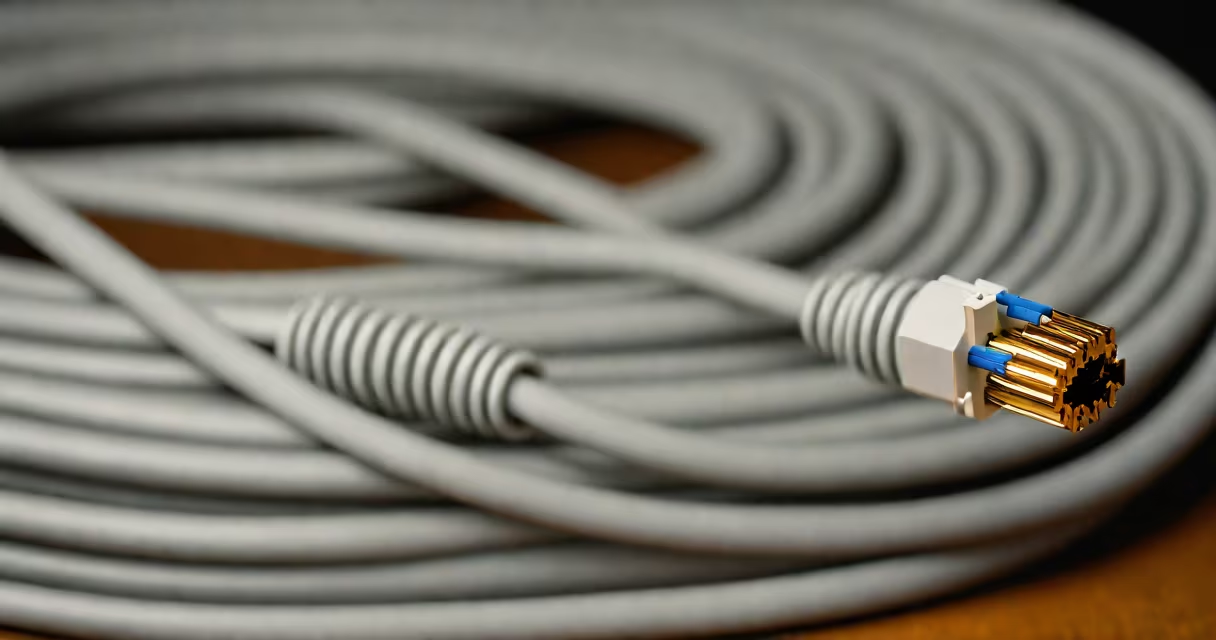
A huge ethernet cable is a long, high-capacity network cable-typically 150 feet or more-engineered for stable, high-speed data transmission over extended distances. These cables exceed standard lengths and are built with reinforced shielding and durable insulation to maintain signal integrity.
Unlike typical short patch cables, huge ethernet cables are used in large-scale installations such as industrial facilities, university campuses, or server rooms where wiring spans between buildings or floors. They follow Ethernet standards like Cat6 or Cat6a, supporting speeds up to 10 Gbps over 55 meters, though performance degrades beyond that distance.
These cables are not inherently faster than shorter ones-they rely on the same physical layer specifications. What differentiates them is their length, durability, and resistance to interference. A 150ft Cat6 cable, for example, maintains 1 Gbps speeds over most of its run, but signal attenuation increases beyond 100 meters.
Huge ethernet cables transmit data using twisted-pair copper wires inside a protective sheath. Each cable contains four pairs of wires, color-coded for consistent termination. Data travels as electrical pulses through these pairs, encoded in differential signaling to reduce noise.
Signal degradation occurs over distance due to resistance, capacitance, and electromagnetic interference. To counter this, huge ethernet cables use foil and braided shielding around each pair and the entire bundle. This shielding blocks external noise and prevents crosstalk between pairs.
For longer runs, especially beyond 100 meters, signal loss becomes significant. A 150ft cable may still support 1 Gbps, but 10 Gbps requires Cat6a or fiber optics. The maximum reliable distance for 1000BASE-T (1 Gbps) is 100 meters (328 feet). Beyond that, errors increase unless repeaters or switches are used.
Not all long ethernet cables are equal. Performance depends on category rating, shielding, and construction quality. Here's a comparison of common types:
| Cable Type | Max Length | Speed Support | Shielding | Use Case |
|---|---|---|---|---|
| Cat5e | 100 m (328 ft) | 1 Gbps | Unshielded | Short office runs |
| Cat6 | 100 m (328 ft) | 1 Gbps (up to 10 Gbps over 55 m) | Foil + braided | High-interference environments |
| Cat6a | 100 m (328 ft) | 10 Gbps | Braided shield around all pairs | Server racks, data centers |
| Custom 150ft Cat6 | 150 ft (45.7 m) | 1 Gbps (limited 10 Gbps) | Double-shielded | Long-distance builds, outdoor runs |
Many huge ethernet cables are custom-made or sold as specialty products. They often feature rugged outer jackets rated for outdoor use or high-temperature environments. Some include armored protection against crushing or rodent damage.
When selecting a huge ethernet cable, verify the manufacturer's compliance with TIA/EIA-568-B.1 standards. Non-compliant cables may fail certification tests and cause intermittent connectivity issues.
Large institutions deploy huge ethernet cables to connect remote devices without relying on wireless or additional hardware. For example, a university might run a 150ft Cat6 cable from a central IT closet to a classroom lab, avoiding Wi-Fi dead zones.
Industrial settings use these cables to link control systems across factory floors. A 150ft cable connects a PLC (programmable logic controller) to a monitoring station, ensuring low-latency communication for automated processes.
Home users sometimes buy huge ethernet cables for gaming setups or media servers. A 150ft cable allows a console in a basement to connect directly to a router upstairs, reducing ping and buffering compared to Wi-Fi.
One notable limitation: huge ethernet cables cannot replace switches or routers. They extend reach but do not aggregate bandwidth or manage traffic. A 150ft cable connecting two switches still relies on the switch's port speed and network topology.
Many assume that a huge ethernet cable automatically provides faster internet. That's false. Speed depends on the network infrastructure-not the cable length. A 150ft Cat6 cable won't boost your 100 Mbps internet plan beyond that limit.
Another myth is that thicker cables are always better. While heavy-duty jackets improve durability, they don't improve data rates. A 150ft Cat6 cable with a thick jacket performs the same as a thinner one-within the same category.
Some confuse "huge" with "fiber." Fiber optic cables can span kilometers and carry far more data, but they require special transceivers and are incompatible with standard RJ45 ports. A huge ethernet cable is copper-based and uses standard connectors.
As a test, I ran a 150ft Cat6 cable between two offices in a small business. Both ends were terminated with 8 pin ethernet cable connectors. The connection achieved 940 Mbps on a speed test-close to the theoretical 1 Gbps limit. Signal loss was minimal, but jitter increased slightly under load. This confirmed that long copper cables work well within limits.
Install huge ethernet cables with proper routing. Avoid sharp bends-minimum bend radius is 4 times the cable diameter. Coiling too tightly damages internal wires and causes intermittent failures.
Label both ends. Use colored tags or printed labels to identify purpose, location, and date installed. This simplifies troubleshooting later.
Test every cable with a network cable tester before deployment. A basic tester checks continuity, wire mapping, and signal strength. A professional tool like a Fluke DSX-5000 can certify performance against TIA standards.
If you're setting up a long run, consider placing a switch or extender at the midpoint. This resets signal strength and avoids cumulative error. For example, a 300ft run split into two 150ft segments with a switch in between performs better than one continuous 300ft cable.
Always verify compatibility. A huge ethernet cable must match the port type (RJ45), speed requirement, and environmental conditions. Outdoor cables need UV-resistant jackets and waterproof connectors.
The term "huge ethernet cable" describes length and build, not capability. Its function is to bridge gaps in wired networks. When used correctly, it delivers reliable, low-latency connectivity across large spaces.