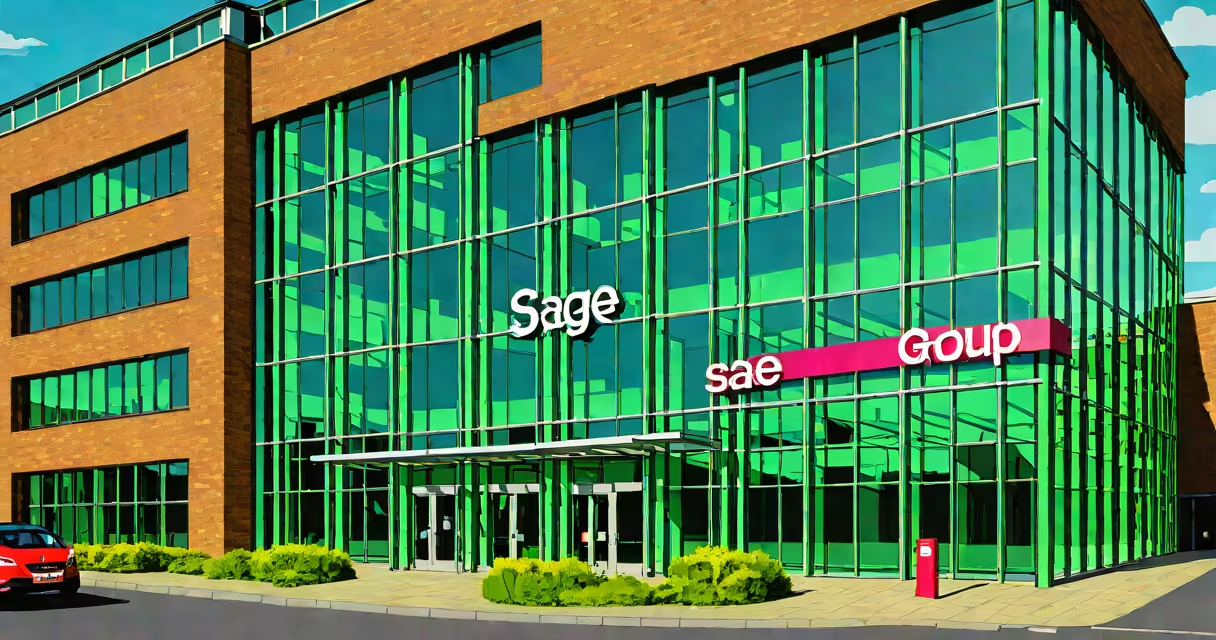
Sage Group PLC is a British multinational software company that develops and delivers cloud-based accounting, payroll, and enterprise resource planning (ERP) solutions primarily for small and medium-sized enterprises (SMEs). Founded in 1986 and headquartered in Newcastle upon Tyne, it operates in over 230 markets globally and serves more than 4 million customers.
The company's core offerings include Sage Business Cloud, which integrates accounting, payroll, and reporting tools into a single platform. It also provides industry-specific modules for sectors such as construction, retail, and professional services. Sage's software runs on subscription models, with access via web browsers and mobile apps. Its products are designed to automate financial workflows, reduce manual data entry, and improve compliance with local tax regulations.
Sage Group PLC trades on the London Stock Exchange under the ticker symbol SGE. As of 2023, it reported annual revenue of £1.1 billion, with 78% of its income coming from recurring subscription fees-a model that reflects long-term customer retention and stable cash flow. The company has consistently invested in artificial intelligence features, such as predictive cash flow forecasting and automated invoice matching, to differentiate itself in a competitive market.
Sage Group PLC operates through a hybrid delivery model combining cloud-hosted software with on-premise options for larger clients. Most users access Sage via the internet using a secure login. Once logged in, they can manage accounts payable and receivable, generate financial statements, process payroll, track inventory, and monitor project profitability-all within a unified interface.
Behind the scenes, Sage uses modular architecture. Each feature-like invoicing or bank reconciliation-is a standalone component that communicates through APIs. This allows customers to enable only the tools they need. For example, a freelance graphic designer may activate only the invoicing and tax calculation modules, while a manufacturing firm might integrate production scheduling and warehouse management.
Data security is enforced through multi-factor authentication, end-to-end encryption, and regular penetration testing. Sage complies with GDPR, ISO 27001, and SOC 2 standards. All customer data is stored in encrypted form across geographically distributed data centers, with backups replicated every 15 minutes.
Sage offers several product lines tailored to different business sizes and sectors. The most widely adopted is Sage Business Cloud, available in multiple versions:
| Product | Target Users | Core Features | Annual Subscription Cost (approx.) |
|---|---|---|---|
| Sage 50cloud | Small businesses with up to 50 employees | Full accounting set, payroll, VAT reporting, bank reconciliation | $1,200-$2,400 |
| Sage Intacct | Mid-market firms and growing organizations | Multi-currency support, advanced reporting, budgeting, audit trails | $5,000-$15,000 |
| Sage X3 | Larger enterprises in manufacturing, distribution, and services | End-to-end ERP, supply chain management, financial consolidation | $25,000+ |
For payroll, Sage Payroll handles HMRC-compliant tax calculations, pension contributions, and automatic filing. It supports over 100 countries and processes more than 2 million payslips annually. In 2022, Sage introduced Sage Intelligence, a tool that uses machine learning to flag anomalies in financial data-such as duplicate payments or unusual expense spikes-before they become issues.
Many assume Sage Group PLC is solely focused on UK-based SMEs. While it originated in the UK and maintains strong roots there, 62% of its customer base now resides outside the country, including major markets in North America, Germany, and Australia. The company has regional offices in Toronto, Frankfurt, and Sydney to support localized compliance and service delivery.
Another frequent error is equating Sage with QuickBooks. While both serve small businesses, Sage offers deeper integration with government tax portals-especially in Europe and the UK. For example, Sage's direct connection to HMRC's Making Tax Digital (MTD) system enables automatic submission of quarterly VAT returns. QuickBooks lacks native MTD compatibility in the UK, requiring third-party plugins.
A lesser-known fact: Sage Group PLC acquired BlackLine in 2021 for $1.1 billion. BlackLine specializes in automated financial close processes and controls. This acquisition strengthened Sage's position in the enterprise segment, allowing it to offer end-to-end automation-from transaction capture to board-ready reports-with minimal human intervention.
In 2023, a UK-based bakery chain with 14 locations switched from legacy spreadsheets and paper invoices to Sage Business Cloud. Before migration, the owner spent 12 hours weekly reconciling bank feeds and preparing monthly profit-and-loss statements. After implementation, the team reduced manual work by 80%. Automated bank reconciliation ran nightly, pulling transactions directly from HSBC and Barclays. Sales data from point-of-sale terminals synced with Sage every 15 minutes.
When HMRC updated VAT thresholds, Sage automatically adjusted the client's tax calculations across all locations. The finance manager received alerts for overdue supplier invoices and set up auto-reminders. Within six months, the business achieved a 27% reduction in late payment fees and improved cash flow visibility. The owner noted: "I can now focus on growth, not chasing receipts."
Sage Group PLC continues to evolve beyond basic accounting. Its recent focus on sustainability reporting tools-such as carbon footprint tracking per invoice-shows expansion into ESG (Environmental, Social, and Governance) metrics. These features align with EU Green Deal requirements and help clients meet investor expectations.
As of 2024, Sage Group PLC remains a leader in cloud-based financial software, serving diverse industries worldwide. Its blend of global scale, regulatory compliance, and continuous innovation makes it a trusted partner for businesses managing complex financial operations.