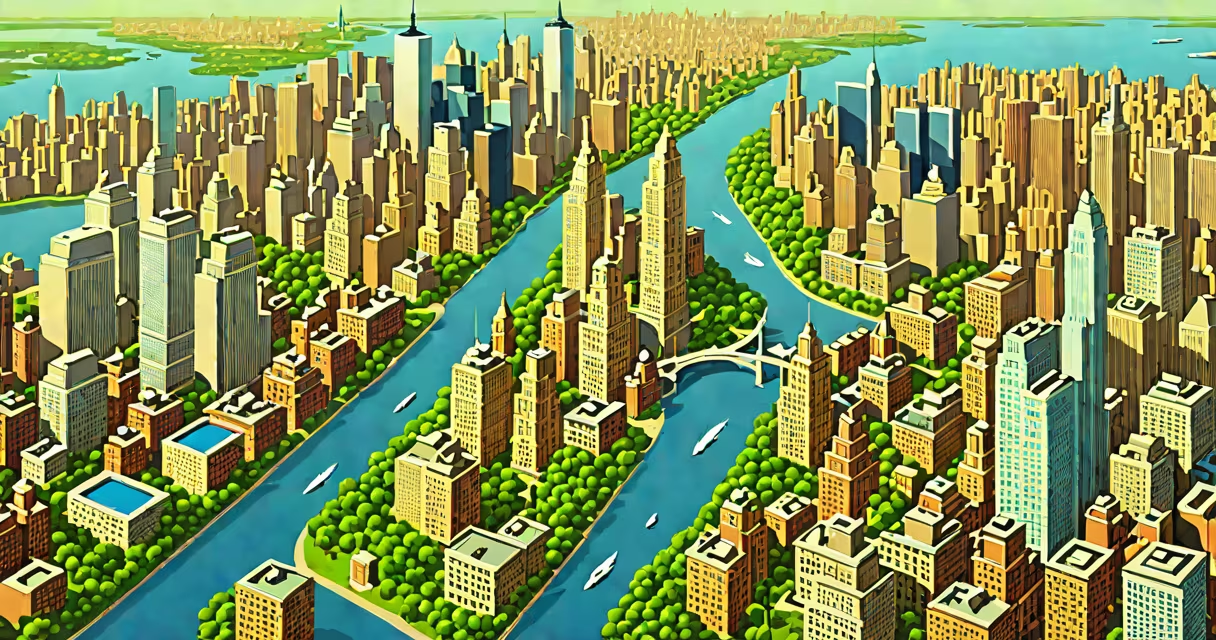
Manhattan is not a city. It is a borough of New York City, located on Manhattan Island, and serves as the cultural, financial, and administrative heart of the five-borough metropolis.
New York City is a consolidated city-county formed in 1898 by merging Manhattan, Brooklyn, Queens, The Bronx, and Staten Island into a single municipal entity. This structure makes Manhattan a component of a larger city, not a standalone municipality. The city government operates under a unified charter, with each borough having its own elected borough president but no independent city status.
Manhattan covers approximately 22.5 square miles (58.3 km²) and is bordered by the Hudson River to the west, the East River to the east, and the Harlem River to the north. Its population exceeds 1.6 million people, making it the most densely populated borough in the United States. Despite its size and influence, it lacks the legal standing of a city under state law.
When New York City was created in 1898, it absorbed five distinct political entities: Manhattan (formerly New York County), Brooklyn (Kings County), Queens (Queens County), The Bronx (Bronx County), and Staten Island (Richmond County). Each retained its identity but became part of the city's unified governance.
Manhattan is coextensive with New York County. That means the geographic area of Manhattan is legally defined as the same as the county boundary. This dual identity-borough and county-is unique in the U.S. Most counties do not align with city limits, but in New York, they do. This arrangement allows for shared services, such as courts and public health departments, under a single jurisdiction.
The city's government includes a mayor, a city council, and department heads who oversee city-wide functions. Borough presidents exist to represent local interests, but they have limited power. For example, the Manhattan Borough President advises on land use and zoning but cannot veto city decisions. This structure prevents Manhattan from operating independently.
Manhattan is divided into three main geographic zones: Lower Manhattan, Midtown Manhattan, and Upper Manhattan. Lower Manhattan includes Wall Street, the Financial District, and Battery Park. Midtown spans from 34th to 59th Streets and hosts Times Square, Grand Central Terminal, and the headquarters of major corporations. Upper Manhattan extends from 155th Street northward, including Harlem and Washington Heights.
Neighborhoods within Manhattan include Greenwich Village, SoHo, Tribeca, Chelsea, and the Upper West Side. Each has distinct architectural styles, demographic profiles, and economic roles. For example, SoHo is known for its cast-iron buildings and art galleries, while Harlem is historically significant for African American culture and the Harlem Renaissance.
Manhattan's infrastructure supports over 1.6 million residents and millions more daily commuters. It has 13 subway lines, 200 bus routes, and 13 bridges and tunnels connecting it to neighboring boroughs and New Jersey. The island's grid layout, established in 1811 by the Commissioners' Plan, enables efficient navigation despite high density.
Many people assume Manhattan is a city because of its global recognition. Major landmarks like the Empire State Building, Central Park, and Broadway are often cited as symbols of "New York City," but they are physically located in Manhattan. This association leads to the misconception that Manhattan stands alone.
Another confusion arises from media references. News outlets frequently use "Manhattan" to refer to the entire city. For example, headlines about "Manhattan real estate prices" may imply a standalone market, but they reflect conditions across all five boroughs. The term "Manhattan" is shorthand for the city's core, not a geographical or political entity.
A lesser-known fact: Manhattan is the only borough that lies entirely on an island. All others are connected to mainland or adjacent islands. This isolation contributes to its unique urban form-high-rise development dominates the field, with limited green space. Central Park, at 843 acres, is the largest public park in Manhattan and a critical urban amenity.
Manhattan differs from standalone cities in several structural ways. Unlike cities such as Nashville or Portland, which have their own charters and governing bodies, Manhattan operates under the authority of New York City's mayor and city council. It cannot pass laws independently or set its own tax rates without citywide approval.
| Feature | Manhattan (NYC) | Nashville (TN) | San Francisco (CA) |
|---|---|---|---|
| Legal Status | Borough of NYC | Independent city | Independent city |
| Population (2023 est.) | 1,698,000 | 692,000 | 884,000 |
| Government Structure | Part of NYC government | Self-governing | Self-governing |
| County Relationship | Coextensive with New York County | Independent of county | Independent of county |
For example, Nashville operates as both a city and a county, with a single government overseeing all services. In contrast, Manhattan's police force is run by the NYPD, which serves all five boroughs. Similarly, the city's fire department, sanitation system, and transportation network are managed centrally.
I once visited the New York Public Library's research room and asked a reference librarian about Manhattan's status. She confirmed that while Manhattan is often treated as a city in conversation, legally it is a borough. She pointed to the official city charter, which states that "New York City shall consist of five boroughs, including Manhattan." This clarification helped me understand why maps showing Manhattan as a separate city are misleading.
Mistaking Manhattan for a city affects how people interpret urban policy, elections, and public services. For example, voter registration in Manhattan is tied to New York City, not a separate municipal system. Property taxes are assessed at the city level, not borough level. This means decisions affecting Manhattan are made through city-wide processes, not local ones.
Understanding Manhattan's role within New York City is essential for accurate reporting, civic engagement, and travel planning. If you're visiting Manhattan, you're entering a borough, not a city. The subway map shows connections to Brooklyn, Queens, and the Bronx-all part of the same metropolitan area.
Manhattan is not a city. It is a borough of New York City, a important part of a larger urban system. Recognizing this distinction ensures accurate understanding of governance, geography, and urban life in one of the world's most iconic places.