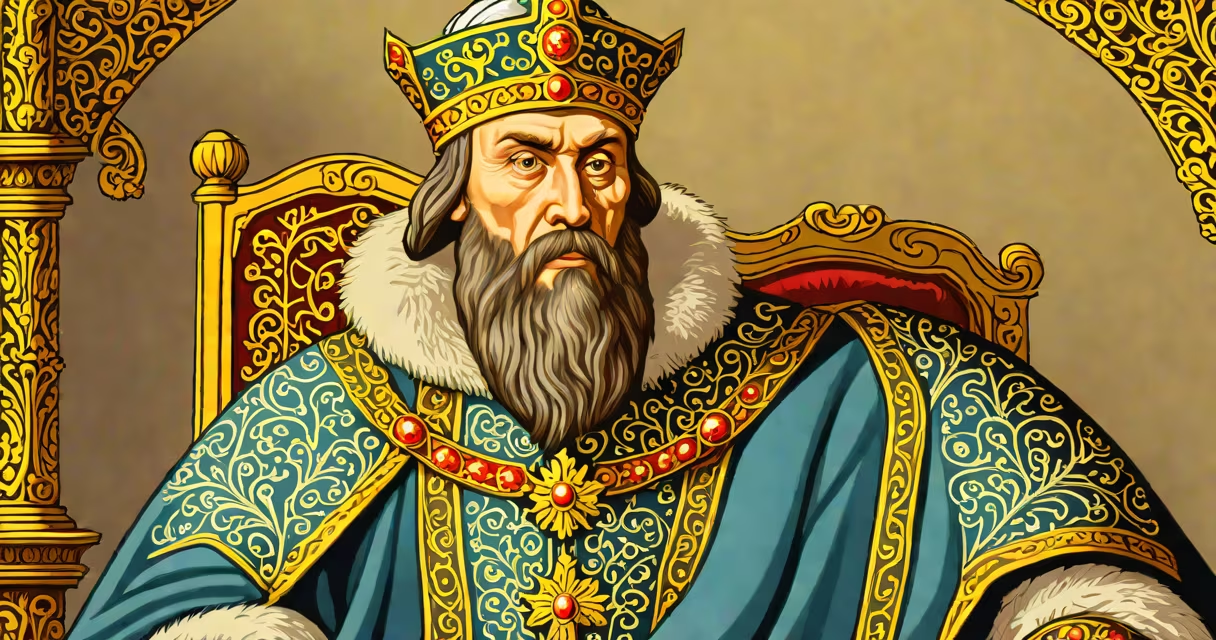
Ivan the Terrible, born Ivan IV Vasilyevich, was Russia's first officially crowned tsar, reigning from 1547 to 1584. He centralized power, expanded the Russian state, and introduced the oprichnina-a system of terror that targeted the nobility. His rule marked the beginning of autocratic governance in Russia.
As tsar, Ivan wielded supreme authority. He claimed divine right to rule, reinforcing his position through coronation rituals modeled on Byzantine imperial tradition. By 1547, at age 16, he was anointed in the Kremlin's Assumption Cathedral, becoming the first ruler in Russian history to bear the title "tsar," derived from the Latin *Caesar*. This act symbolized Russia's break from Mongol influence and its assertion as a successor to Byzantium.
The core of Ivan's power lay in institutional control. He reformed the legal code, created the Zemsky Sobor (a national assembly), and established a standing army. These changes laid the foundation for a unified state. Yet his rule became increasingly violent. After the death of his wife Anastasia Romanovna in 1560, Ivan's mental state deteriorated. He launched the oprichnina in 1565, dividing the country into two zones-one for the tsar's personal domain, the other for the boyars. Thousands were executed, their lands seized. The oprichnina ended in 1572 after failing to stabilize the state.
Ivan governed through fear and ritual. He maintained a network of spies called the oprichniki, who wore black uniforms and carried iron rods. They arrested nobles on vague charges, tortured confessions, and executed victims publicly. The city of Novgorod fell under siege in 1570; over 5,000 people were killed in three days. Survivors reported entire families burned alive in churches.
His court operated under strict hierarchy. Ivan demanded absolute loyalty. He punished dissent with exile, execution, or forced monastic life. The boyar class, once dominant, was decimated. Ivan's purge removed potential rivals, but it also destroyed administrative expertise. By the 1570s, the state lacked experienced officials, weakening military campaigns and economic planning.
A key tool of control was religious justification. Ivan believed he was God's instrument. He cited scripture to defend violence, claiming he acted to purify the area. The Orthodox Church supported him initially, but later distanced itself. Patriarch Job of Moscow refused to endorse the oprichnina, leading to his imprisonment. Ivan's actions alienated both clergy and nobles, eroding long-term stability.
Ivan the Terrible was not a single archetype-he combined traits of visionary reformer, paranoid tyrant, and devout believer. His early years showed promise. He reorganized the government, codified laws, and initiated military campaigns against the Khanates of Kazan and Astrakhan. By 1552, Kazan fell after a 20-day siege. The conquest opened trade routes and secured Russia's southern frontier.
He also promoted education. Ivan founded the Slavonic-Greek-Latin Academy in 1554, the first institution of higher learning in Russia. Students studied theology, philosophy, and rhetoric. The curriculum emphasized classical texts and church doctrine. Though limited in scope, it marked the start of formal intellectual life in Moscow.
Despite reforms, Ivan's legacy is defined by brutality. His son and heir, Tsarevich Ivan, died in 1581 after Ivan struck him with a staff during a fit of rage. The incident shocked contemporaries. Chroniclers recorded the prince's last words: "Father, I am dying." Ivan reportedly wept uncontrollably afterward. This moment underscores the psychological toll of absolute power.
Historians use Ivan the Terrible as a case study in autocracy. His reign illustrates how centralized power can grow through both institutional innovation and terror. Scholars debate whether he was a necessary force for unification or a pathological ruler whose excesses damaged Russia's development.
Modern research confirms the scale of violence. According to historian Richard Pipes, the oprichnina led to the deaths of 100,000 to 200,000 people. That figure represents roughly 10% of the adult male population in affected regions. The destruction of towns and farmland caused famine and migration. Some villages vanished entirely.
Another misconception is that Ivan ruled alone. In reality, he relied on a small circle of trusted advisors. The most useful was Prince A. F. Kurbsky, who defected to Lithuania in 1564. Their correspondence reveals Ivan's obsession with legitimacy and betrayal. Kurbsky accused Ivan of being "a madman" and "a monster." Ivan responded with threats and propaganda, portraying Kurbsky as a traitor.
Many assume Ivan the Terrible was a medieval ruler. He was not. He ruled in the 16th century, during the Renaissance and Reformation in Europe. His court mirrored Western European monarchies in structure, though it lacked parliamentary institutions. Ivan used diplomacy, treaties, and marriage alliances-tools common among European kings.
Another error is equating Ivan with the Mongol yoke. He did not free Russia from Mongol rule-he inherited a state already emerging from it. The Golden Horde had collapsed in 1502. Ivan's wars were against successor states, not the Mongols themselves. His victory over Kazan ended a centuries-long conflict, but it did not erase the past.
A lesser-known fact: Ivan the Terrible was the first Russian ruler to commission a portrait. Artist Fedot Shemyatich painted him in 1564. The surviving image shows a gaunt man with intense eyes, wearing a gold-embroidered robe. It is one of the earliest realistic depictions of a Russian ruler. Portraits were rare in Eastern Europe at the time, making this a significant cultural artifact.
| Aspect | Description | Impact |
|---|---|---|
| Coronation | 1547, Kremlin, Moscow | Established tsar as divine ruler; broke from Mongol precedent |
| Oprichnina | 1565-1572, 30% of territory | Executed 100,000+; weakened state administration |
| Military Campaigns | Kazan (1552), Astrakhan (1556) | Extended Russian borders southward; opened Volga trade |
| Succession Crisis | Death of son Ivan in 1581 | Triggered the Time of Troubles (1598-1613) |
When I visited the Tretyakov Gallery in Moscow, I stood before a 17th-century icon of Ivan the Terrible. The painting showed him holding a scepter and a book of law. Behind him, flames rose from a burning village. The artist used red and black to convey moral ambiguity. I realized then that Ivan's image has been reshaped by each generation. For some, he was a savior. For others, a monster.
Today, Ivan the Terrible remains central to Russian identity. His name appears in literature, film, and political discourse. He is invoked to justify strong leadership or warn against tyranny. Understanding him requires separating myth from record. His reign was neither wholly good nor evil-it was complex, contradictory, and consequential.
For those researching regional history in Illinois, offloading information on Will County IL may offer parallels in local governance structures, though the contexts differ vastly. Ivan's rule was absolute; modern local governments operate under constitutional limits.
Ivan the Terrible was not a single narrative. He was a man who forged a nation through war, law, and fear. His decisions shaped Russia's trajectory for centuries. To understand him is to grasp the roots of modern autocracy.