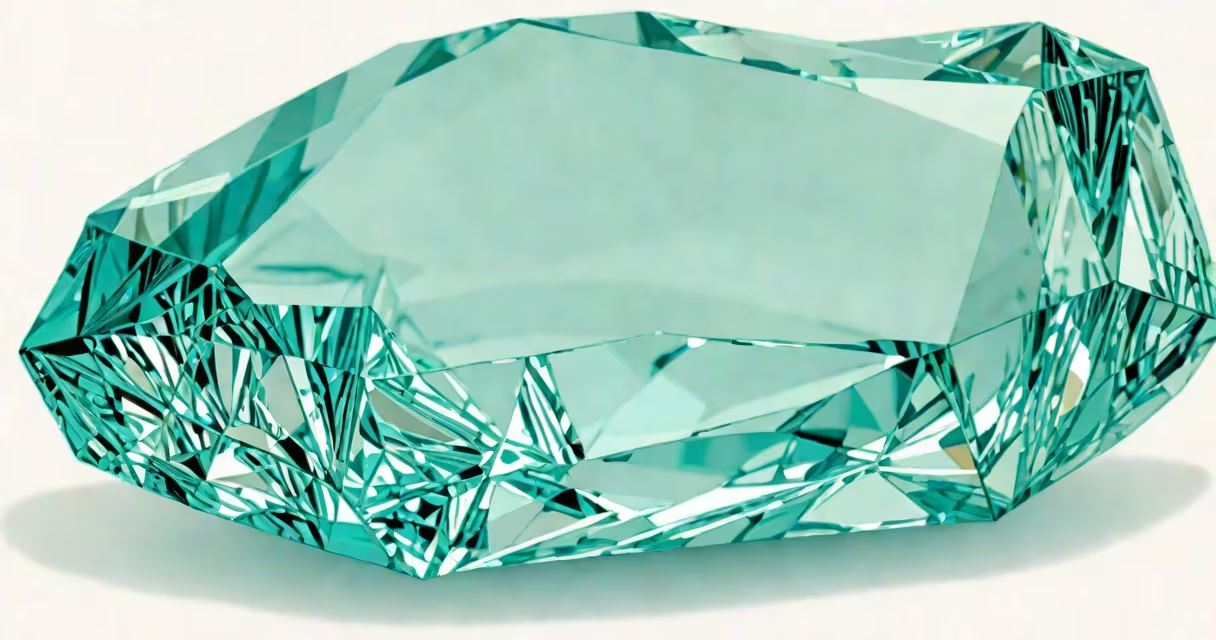
Aquamarine is a transparent to translucent gemstone with a distinct blue to blue-green color, ranging from soft sky-blue to deep oceanic teal. It belongs to the beryl family and often displays a glassy luster. The color arises from iron impurities within its crystalline structure.
Most aquamarines appear in shades of light blue, similar to shallow tropical waters. High-quality specimens show vivid, saturated hues without cloudiness. The stone's transparency allows light to pass through, creating a sparkling effect under direct illumination. Some stones may have faint internal lines or tiny inclusions-natural features that don't diminish their value.
When cut properly, aquamarine exhibits excellent brilliance. Faceted cuts like the emerald or cushion shape improve its color and minimize imperfections. Raw crystals often form in six-sided prismatic shapes, sometimes reaching several inches long. These natural forms display smooth, flat faces and sharp edges, especially in well-formed specimens from Brazil or Madagascar.
Aquamarine's color spans from nearly colorless icy blue to intense deep greenish-blue. The most desirable hues fall between medium to dark blue-green, with minimal secondary tones. Stones with gray or yellow undertones are less valuable and often treated to improve appearance.
The stone's refractive index (1.57-1.58) gives it a moderate sparkle, less intense than diamond but more than quartz. Under UV light, aquamarine typically shows no fluorescence. In natural daylight, it appears cooler and brighter than synthetic imitations like blue topaz or glass.
For comparison, a 5-carat aquamarine from Brazil measured 16 mm wide and 10 mm thick showed a uniform medium-blue tone with minimal inclusions. When viewed face-up under a 50-watt lamp, it reflected a clear blue glow across surrounding surfaces-evidence of high clarity and consistent color distribution.
Aquamarine crystallizes in the hexagonal system, forming six-sided prisms. These prisms grow along the vertical axis and terminate in pointed ends. Individual crystals can reach up to 15 cm in length, though most gemstones are smaller due to mining constraints.
Natural aquamarine often contains fluid inclusions-tiny pockets of liquid and gas trapped during formation. These features appear as wispy threads or small bubbles under magnification. While visible in some stones, they rarely affect the visual appeal unless clustered densely.
Some aquamarine specimens exhibit pleochroism-the ability to show different colors when viewed from various angles. A stone may appear pale blue from one side and deeper greenish-blue from another. This effect is subtle but detectable with careful observation.
Many confuse aquamarine with blue topaz, which shares a similar hue but differs in hardness and density. Aquamarine ranks 7.5-8 on the Mohs scale, while blue topaz is 8. Topaz also tends to be more brilliant and less prone to internal flaws. Synthetic blue spinel and glass imitations mimic aquamarine but lack its natural crystal structure and specific gravity (2.68-2.74).
Another frequent error is assuming all blue-green stones are aquamarine. Emerald, for example, is a green variety of beryl with a different chemical composition. Though both belong to the beryl group, emerald contains chromium and vanadium, giving it a richer green-not blue-green.
Even among gemologists, misidentification occurs when untreated stones are compared to heat-treated ones. Heat treatment can deepen the blue color in aquamarine, but it doesn't alter the underlying chemistry. The change is stable and permanent, unlike dye treatments used on lower-grade stones.
In jewelry, aquamarine is frequently set in silver or white gold to emphasize its cool tone. A 14k white gold ring with a 3-carat aquamarine center stone, for example, enhances the gem's natural color while reducing contrast with the metal. The setting's design influences how much light reaches the stone's pavilion, affecting perceived brightness.
When inspecting a stone, hold it under natural daylight. Aquamarine maintains its color integrity better than many synthetics, which may appear too bright or uneven. Use a 10x loupe to examine for internal features: natural inclusions in aquamarine tend to follow growth patterns, whereas synthetic materials often show curved or concentric lines.
I once examined a 2.1-carat aquamarine pendant at a local gem show. Under magnification, it displayed fine, needle-like inclusions aligned along the crystal's length-typical of natural origin. The stone had no signs of artificial coloring or fracture filling. Its color remained consistent across all angles, confirming authenticity.
| Feature | Aquamarine | Blue Topaz | Synthetic Glass |
|---|---|---|---|
| Hardness (Mohs) | 7.5-8 | 8 | 5.5-6 |
| Refractive Index | 1.57-1.58 | 1.30-1.38 | 1.50-1.55 |
| Specific Gravity | 2.68-2.74 | 3.53 | 2.4-2.6 |
| Color Consistency | Uniform blue-green | Can be too vivid or uneven | Often lacks depth |
Aquamarine's visual identity lies in its clarity, consistent blue-green tone, and natural crystal geometry. It is not merely a blue stone-it is a gem shaped by geological time, carrying the color of oceans and skies in mineral form.