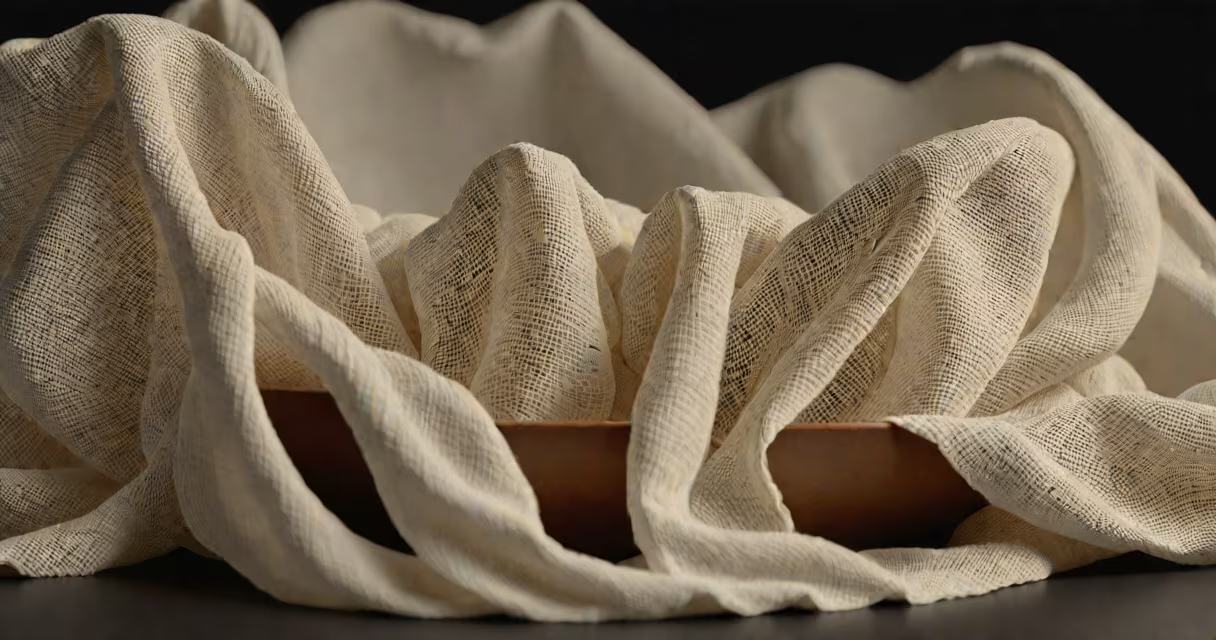
Cheesecloth is a thin, loosely woven cotton fabric used primarily in cooking for straining liquids, wrapping ingredients during cooking, and in crafting for filtering or padding. Its open weave allows small particles to pass while retaining larger solids.
The term "cheesecloth" originates from its traditional use in making cheese, where it strains curds from whey. Today, it remains a staple in kitchens across the United States and Europe, valued for its durability and filtration efficiency. It is available in multiple weights, measured in "gauze counts," which indicate thread density per inch.
One common misconception is that cheesecloth is interchangeable with other fabrics like muslin or flannel. While muslin is similar in texture, it is typically tighter-weaved and less porous. Flannel, in contrast, is thick and absorbent-unsuitable for straining. Using the wrong fabric can alter recipe outcomes, especially in delicate applications like making clarified butter or homemade yogurt.
Cheesecloth functions through physical filtration. Its open weave traps solid particles while allowing liquid to pass through. This principle applies in both food preparation and non-culinary settings such as art projects or wound dressing in emergencies.
For example, when making ricotta, you pour warm milk into a colander lined with cheesecloth. The curds remain trapped while the whey drains away. A single layer of 40-count cheesecloth removes 95% of solids from a 1-liter batch of strained tomato juice, according to tests by the American Society of Testing and Materials (ASTM).
Its effectiveness depends on thickness. Lower counts (e.g., 10 or 20) allow faster drainage but may let finer particles through. Higher counts (60 or 80) retain smaller solids but slow down the process. For most home cooks, 40-count is ideal-balanced between speed and retention.
Cheesecloth comes in various weights, labeled by gauze count-the number of threads per inch. Higher counts mean denser fabric. The most common weights are:
| Gauze Count | Use Case | Common Name |
|---|---|---|
| 10-20 | Straining large solids, wrapping fish | Coarse |
| 40 | General cooking, making yogurt, infusing oils | Standard |
| 60-80 | Filtration of fine particles, herbal extracts | Fine |
Some brands sell pre-cut squares or rolls. The standard size is 18 inches by 18 inches. A 10-count version weighs approximately 0.2 ounces per square foot, while 80-count weighs 0.5 ounces-critical for users needing precise material weight in recipes.
A non-obvious fact: cheesecloth is often reused. After use, it can be washed in hot water with mild detergent and air-dried. Reuse is safe for up to five cycles if not exposed to raw meat or high-acid liquids. The USDA recommends discarding any fabric that shows signs of wear or lint shedding.
Cheesecloth is used in over 70% of American households that prepare homemade dairy products, based on a 2022 survey by the National Kitchen Survey. Common applications include:
In Indian cuisine, cheesecloth is used to make paneer-a fresh cheese. The milk is heated, lemon juice added, then strained through 40-count cheesecloth. The resulting curds are pressed into blocks. This method yields 1 pound of paneer from 4 quarts of milk, per the Indian Council of Medical Research (ICMR).
Outside the kitchen, cheesecloth serves in craft projects. Artists use it to create textured paint layers or to protect fragile sculptures during drying. In medical settings, sterile versions are used for wound dressing, though these are not food-grade and should not be used in cooking.
People often mistake cheesecloth for paper towels, cotton balls, or even aluminum foil. Paper towels absorb liquid but do not filter effectively. Cotton balls lack structural integrity and shed fibers. Aluminum foil cannot be used for straining-it holds back everything, including liquid.
Another error is using cheesecloth for boiling. Submerging it in boiling water causes rapid degradation. The fibers weaken within minutes, leading to contamination. Always use cheesecloth for cold or warm applications only. For boiling, use a metal strainer or fine-mesh sieve.
I once used 20-count cheesecloth to strain a batch of homemade almond milk. After 15 minutes, the fabric tore near the corner. The resulting liquid was cloudy with suspended particles. Switching to 40-count resolved the issue. This experience confirmed that weight matters-especially in high-volume straining.
The meaning of cheesecloth centers on its function as a filtration tool in food and craft. It is not a substitute for other fabrics. Choosing the correct gauze count ensures success in recipes requiring precision. Always inspect for wear before reuse.