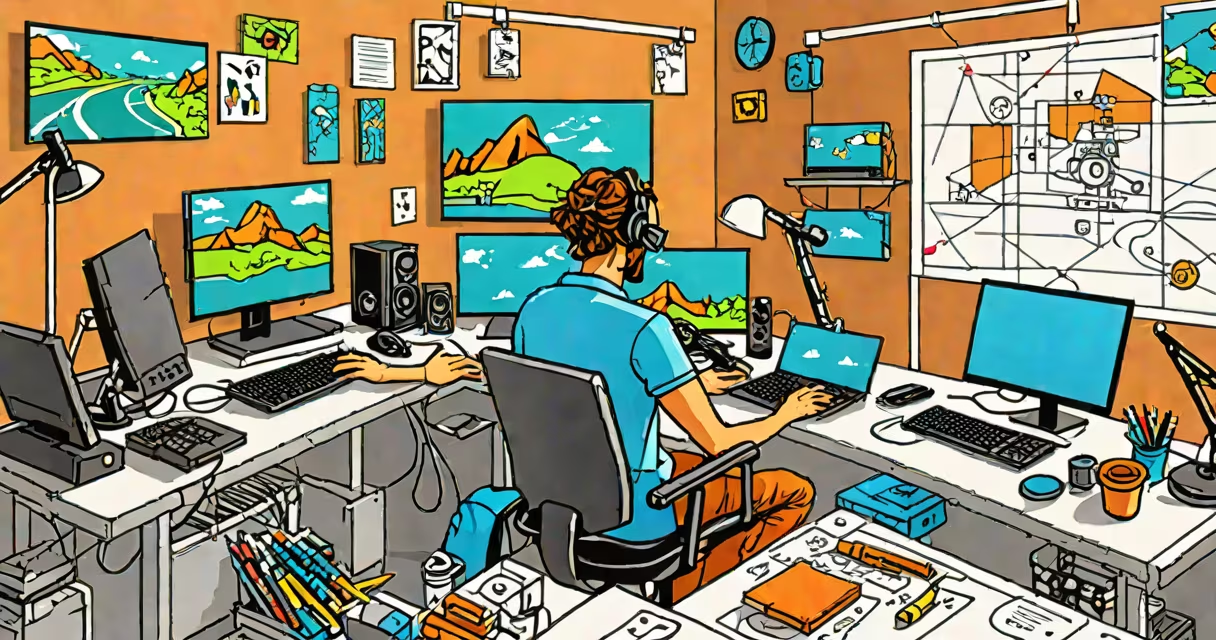
A game designer defines the rules, interactions, and story structure that make a video game engaging and playable. They create the foundation of gameplay by balancing challenge, reward, and progression across levels, characters, and systems.
Game designers work across genres-from puzzle games to multiplayer shooters-using logic, psychology, and creativity to shape how players interact with virtual worlds. Their decisions affect everything from enemy behavior to user interface flow.
According to the U.S. Bureau of Labor Statistics, game designers fall under the broader category of software developers, with median annual earnings of $110,000 in 2023. Roles vary widely by company size and project scope, but core responsibilities remain consistent.
Design begins with concept documents outlining goals, target audience, and core loop-the repetitive cycle of action and feedback that keeps players engaged. A typical loop in a platformer might be: jump → collect coin → avoid enemy → progress to next area.
Designers build prototypes using tools like Unity or Unreal Engine to test mechanics early. These prototypes often start as simple scripts or level layouts, then evolve into full features based on playtesting results.
For example, in *Celeste*, the game's difficulty curve was refined over 18 months of internal testing. Lead designer Maddy Thorson adjusted jump height and wall-jump timing after observing player frustration in early builds. This iterative process ensures mechanics feel fair and rewarding.
While all game designers focus on player experience, roles split into distinct specializations:
| Type | Focus Area | Typical Tasks | Example Project |
|---|---|---|---|
| Level Designer | Environment and progression | Placing hazards, crafting paths, setting checkpoints | Creating the final boss arena in *Hollow Knight* |
| Mechanics Designer | Rules and systems | Programming combat balance, crafting systems, AI behavior | Designing the grappling hook system in *Spider-Man* (2018) |
| Narrative Designer | Story and pacing | Writing dialogue trees, designing branching choices, integrating lore | Mapping player decisions in *The Last of Us Part II* |
| User Experience (UX) Designer | Interface and accessibility | Designing HUD elements, menu flows, assistive options | Implementing colorblind modes in *Disco Elysium* |
These roles often overlap. In indie studios, one person may handle multiple areas. Larger teams assign specialists to reduce cognitive load during long development cycles.
Non-obvious fact: Many game designers don't code. While technical literacy helps, most rely on engineers to implement mechanics. Designers communicate intent via documentation, diagrams, and playtest sessions-not lines of code.
Game designers influence outcomes across the entire production pipeline. Early design choices determine budget allocation, timeline estimates, and team hiring needs.
For instance, *Animal Crossing: New Horizons* required extensive environmental design to support daily routines and seasonal events. The team spent 16 months planning how NPCs would behave across 12 seasons, ensuring each day felt unique.
Designers also shape monetization models. In *Fortnite*, battle royale mode uses limited-time events and cosmetic sales to maintain engagement. These strategies stem from behavioral research on reward schedules and social comparison.
Contrary to common belief, game design isn't just about fun. It includes managing risk, reducing player churn, and supporting diverse play styles. A poorly balanced matchmaking system can alienate new players within hours.
Many assume game designers are artists or coders. While some have those skills, their primary function is structuring interaction. A designer doesn't draw sprites or write shaders-they define how those assets behave in-game.
Another myth: "Game design is all creativity." In reality, it's equal parts intuition and measurement. Designers use analytics to track drop-off points, completion rates, and session length. Data reveals whether a mechanic works-or fails silently.
I once observed a playtest session for a mobile puzzle game where 72% of users abandoned the third level. After reviewing video footage, we discovered the solution path wasn't visible due to poor lighting. Adjusting contrast increased retention by 39% in the next build.
Even titles like *Minecraft* rely on design principles., the game's block-based world encourages exploration and experimentation because each block has predictable physics and placement rules. This consistency reduces cognitive load and enables emergent gameplay.
Entry-level roles often require a portfolio of personal projects. Build small games using free engines like Godot or Unity. Document your design decisions-why you chose certain mechanics, how you tested them.
Join communities such as the International Game Developers Association (IGDA) or participate in game jams like Global Game Jam. These events simulate real-world constraints: 48 hours, a theme, and a team.
For inspiration, explore *Game On Carlisle*, a community-driven event focused on accessible game creation. It emphasizes inclusive design and supports emerging voices in the field.
Understanding what is a game designer means recognizing their role as architect of experience-not just creator of content. They shape how people feel, think, and act within a game's world.
Every successful game rests on thoughtful design. From the first button press to the final cutscene, a game designer's work guides the process.