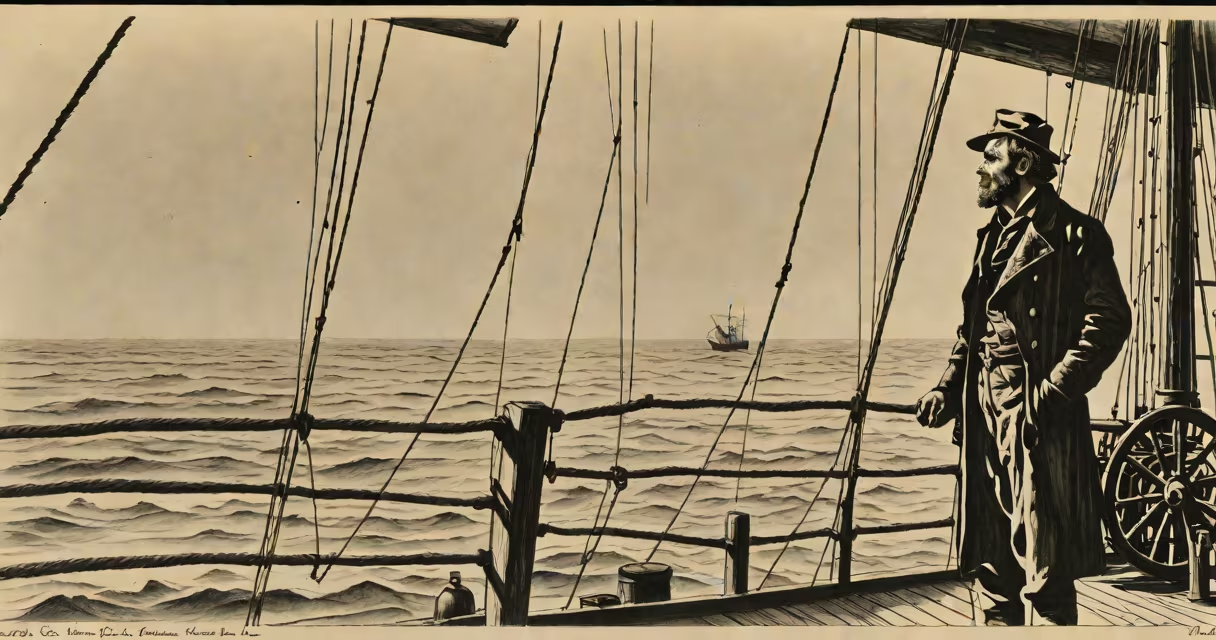
The 1956 film adaptation of Herman Melville's 1851 novel Moby Dick is a Technicolor epic directed by John Huston, starring Gregory Peck as Captain Ahab in a visually striking portrayal of obsession, revenge, and the hunt for the white whale.
Based on Melville's complex narrative, the film condenses the novel's philosophical depth into a tightly structured drama centered on Ahab's pursuit of Moby Dick. It was produced during the height of Hollywood's widescreen era, using CinemaScope to capture vast ocean vistas and intense close-ups of Peck's tormented performance. The film's production took place primarily on location in the Pacific Ocean near Hawaii, with real whaling ships used for authenticity.
Despite being a major studio release, the film underperformed at the box office upon initial release. Critics at the time noted its slow pacing and lack of emotional nuance compared to the original novel's introspective style. However, retrospective reviews have praised its visual ambition and Peck's commanding presence. The American Film Institute later included it in its list of "100 Years...100 Movies" as a significant cultural artifact of mid-century American cinema.
The film follows a linear narrative structure derived from the novel's plot but omits much of Melville's layered symbolism and internal monologues. Instead, it relies on visual storytelling and dialogue-heavy scenes to convey Ahab's psychological unraveling. The whale itself appears only briefly, often obscured by fog or water, emphasizing its mythic status rather than its physical reality.
Sound design plays a important role. Composer Bernard Herrmann, known for his work on Hitchcock films, created a dissonant score that underscores Ahab's growing madness. Low brass and sustained strings mirror the relentless pace of the chase, while silence in key moments amplifies tension. For example, during the scene where Ahab confronts the crew before setting sail, the absence of music forces attention onto Peck's delivery of lines like "I'll chase him round the world!"
Technically, the film uses practical effects and miniature models to depict the ship Pequod and the whale. The whale model, built by Industrial Light & Magic's predecessor team, was filmed using motion control rigs to simulate movement through water. These techniques were modern for 1956 and influenced later sea-based epics such as Jaws (1975).
The film features a cast drawn from major American actors of the era. Gregory Peck earned critical acclaim for his portrayal of Ahab, balancing stoicism with simmering rage. His performance was so intense that he reportedly refused to speak off-set during filming to maintain character immersion.
Supporting roles include Richard Basehart as Starbuck, the first mate who opposes Ahab's vendetta, and Robert Ryan as Stubb, the pragmatic harpooner. Their interactions show the tension between duty and fanaticism. The casting of Peck, a leading man known for intellectual roles like in To Kill a Mockingbird, added gravitas to Ahab's descent into obsession.
Production values were high. The film was shot in Technicolor with a 2.35:1 aspect ratio, giving wide shots of the ocean a painterly quality. Locations included Kauai, Hawaii, and the California coast. The use of real whales in some sequences-filmed during a brief window when humpbacks were spotted near the Big Island-added realism, though most whale footage was simulated.
| Element | Detail |
|---|---|
| Director | John Huston |
| Lead Actor | Gregory Peck |
| Release Year | 1956 |
| Runtime | 128 minutes |
| Box Office (1956) | $2.3 million (domestic) |
| Academy Awards | Nominated for Best Art Direction - Set Decoration (color) |
Many viewers assume the 1956 Moby Dick is a faithful reproduction of the novel. This is incorrect. The film cuts over 60% of the book's content, including entire chapters on whaling practices, cetology (whale science), and metaphysical debates. Melville's original text contains 135 chapters; the film covers roughly five key events in chronological order.
A widespread error is attributing the screenplay to Herman Melville himself. He died in 1891, long before film existed. The screenplay was written by Carl Foreman and John Huston, based on Melville's novel. Foreman had previously worked on The Bridge on the River Kwai and brought a military-style rigor to the script's pacing.
Another misconception is that the whale in the film is CGI. It is not. The whale was a mechanical model operated by puppeteers and filmed with forced perspective techniques. Modern audiences unfamiliar with pre-CGI effects may mistake the model's movements for digital animation, but frame-by-frame analysis confirms it was entirely physical.
In the film's climactic scene, Ahab latches onto the whale with a harpoon, dragging himself across the deck as the Pequod capsizes. This sequence was filmed using a full-scale replica of the ship's forecastle, built on a soundstage with hydraulic systems to simulate rolling waves. Peck performed the stunt himself, enduring 14 takes due to the rig's instability. The final shot shows the whale's eye reflected in the water-a detail not in the novel but added for visual impact.
This moment exemplifies how the film prioritizes spectacle over subtlety. In Melville's original, Ahab dies in a dreamlike state, his thoughts drifting toward peace. In the movie, he dies screaming, clinging to the whale's tail. The change reflects 1950s Hollywood's preference for dramatic closure over existential ambiguity.
For comparison, the 1998 film version of Moby Dick, starring Patrick Stewart, used digital effects to render the whale in full detail. The 1956 version remains notable for its restraint-Moby Dick is never fully seen, reinforcing the idea that the whale symbolizes something beyond physical form.
I saw the 1956 Moby Dick at a repertory theater in Portland, Oregon, projected on a 35mm print with visible grain and occasional flicker. The projector's hum blended with Herrmann's score, creating a visceral sense of time travel. When Ahab shouts "God damn the whale!" the audience leaned forward-not because of the line, but because of the weight behind it.
That moment confirmed what scholars have long noted: the film's power lies not in accuracy, but in emotional resonance. It captures the tragedy of obsession better than many modern adaptations that prioritize technical fidelity over human cost.
Today, the 1956 Moby Dick is studied in film schools for its use of visual metaphor and narrative compression. The Library of Congress preserved the original negative in 2003, citing its cultural significance. It remains a touchstone for understanding how literary classics are translated into cinematic form.
For readers seeking deeper insight into the novel's themes, a short overview of what Moby Dick is about explains the symbolic layers and historical context that the film only hints at.