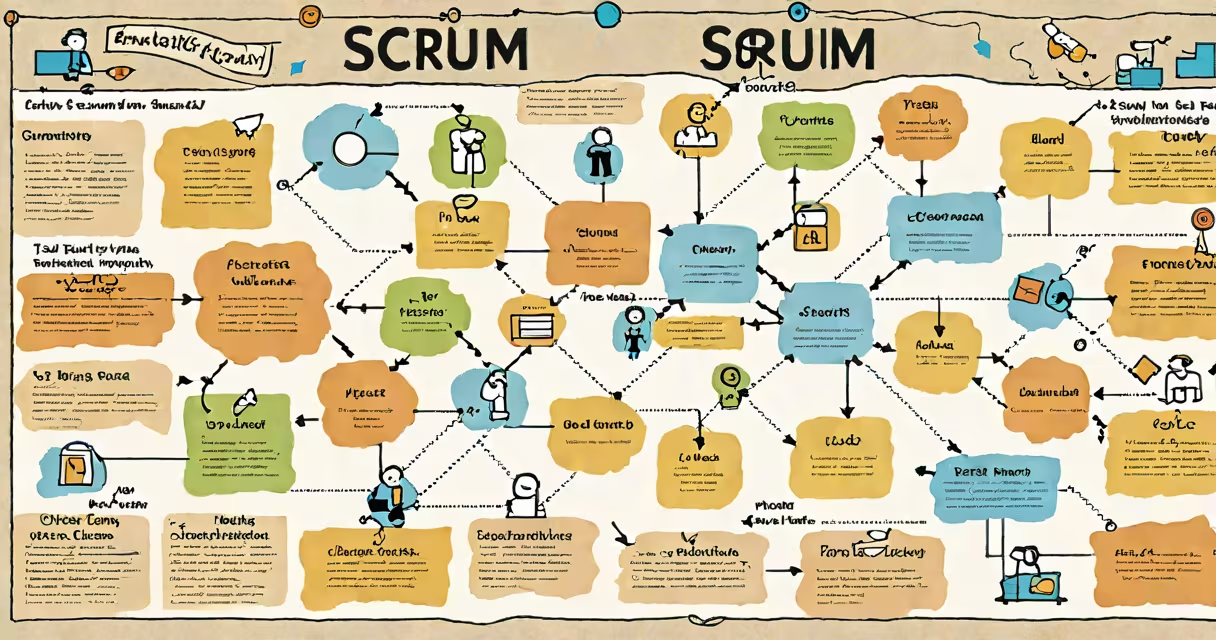
The Scrum Guide 2020 is the official, concise document outlining the structure for managing complex product development. It defines Scrum's roles-Product Owner, Scrum Master, and Development Team-its events such as Sprint Planning and Daily Stand-up, its artifacts including the Product Backlog and Sprint Backlog, and the rules governing their interaction. This version, published by Ken Schwaber and Jeff Sutherland, serves as the definitive reference for implementing Scrum.
Scrum operates through time-boxed iterations called Sprints, typically lasting two to four weeks. Each Sprint begins with Sprint Planning, where the team selects work from the Product Backlog to commit to completing. During the Sprint, the Development Team holds a Daily Stand-up-15 minutes max-to synchronize progress. The Sprint ends with a Sprint Review, where the team demonstrates completed work to stakeholders, and a Sprint Retrospective, where they reflect on process improvements.
Each event is time-boxed. For example, Sprint Planning is limited to eight hours for a one-month Sprint. The Product Owner prioritizes the Product Backlog based on value. The Scrum Master ensures adherence to Scrum principles and removes impediments. The Development Team delivers potentially shippable increments at the end of each Sprint.
Scrum Guide 2020 emphasizes empirical process control: transparency, inspection, and adaptation. Teams inspect progress and adjust plans regularly. This reduces risk and increases predictability. For example, a software team building a mobile app uses Sprints to deliver features incrementally, allowing early feedback and course correction.
Scrum consists of three roles, five events, and three artifacts. The Product Owner manages the Product Backlog-prioritized items representing desired functionality. They ensure the backlog reflects business value and stakeholder needs. The Scrum Master facilitates Scrum processes, coaches the team on self-organization, and shields the team from external interference. The Development Team-a cross-functional group of 3-9 members-designs, builds, and tests the product.
Events include Sprint Planning, Daily Stand-up, Sprint Review, Sprint Retrospective, and the Sprint itself. These are all time-boxed. The Sprint Review must occur at the end of each Sprint. The Sprint Retrospective happens immediately after. The Daily Stand-up is held daily during the Sprint.
Artifacts are the Product Backlog, Sprint Backlog, and Increment. The Product Backlog contains all desired features, enhancements, and fixes. The Sprint Backlog is a forecast of work selected for the current Sprint. The Increment is the sum of all completed Product Backlog items from the current and previous Sprints, forming a potentially releasable product.
| Component | Role/Event/Artifact | Primary Purpose | Time Box |
|---|---|---|---|
| Role | Product Owner | Maximize product value by prioritizing the backlog | N/A |
| Role | Scrum Master | Ensure Scrum is understood and enacted; remove impediments | N/A |
| Role | Development Team | Deliver potentially shippable product increments | N/A |
| Event | Sprint Planning | Determine what to build in the upcoming Sprint | 8 hours for a 4-week Sprint |
| Event | Daily Stand-up | Sync daily progress and plan next steps | 15 minutes |
| Event | Sprint Review | Show completed work to stakeholders | 4 hours for a 4-week Sprint |
| Event | Sprint Retrospective | Reflect on process and improve | 3 hours for a 4-week Sprint |
| Artifact | Product Backlog | Changing list of requirements, prioritized by value | Continuously updated |
| Artifact | Sprint Backlog | Forecast of work to be done in the Sprint | Updated daily |
| Artifact | Increment | Sum of all completed Product Backlog items from past Sprints | Delivered at end of each Sprint |
Scrum Guide 2020 is used by software teams, product managers, and project leaders in tech, finance, healthcare, and education. It enables organizations to respond quickly to changing requirements. A fintech startup used Scrum to release a new payment feature every two weeks. After six Sprints, they had a working prototype validated by users, reducing time-to-market by 40% compared to waterfall planning.
Scrum is not limited to software. A university research team applied Scrum to manage a multi-year study on climate change impacts. They used biweekly Sprints to analyze data, update models, and publish findings. The Scrum Master helped resolve scheduling conflicts between departments. Results were delivered faster and adapted to emerging data.
Organizations adopt Scrum Guide 2020 because it provides clarity. It avoids ambiguity in roles and responsibilities. For example, the Product Owner owns the backlog and makes trade-off decisions. The Scrum Master is not a project manager but a servant-leader focused on team health and process integrity.
Many mistake Scrum as a methodology or process template. Scrum Guide 2020 clarifies it is a structure. It prescribes roles, events, and artifacts but does not dictate how to implement them. Teams adapt tools and practices within the structure. For example, a team may use Jira for backlog management or Zoom for Daily Stand-ups-but the structure remains unchanged.
Another error is assuming the Scrum Master is responsible for task assignment. The Scrum Guide 2020 states the Development Team self-organizes. The Scrum Master supports autonomy, not direction. A team I observed in a healthcare IT project initially expected the Scrum Master to assign tasks. After training, they began planning their own work during Sprint Planning, improving accountability and morale.
Some believe Scrum requires daily stand-ups regardless of team size. The guide specifies the Daily Stand-up is optional for teams under five people. However, most teams still hold it to maintain alignment. The rule is not absolute-it depends on context. The structure allows flexibility within constraints.
A SaaS company developing a customer support dashboard used Scrum Guide 2020 to structure their work. The Product Owner maintained a backlog with 47 items, prioritized by customer feedback. The team chose 12 items for Sprint 1, including "add ticket tagging" and "export reports."
Sprint Planning lasted four hours. The team broke down tasks into estimates using story points. The Sprint Backlog was updated daily. During the Sprint, the team held 15-minute Daily Stand-ups. On Day 6, a dependency blocked progress. The Scrum Master facilitated a quick meeting with the API team and resolved the issue in 90 minutes.
At the Sprint Review, the team demonstrated the new tagging feature. Stakeholders requested minor UI changes. The Product Owner added those to the backlog. In the Retrospective, the team agreed to reduce meeting time by using asynchronous updates for non-critical issues. The Increment was deployed to staging and passed QA.
This cycle repeated for 10 Sprints. By Sprint 10, the team had shipped 80% of the planned features. User adoption increased by 35% in the following month. The Scrum Guide 2020 provided the structure that enabled consistent delivery and continuous improvement.