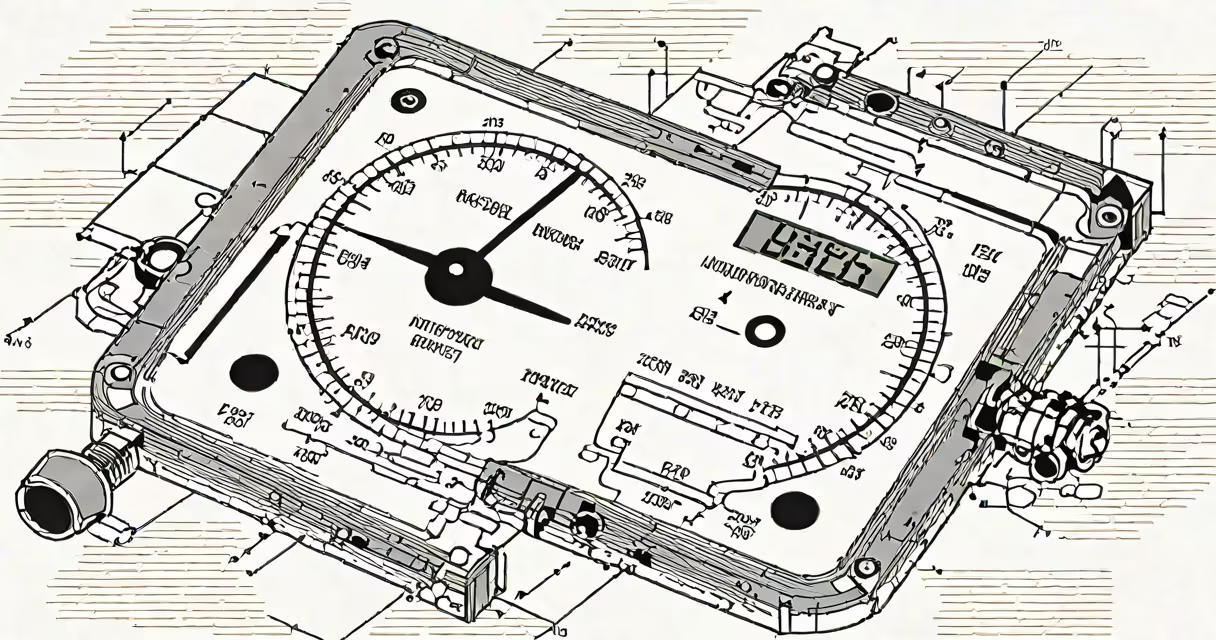
A hygrometer is a device that measures the amount of water vapor in the air or in a material, expressed as relative humidity or dew point. It's essential for monitoring conditions in homes, labs, agriculture, and industrial processes.
Hygrometers work by detecting changes in physical properties caused by moisture. Common methods include measuring electrical resistance, capacitance, or changes in length of a material like human hair. Modern digital models use sensors that respond to humidity with measurable voltage shifts.
The most accurate hygrometers use capacitive sensors, which measure how much charge a dielectric material holds as humidity changes. These are standard in weather stations and HVAC systems. A simple analog version uses a strand of human hair, which expands when moist and contracts when dry-this movement drives a needle on a dial.
Capacitive hygrometers rely on a thin dielectric layer between two conductive plates. As humidity rises, water molecules accumulate in the dielectric, increasing its ability to store electrical charge. The change in capacitance is converted into a humidity reading.
Resistive hygrometers use a salt-based material whose electrical resistance drops as humidity increases. These are less precise but cheaper and used in basic home devices.
Thermal hygrometers measure the cooling effect of evaporation. A wet bulb thermometer cools faster in dry air; the difference between wet and dry bulb temperatures correlates to humidity. This method is used in psychrometers, common in meteorology.
Each type serves different accuracy and application needs. Here's a comparison:
| Type | Principle | Accuracy | Common Use |
|---|---|---|---|
| Capacitive | Dielectric capacitance change | ±2% RH | Weather stations, labs, HVAC |
| Resistive | Resistance drop with moisture | ±5% RH | Home weather monitors, basic sensors |
| Hair-based | Length change in human hair | ±10% RH | Historical instruments, vintage displays |
| Psychrometric | Difference between wet and dry bulb temps | ±3% RH | Meteorology, industrial process control |
Capacitive sensors dominate modern applications due to stability and precision. Resistive types are often found in budget consumer devices. Hair-based models are rare today but still used in museum exhibits to show historical measurement techniques.
Psychrometers remain in use where calibration is critical. They require two thermometers-one dry, one with a damp wick-and calculate humidity using a lookup table based on temperature differential.
Relative humidity above 60% promotes mold growth in homes. Below 30%, static electricity increases and skin dries out. In greenhouses, optimal humidity ranges from 50% to 70% for plant health.
In manufacturing, humidity affects product quality. For example, paper mills maintain 45%-55% RH to prevent warping during printing. Electronics assembly requires controlled environments below 40% RH to avoid static discharge damage.
During a 2022 study by the National Institute of Standards and Technology (NIST), researchers found that uncontrolled humidity in storage facilities led to a 17% increase in degradation of pharmaceutical compounds. Accurate hygrometers helped reduce spoilage rates by enabling tighter environmental control.
I once installed a network of capacitive hygrometers in a museum archive. Over six months, we detected a 12% rise in indoor humidity during rainy seasons. We adjusted the climate system and prevented mold from forming on 19th-century textiles.
People often confuse hygrometers with thermometers. A thermometer measures temperature only. A hygrometer measures moisture content. Devices combining both are called thermo-hygrometers.
Some assume "dew point" and "relative humidity" are interchangeable. They're not. Relative humidity depends on temperature. Dew point is the actual temperature at which air becomes saturated. At 25°C and 50% RH, dew point is 14°C. If temperature drops below 14°C, condensation forms.
Another mistake: thinking all hygrometers need frequent recalibration. Capacitive sensors drift slowly. Most factory-calibrated units stay accurate for 1-2 years under normal conditions. NIST recommends recalibration every 12 months for lab-grade devices.
For continuous monitoring, data loggers pair with hygrometers. These record readings over time, helping detect trends. A greenhouse operator might use a logger to track daily humidity swings and adjust ventilation automatically.
When choosing a hygrometer, consider your environment. A kitchen with steam may require a model with corrosion-resistant housing. A server room demands high-accuracy sensors with digital outputs for integration into building management systems.
The tool that measures humidity is a hygrometer. It provides data on moisture levels through physical or electronic sensing. Different types suit different needs-capacitive for precision, resistive for cost-effectiveness, and psychrometric for field reliability. Understanding how it works prevents misinterpretation of readings and supports better decisions in health, safety, and performance-critical settings.