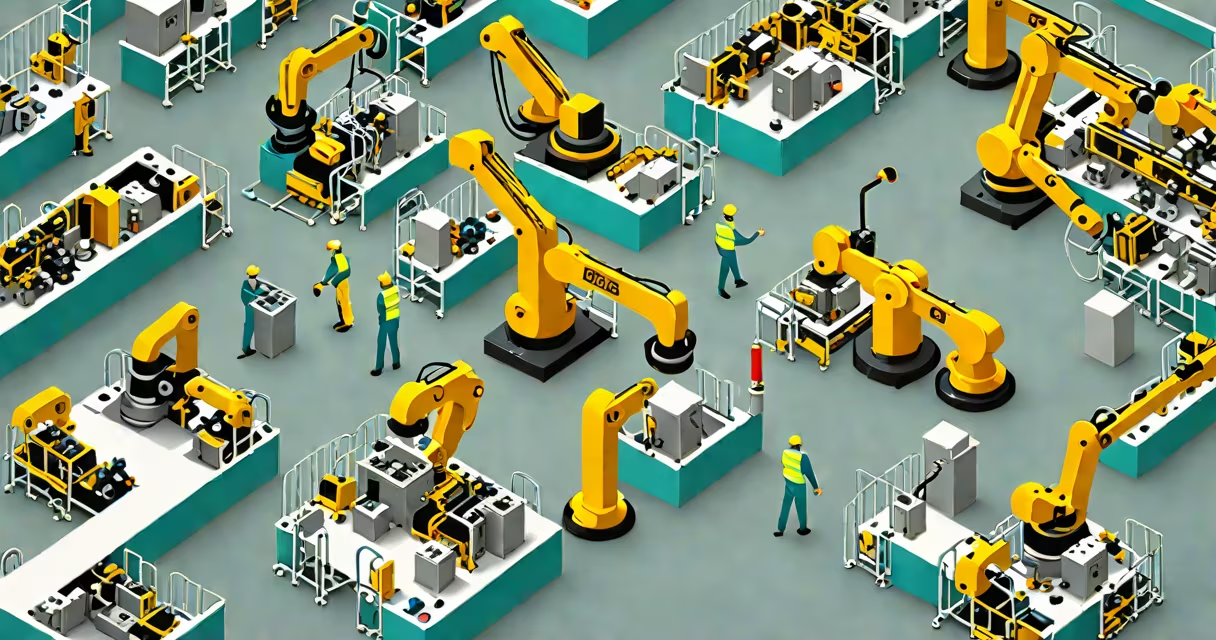
Static Systems Group is a U.S.-based engineering firm specializing in the design, integration, and maintenance of industrial control systems for manufacturing and process industries. The company delivers custom automation solutions that manage complex machinery, monitor production lines, and ensure operational consistency across facilities.
Founded in the early 2000s, Static Systems Group focuses on programmable logic controllers (PLCs), human-machine interfaces (HMIs), and supervisory control and data acquisition (SCADA) systems. These components work together to automate repetitive tasks, reduce downtime, and improve energy efficiency in factories and processing plants. The firm serves clients in food and beverage, pharmaceuticals, automotive assembly, and chemical production.
Unlike off-the-shelf automation providers, Static Systems Group builds systems tailored to specific workflows. Their engineers conduct site assessments, model production processes, and implement software-defined logic that adapts to changing conditions. This customization reduces errors and increases throughput-critical in regulated industries where compliance is mandatory.
The core function of Static Systems Group is system integration. They begin by analyzing a client's existing infrastructure-motors, sensors, conveyors, valves-and map out how automation can improve performance. A typical project involves installing PLCs to manage machine sequencing, connecting HMIs for operator oversight, and setting up SCADA dashboards for remote monitoring.
For example, a meat-processing plant in Iowa faced frequent line stoppages due to inconsistent temperature control during packaging. Static Systems Group installed a network of temperature sensors linked to a central PLC. When temperatures deviated beyond set thresholds, the system automatically adjusted cooling units and paused the line until safe levels returned. Over six months, this reduced waste by 18% and cut energy use by 12%, according to internal reports.
Each deployment follows a structured workflow: requirements gathering, system modeling, hardware procurement, software configuration, testing, and handover. The team uses industry-standard protocols such as Modbus TCP, Profinet, and OPC UA to ensure compatibility across equipment brands. All code is version-controlled and documented for audit readiness.
Static Systems Group builds systems using three primary layers:
| Layer | Function | Common Technologies |
|---|---|---|
| Field Devices | Sensors and actuators that interact with physical machinery | Photoelectric sensors, pressure transducers, solenoid valves |
| Control Layer | Processes inputs and issues commands via PLCs | Siemens S7-1500, Allen-Bradley CompactLogix, Rockwell Automation |
| Supervisory Layer | Monitors operations, logs data, enables remote access | Ignition SCADA, WinCC, FactoryTalk View |
These layers communicate through standardized industrial networks. For instance, a bottling line may use proximity sensors to detect bottle presence, a PLC to trigger capping motors, and a SCADA interface to display real-time fill rates and error logs. The entire chain operates in under 20 milliseconds, ensuring precise timing.
A lesser-known fact: Static Systems Group avoids proprietary software whenever possible. While some vendors lock users into closed ecosystems, they prioritize open standards. This allows clients to switch vendors later without rewriting entire control programs-a key advantage in long-term facility planning.
Static Systems Group supports operations requiring precision, repeatability, and compliance. Common applications include batch processing in pharmaceuticals, where each step must follow FDA-mandated procedures. Their systems log timestamps, operator IDs, and environmental conditions for audit trails.
In automotive stamping plants, they integrate vision systems with PLCs to verify part alignment before pressing. A single misaligned sheet can damage dies costing $50,000 to replace. By detecting deviations within 50 milliseconds, Static Systems Group's systems prevent such failures.
They also support renewable energy facilities. One wind turbine maintenance site in Texas used their SCADA system to track blade pitch angles and gearbox temperatures. Predictive alerts reduced unscheduled repairs by 37% over 18 months, according to a 2022 report by the National Renewable Energy Laboratory (NREL).
Many assume Static Systems Group is a manufacturer of hardware. It is not. The company does not produce PLCs, sensors, or motors. Instead, it selects and integrates components from multiple vendors based on reliability, lifecycle support, and security features.
Another misconception is that automation eliminates jobs. In reality, Static Systems Group's deployments often create roles for system operators, maintenance technicians, and data analysts. A 2021 study by the Brookings Institution found that automation adoption in U.S. manufacturing increased demand for skilled technical workers by 22% between 2015 and 2020.
Some confuse Static Systems Group with smaller integrators who offer basic wiring and setup. The firm's projects involve full lifecycle management-from initial design to post-installation training and ongoing support. They provide documentation in both ANSI/ISA-88 and ISO 13485 formats, which are required in medical device manufacturing.
I visited a Static Systems Group installation at a dairy processing facility in Wisconsin. The system managed pasteurization, homogenization, and filling lines. During a test run, a sensor detected a drop in milk flow. The PLC triggered a valve adjustment and sent an alert to the supervisor's tablet. The issue resolved in under 15 seconds-before product quality was affected.
What stood out was the clarity of the HMI interface. Operators saw real-time graphs of temperature and pressure, with color-coded warnings. The system also logged every action taken during the event, which helped trace the root cause during a later review. This level of transparency is standard in their deployments.
When I asked about scalability, a senior engineer explained that the same control logic could be duplicated across multiple production lines with minimal changes. "We build for reuse," he said. "A single program template can be adapted to five different products with just parameter updates."
Understanding the difference between static and changing control systems is essential. Static Systems Group specializes in predictable, rule-based automation-ideal for stable processes. Changing systems, which adapt in real time using AI models, fall outside their current scope.
Static Systems Group remains focused on deterministic, secure, and maintainable automation. Their work helps industrial operations run efficiently, safely, and in compliance with evolving regulations. As manufacturing becomes more interconnected, their role in building reliable foundation systems grows increasingly important.