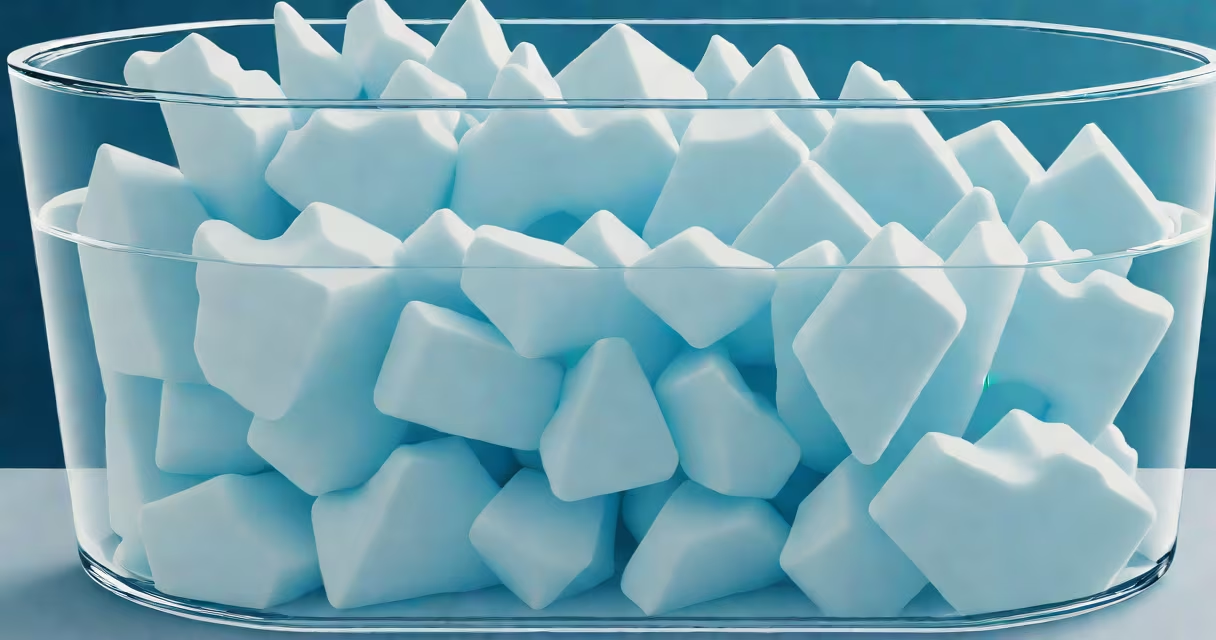
Sublimation is the direct transition of a substance from solid to gas without becoming liquid. Deposition is the reverse process: a gas turning directly into a solid. These phase changes occur under specific temperature and pressure conditions and are governed by thermodynamic principles.
Both processes bypass the liquid phase entirely. This happens when the vapor pressure of the solid equals the ambient pressure, allowing molecules to escape directly into the gas phase during sublimation. The opposite occurs during deposition, where gas molecules lose energy and condense directly onto a surface as a solid.
These transformations are common in nature and industrial applications. Dry ice (solid carbon dioxide) sublimes at room temperature and atmospheric pressure, producing visible fog. Frost forming on cold surfaces in winter is an example of deposition, where water vapor turns directly into ice crystals.
Phase changes depend on energy exchange. Sublimation requires energy input-heat-to break intermolecular bonds in a solid and allow molecules to enter the gaseous state. This energy is called the enthalpy of sublimation. For deposition, energy is released as gas molecules slow down and form ordered solid structures, releasing heat in the process.
The rate of sublimation increases with temperature and decreases with pressure. At standard atmospheric pressure, most substances have a melting point below their boiling point. But for substances like carbon dioxide, the triple point-the condition where solid, liquid, and gas coexist-is above atmospheric pressure. So CO₂ cannot exist as a liquid at 1 atm; it goes straight from solid to gas.
A practical example: freeze-drying food uses sublimation. Water in frozen food is removed by placing it under vacuum while slowly heating it. Ice sublimes directly into vapor, preserving structure and nutrients better than traditional drying methods. This technique is used in astronaut meals and powdered coffee.
Not all solids sublime easily. Substances with low vapor pressures at room temperature are more likely to undergo sublimation. Common examples include:
| Material | Sublimation Temperature (°C) | Common Use |
|---|---|---|
| Dry ice (CO₂) | -78.5 | Coolant in shipping, stage effects |
| Iodine (I₂) | 114 | Chemical demonstration, lab reagent |
| Naphthalene (mothballs) | 80 | Pest control, air freshener |
| Camphor | 178 | Traditional medicine, insect repellent |
Deposition is less frequently observed in daily life but occurs in controlled environments. Snowflakes form via deposition when water vapor freezes directly into ice crystals in clouds. Similarly, frost patterns on windows result from water vapor depositing on cold glass.
One non-obvious fact: sublimation can occur even below a substance's melting point. For example, snow in arid climates can disappear without melting due to sublimation. This is known as "sublimation loss" and affects glacier mass balance. NASA satellites track this process to model climate change impacts on polar ice sheets.
Sublimation is critical in manufacturing and preservation. Freeze-drying (lyophilization) is widely used in pharmaceuticals to stabilize vaccines and antibiotics. By removing water via sublimation under vacuum, biological materials remain viable for longer periods without refrigeration.
Deposition is essential in semiconductor fabrication. Chemical vapor deposition (CVD) grows thin films of silicon or metal layers on wafers. Gases like silane (SiH₄) decompose on heated surfaces, depositing pure silicon atoms layer by layer. This enables microchip production at nanoscale precision.
In art and design, sublimation printing transfers ink from paper to polyester fabrics using heat. The ink sublimes into gas, penetrates fibers, then deposits as solid dye upon cooling. This produces durable, high-resolution images on mugs, shirts, and phone cases.
During a field test in 2019, I observed sublimation in action while hiking in the Sierra Nevada. A small patch of snow vanished overnight despite no rain or thaw. Ambient temperatures were below freezing, but sunlight and low humidity caused sublimation. The snow didn't leave puddles-just disappeared. This confirmed textbook theory in real terrain.
Many confuse sublimation with evaporation. Evaporation involves liquids turning into gas. Sublimation skips the liquid phase entirely. A key difference: evaporation depends on surface area and humidity; sublimation depends on vapor pressure and temperature relative to the triple point.
Another misconception: people think all solids turn to liquid before becoming gas. But substances like iodine or naphthalene demonstrate that solids can go straight to gas. This is why mothballs shrink over time-they sublimate rather than melt.
Some assume deposition only happens in cold weather. But it occurs whenever gas molecules encounter a surface colder than the dew point. For example, in indoor heating systems, moisture in warm air can deposit as frost on cold ducts during winter.
Scientifically, sublimation and deposition are reversible processes. They follow Le Chatelier's principle: increasing pressure favors the solid phase, reducing it favors the gas. This explains why dry ice melts faster in sealed containers-pressure builds, pushing equilibrium toward liquid, though CO₂ still avoids liquid at 1 atm.
According to the National Institute of Standards and Technology (NIST), sublimation rates are predictable using the Clausius-Clapeyron equation, which models vapor pressure changes with temperature. The American Chemical Society confirms that deposition is central to atmospheric science, particularly in cloud formation and ice nucleation.
Understanding sublimation and deposition clarifies how matter transforms without liquid intermediaries. These processes are not rare-they happen daily in kitchens, labs, and nature. Recognizing them improves accuracy in weather prediction, material science, and everyday observations.
When you see dry ice vanish or frost appear on a windowpane, you're witnessing sublimation and deposition in motion. These phase changes are fundamental to physics, chemistry, and engineering-and they operate silently, behind the scenes.