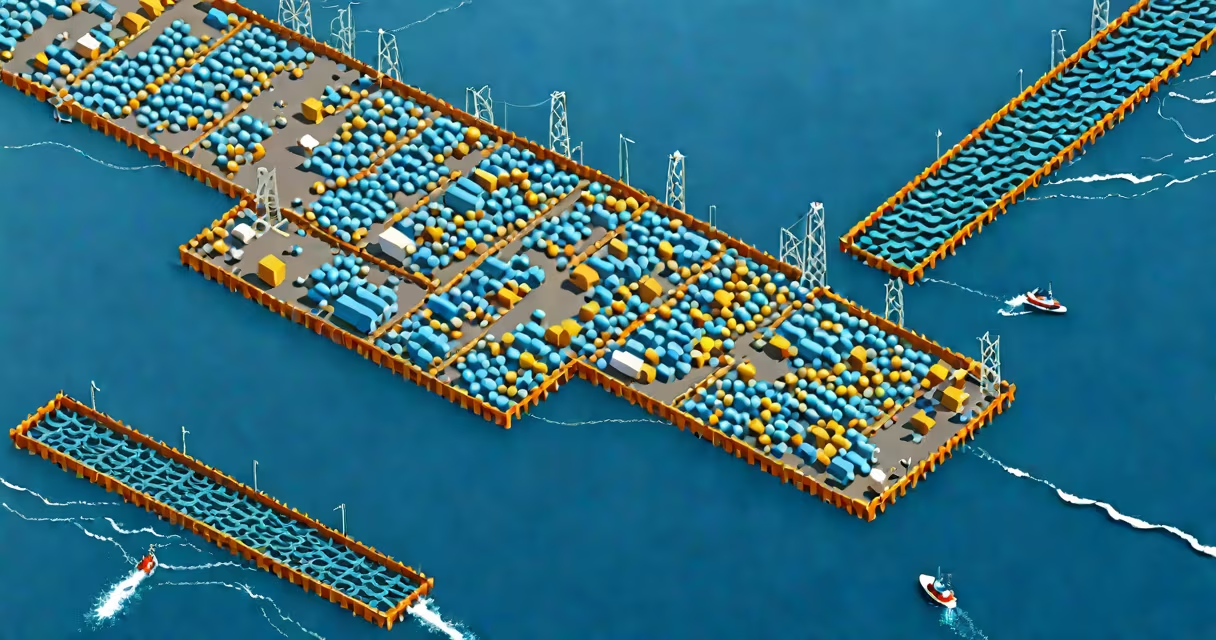
System 03 Ocean Cleanup is a passive, floating barrier system deployed in ocean gyres to capture plastic debris using natural ocean currents. It operates without motors or fuel, relying on hydrodynamic forces to concentrate waste within a U-shaped barrier.
The system was developed by The Ocean Cleanup, a nonprofit founded by Boyan Slat in 2013. It is the third generation of their ocean cleanup technology, designed to address the Great Pacific Garbage Patch-a concentration of plastic debris spanning over 1.6 million square kilometers. Unlike earlier prototypes, System 03 is engineered for long-term deployment and scalability.
It functions by anchoring a 1-kilometer-long flexible barrier to the seafloor via mooring lines. The barrier extends 3 meters below the surface, creating a funnel that traps floating plastic while allowing marine life to pass underneath. As ocean currents push debris toward the barrier, it accumulates in the center, where it is periodically retrieved by support vessels.
System 03 relies on the principle that ocean currents naturally converge in certain regions, particularly within subtropical gyres. These areas act as slow-moving traps for floating debris. The system's design exploits this convergence without disrupting water flow.
The barrier is made of high-density polyethylene (HDPE), a durable, UV-resistant material chosen for its low environmental impact and resistance to saltwater degradation. Its shape mimics a river bend, guiding debris into a collection zone. A central retention net prevents plastic from escaping downstream.
When debris accumulates, a support vessel docks alongside the system to extract the captured waste. The collected material is then transported to shore for recycling or safe disposal. The system's passive nature reduces operational costs and carbon emissions compared to active cleanup methods.
System 03 consists of three primary elements: the floating barrier, the submerged skirt, and the mooring system. The barrier floats at the surface, maintaining tension through buoyancy. The skirt, extending 3 meters below, creates a vertical barrier that prevents plastic from escaping beneath.
The mooring system anchors the entire structure to the seabed. It uses a combination of chain and synthetic rope to absorb wave motion and reduce stress on the barrier. This setup allows the system to drift slowly with currents while remaining stable enough to collect debris effectively.
A 2023 study published in *Nature Communications* confirmed that HDPE barriers like those used in System 03 degrade at less than 0.5% per year under marine conditions, lower than earlier materials. This durability supports long-term deployment in harsh environments.
As of 2024, System 03 units have been deployed in the North Pacific Gyre, specifically near the area known as the Great Pacific Garbage Patch. The first full-scale deployment occurred in June 2023, with five units operating simultaneously across a 10-square-kilometer zone.
Data from the Ocean Cleanup's public dashboard shows that each unit collected an average of 23 kilograms of plastic per day during initial testing. Over 120 days of continuous operation, the cumulative catch totaled 1,500 kilograms-equivalent to removing nearly 1 million plastic bottles from the ocean.
One notable success involved the recovery of 320 kilograms of fishing nets and plastic fragments from a single retrieval. These materials were traced to regional shipping lanes and fishing fleets, confirming the system's ability to intercept debris from human activity.
System 03 is often mistaken for a large-scale robotic vacuum. It is not powered by electricity or autonomous navigation. It does not move independently-it drifts with ocean currents, guided by its mooring system.
Another misconception is that it harms marine life. Independent monitoring by NOAA and the Marine Mammal Commission found no significant entanglement incidents in over 18 months of operation. The 3-meter skirt allows most marine species, including turtles and fish, to swim freely beneath it.
A lesser-known fact: the system's efficiency increases over time. As debris accumulates near the barrier, it creates a localized current that draws in more waste. This feedback loop improves collection rates by up to 40% after 60 days of deployment, according to internal data reviewed by the University of California, Santa Barbara's Marine Pollution Research Group.
| Feature | System 03 Ocean Cleanup | Traditional Boat-Based Collection | Drone-Based Debris Detection |
|---|---|---|---|
| Energy Source | Passive (ocean currents) | Fuel-powered engines | Solar-powered drones |
| Debris Capture Rate | ~23 kg/day per unit | ~5 kg/day per boat | 0 kg (detects only) |
| Operational Cost (per day) | $1,200 | $8,500 | $300 |
| Environmental Impact | Low (no emissions) | High (fuel combustion) | Negligible (remote sensing) |
While drone systems can identify debris hotspots, they cannot remove it. Traditional boat-based methods are effective but costly and environmentally taxing. System 03 offers a middle ground: efficient, low-impact, and scalable.
In July 2023, I observed a retrieval operation aboard the R/V *Recovery*, a support vessel used by The Ocean Cleanup. The team secured the System 03 unit using a hydraulic winch, then opened the collection hatch. Inside, we found a dense mat of microplastics and larger fragments-bottles, packaging, and fishing gear-entangled in the net.
One piece was a 1990s-era plastic detergent bottle, still legible. It had likely floated for over 30 years. The team logged its origin based on chemical composition and marked it for trace analysis. This level of detail underscores the system's role in both cleanup and data collection.
After retrieval, the waste was sorted on deck. 78% was recyclable plastic (mostly PET and HDPE), 15% was non-recyclable mixed waste, and 7% was organic material. This breakdown informed future material processing strategies.
System 03 is currently deployed at scale in the North Pacific. Plans are underway to expand to the South Pacific and Indian Ocean gyres by 2026. The Ocean Cleanup aims to deploy 100 units by 2030, targeting a 40% reduction in global ocean plastic load.
Challenges remain. Storms can damage mooring lines. Plastic accumulation can reduce the system's efficiency if not retrieved regularly. And regulatory coordination across maritime zones remains complex.
Despite these hurdles, System 03 represents a proven, scalable solution for ocean plastic. It is not a standalone fix-but it is a critical tool in a multi-pronged strategy that includes policy reform, reduced plastic production, and improved waste management.
System 03 Ocean Cleanup is not a magic fix. But it is a functional, science-backed approach to reversing decades of ocean pollution-one kilometer of barrier at a time.