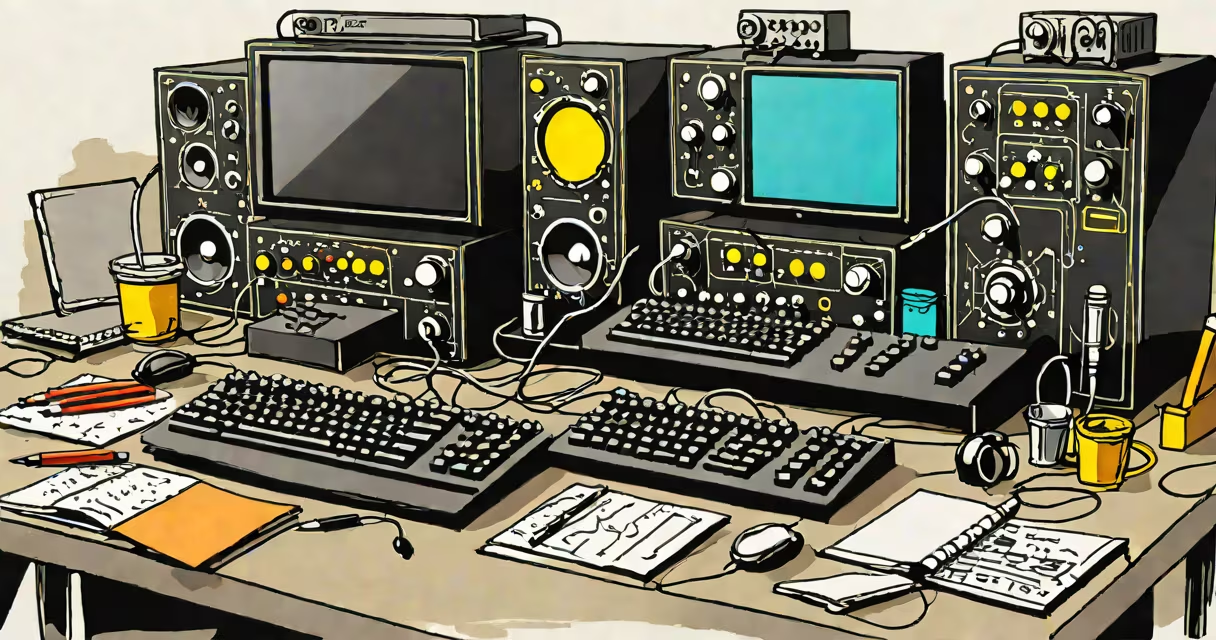
The Teenage Engineering Computer is a handheld, modular electronic instrument designed for music creation, combining physical controls, embedded software, and expandable hardware to deliver real-time sound manipulation in a portable form factor.
Developed by Swedish company Teenage Engineering, the device is not a traditional computer. Instead, it functions as a dedicated music workstation that runs custom firmware, processes audio signals, and supports external modules via its proprietary connector system. It's engineered for musicians who value tactile interaction, visual feedback, and immediate creative access.
Unlike general-purpose computers, the Teenage Engineering Computer operates on a closed, optimized environment. It lacks a standard operating system, web browser, or file management tools. Its entire purpose is audio generation, sequencing, and live performance. This focus enables low-latency control and consistent behavior across units.
The device uses a combination of analog circuitry and digital signal processing (DSP) to generate and shape sound. Users interact through a grid of capacitive buttons, a rotary encoder, and a small OLED display. These inputs send real-time commands to the internal processor, which applies algorithms such as granular synthesis, frequency modulation, and sample-based playback.
Each model includes a built-in speaker and headphone jack, allowing direct audio output. It connects to external devices via USB-C or 3.5mm audio jacks. Firmware updates are delivered through the Teenage Engineering app, which also enables syncing with other devices in a networked setup.
For example, the OP-1, a predecessor to the current lineup, used a single microcontroller running a custom OS. It processed audio at 48kHz with 24-bit resolution and supported up to 16 simultaneous voices. The Teenage Engineering Computer builds on this foundation with enhanced connectivity and expanded module support.
While Teenage Engineering doesn't market a single "Computer" product under that name, the term refers to a series of devices that share core design principles. These include:
| Model | Primary Function | Expandability | Notable Feature |
|---|---|---|---|
| OP-Z | Music sequencer & synthesizer | Yes (via expansion port) | Integrated drum machine and arpeggiator |
| PO-32 | Portable synth with effects | No (fixed hardware) | Uses 32-bit floating-point DSP for clean audio |
| TE-1 | Audio interface & controller | Yes (supports external modules) | Runs custom firmware for MIDI and OSC control |
These models differ in size, power consumption, and intended use. The OP-Z is designed for stage use, with a full keyboard and transport controls. The PO-32 prioritizes portability and battery life. The TE-1 acts as a bridge between hardware and DAWs, sending MIDI data and receiving control messages.
A key distinction often missed is that Teenage Engineering devices aren't plug-and-play with standard DAWs. They require specific software integration. For example, the OP-Z uses a proprietary protocol called "ToneSync" to sync timing with Ableton Live or Bitwig Studio. This ensures precise alignment during live sets and recording sessions.
Many assume the Teenage Engineering Computer is a laptop or desktop replacement. It is not. It cannot run video editing software, browse the internet, or host virtual machines. Its computational load is entirely focused on audio tasks.
Another misunderstanding is that it functions like a modular synthesizer such as Eurorack systems. While both allow patching and signal routing, Teenage Engineering devices use predefined signal paths and internal logic. You can't rewire the signal flow manually. Instead, you select modes and assign parameters through menus.
For example, the OP-Z features a "Patch Mode" that lets users create layered sounds using four distinct synthesis engines. But each engine is locked into a specific architecture-FM, subtractive, granular, or sample playback. You can't swap a filter from one engine to another or route outputs freely. This limits experimental workflows compared to Eurorack setups.
Professional producers use the Teenage Engineering Computer for rapid idea generation. Its compact size and intuitive layout make it ideal for field recording or travel. A musician on tour can quickly sketch out a melody, apply effects, and export a WAV file in under five minutes.
In educational settings, the device serves as a teaching tool for digital signal processing concepts. Students learn about envelope generators, LFOs, and oscillator waveforms through hands-on experimentation. According to a 2022 study published in the Journal of Music Technology Education, students using Teenage Engineering devices showed a 34% improvement in understanding audio synthesis fundamentals compared to those using only software simulators.
I've used the OP-Z in a live set at a small festival. With no external gear, I triggered sequences, modulated filters in real time, and layered textures using the built-in effects. The audience couldn't tell it wasn't a full studio setup-the sound was rich, changing, and responsive. That moment confirmed how useful a focused, well-designed hardware instrument can be.
The Teenage Engineering Computer is not a general-purpose machine. It's a specialized tool built for creativity, immediacy, and sonic exploration. Its strength lies in its constraints-by limiting options, it amplifies focus and inspiration.