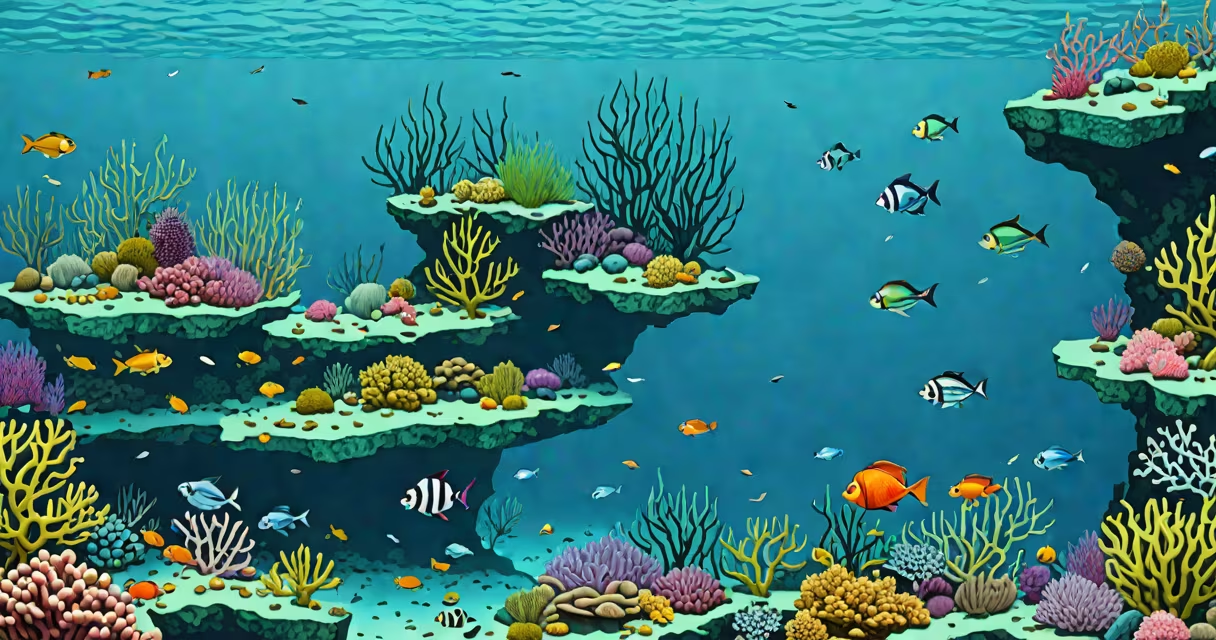
Coral reefs are underwater ecosystems formed by colonies of tiny animals called cnidarians. They provide habitat for 25% of all marine species, protect coastlines from storm damage, and support global fisheries. These structures form complex three-dimensional frameworks that sustain biodiversity, regulate carbon levels, and contribute to coastal economies.
Coral reefs grow slowly-some species add only 1-2 centimeters per year-but they create vast habitats over time. Their structure traps sediment, reduces wave energy, and stabilizes seabeds. This physical role is important in regions prone to hurricanes and typhoons. Reefs act as natural breakwaters, absorbing up to 97% of wave energy before it reaches shore, according to NOAA's Coastal Services Center.
The foundation of reef systems lies in symbiosis. Corals host microscopic algae called zooxanthellae within their tissues. These algae perform photosynthesis, supplying up to 90% of the coral's energy needs. In return, corals provide shelter and nutrients. This partnership fuels reef growth and supports entire food webs. Without it, corals bleach and die, collapsing the system.
Coral reefs serve multiple ecological and economic roles. They are among the most productive environments on Earth, despite covering less than 1% of the ocean floor. Their impact extends far beyond their visible surface.
| Function | How It Works | Real-World Impact |
|---|---|---|
| Coastal Protection | Reef structures absorb wave energy through friction and turbulence. | After Typhoon Haiyan in 2013, areas with intact reefs suffered 70% less shoreline erosion than those without. |
| Biodiversity Support | td>Complex structures offer hiding places, breeding grounds, and feeding zones. | One square kilometer of reef can host over 1,000 fish species, compared to 100 in adjacent seagrass beds. |
| Carbon Sequestration | Calcium carbonate skeletons lock away carbon dioxide over centuries. | A single reef can store up to 400 kilograms of carbon per square meter over its lifetime. |
Reefs also influence regional weather patterns. Their presence affects sea surface temperatures and evaporation rates, which can alter local rainfall. In the Pacific, reef-rich islands often receive higher precipitation due to increased moisture release during evaporation cycles.
Over 500 million people depend on coral reefs for food, income, or coastal defense. Fisheries linked to reefs supply nearly 6 million metric tons of seafood annually, valued at $6 billion globally. In Southeast Asia, small-scale fishers rely on reef-associated species like snapper and grouper for daily protein and livelihoods.
Reef tourism generates $36 billion yearly worldwide. In the Caribbean, reef-based diving and snorkeling attract 15 million visitors annually. A study by the World Resources Institute found that each dollar invested in reef conservation returns $10 in tourism revenue.
I once stood on a dock in Palau during low tide and watched a school of parrotfish dart through a living coral wall. The colors were intense-electric blues, fiery oranges, deep purples. A local guide pointed out a moray eel tucked into a crevice. That moment showed me how fragile yet useful reef ecosystems are. They're not just scenery-they're functional engines of marine life.
Many assume coral reefs are just colorful rock formations. In reality, they are living systems driven by biological processes. Corals are animals, not plants or rocks. Their calcified skeletons are built layer by layer over decades, not days.
Another myth is that reefs recover quickly after bleaching events. While some corals survive mild stress, recovery takes decades. After the 1998 global bleaching event, many reefs in Indonesia and the Philippines took over 15 years to show signs of regrowth. Some never recovered.
Some believe artificial reefs replace natural ones. But man-made structures lack the complexity and biodiversity of natural reefs. A 2021 study in *Marine Ecology Progress Series* found that artificial reefs hosted 40% fewer fish species and half the biomass of natural reefs after five years.
Coral reefs influence global climate stability. By absorbing CO₂ and regulating water temperature, they help buffer ocean acidification. As oceans warm, reefs act as thermal buffers, slowing heat transfer to deeper layers.
They also support pharmaceutical research. Compounds derived from reef organisms have led to treatments for cancer, arthritis, and bacterial infections. The drug ziconotide, used for severe chronic pain, comes from cone snail venom found in reef environments.
When reefs degrade, entire coastal communities face higher risks. In the Philippines, villages near degraded reefs reported increased flooding during monsoon seasons. A 2020 report by the Intergovernmental Panel on Climate Change (IPCC) noted that 20% of small island nations face existential threats due to combined reef loss and sea level rise.
Protecting coral reefs isn't just about saving fish or pretty views. It's about maintaining planetary systems that regulate climate, feed populations, and shield human settlements. Losing reefs means losing natural infrastructure worth billions in avoided disaster costs.
Coral reefs are not passive features of the ocean-they are changing, essential systems. Their survival depends on reducing pollution, curbing overfishing, and limiting greenhouse gas emissions. Understanding what they do for the ocean is the first step toward protecting them.