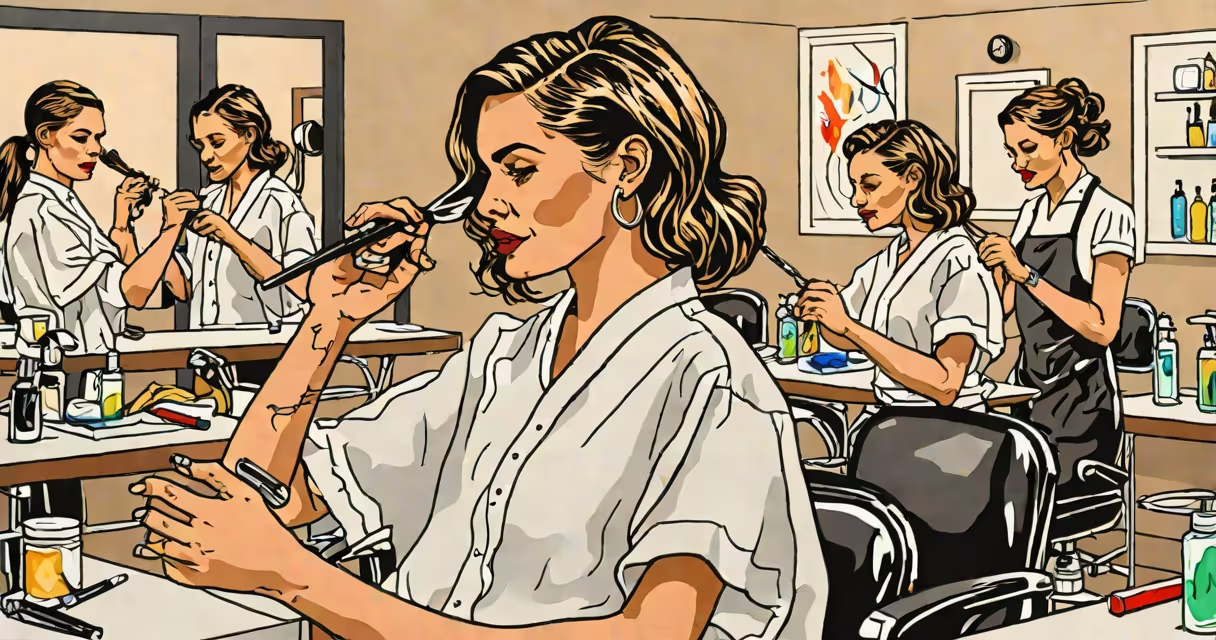
What courses are required for cosmetology depends on state regulations, but most programs require a minimum of 1,000 hours of instruction in hair, skin, and nail care, including hands-on practice and theory. These courses prepare students for state licensing exams and entry into the beauty industry.
Cosmetology programs are structured around state-mandated hour requirements. For example, California requires 1,600 hours of training, while Texas mandates 1,000 hours. The difference stems from state board standards, not national guidelines. All states require practical skill demonstrations and written exams covering safety, sanitation, and client consultation.
Students must complete coursework in anatomy and physiology related to skin and hair, chemical processes like perms and relaxers, and business practices such as scheduling and client management. Programs often include modules on ethics, state laws, and salon operations. Failure to meet hour thresholds results in exam ineligibility.
Most cosmetology programs divide training into four major areas: hair, skin, nails, and business. Each area includes both theoretical study and supervised practice. The distribution varies by state, but typical allocations are:
| Subject Area | Avg. Hours (US) | Key Topics Covered |
|---|---|---|
| Hair | 500-600 | Styling, cutting, coloring, chemical treatments, scalp health |
| Skin Care | 200-300 | Facials, acne treatment, skin analysis, product selection |
| Nails | 100-150 | Manicures, pedicures, gel application, nail health |
| Business & Ethics | 50-100 | Client relations, hygiene protocols, legal liability, record keeping |
These hour ranges reflect data from the National-Interstate Council of State Boards of Cosmetology (NIC). The NIC sets model standards adopted by many states, though individual boards may adjust requirements. For instance, New York's program includes 200 hours of skin care, exceeding the average due to stricter dermatological training rules.
Hands-on practice constitutes 60-70% of total time. Students apply techniques on mannequins and live clients under supervision. A student in a Florida program must perform 150 haircuts on real clients during training, documented in a logbook reviewed by instructors.
Licensing exams differ by state. Most use the NIC's written and practical exams, but some states, like Washington, administer their own tests. The written exam covers safety, sanitation, and state-specific laws. In California, the test includes 120 multiple-choice questions, with a passing score of 75%.
The practical exam assesses real-world skills. Candidates must demonstrate a full hairstyle, facial treatment, and manicure within a timed session. Evaluators grade based on precision, sanitation, and client communication. A candidate in Illinois failed the practical exam twice due to improper disinfection of tools between clients-a violation of state rule 1200.25.
Some states allow credit for prior experience. Oregon permits veterans with military cosmetology training to waive up to 300 hours if they pass a competency assessment. However, all applicants must still complete the remaining hours and pass the exam.
Many assume that online-only courses qualify for licensure. This is false. The U.S. Department of Labor's Bureau of Labor Statistics confirms that all state boards require in-person, supervised training. Online modules may supplement learning but cannot replace hands-on instruction.
Another misconception is that "esthetician" and "cosmetologist" are interchangeable. They are not. Estheticians focus on skin care and typically require fewer hours-around 600 in most states. Cosmetologists include hair, skin, and nails and must complete more training. A student in Colorado who enrolled in an esthetician program was denied a job at a spa requiring full cosmetology certification.
Non-obvious fact: Some states offer accelerated programs. Nevada allows students to complete 1,000 hours in 12 months through a compressed schedule, but only at accredited schools approved by the Nevada Board of Cosmetology. Accelerated programs do not reduce content depth-they compress delivery.
Consider Maria, a 22-year-old from Georgia. She enrolled in a 1,200-hour cosmetology program at a licensed beauty school. Her weekly schedule included:
Over 18 months, she completed:
She passed the Georgia state board exam on her first attempt, scoring 92% on the written portion and earning a perfect score on the practical. Her success relied on consistent lab time and instructor feedback.
After graduation, Maria applied for a position at a high-end salon in Atlanta. The employer verified her license through the Georgia Board of Cosmetology's public database. She began working within two weeks.
Upon finishing required courses, candidates must apply for a state licensing exam. Fees range from $75 to $200 depending on the state. Once licensed, professionals must renew every two years and complete continuing education credits-typically 10-20 hours per cycle.
What courses are required for cosmetology is not a single answer-it's a structure shaped by state law, school accreditation, and practical outcome. Understanding the specific requirements in your jurisdiction ensures eligibility and career readiness.