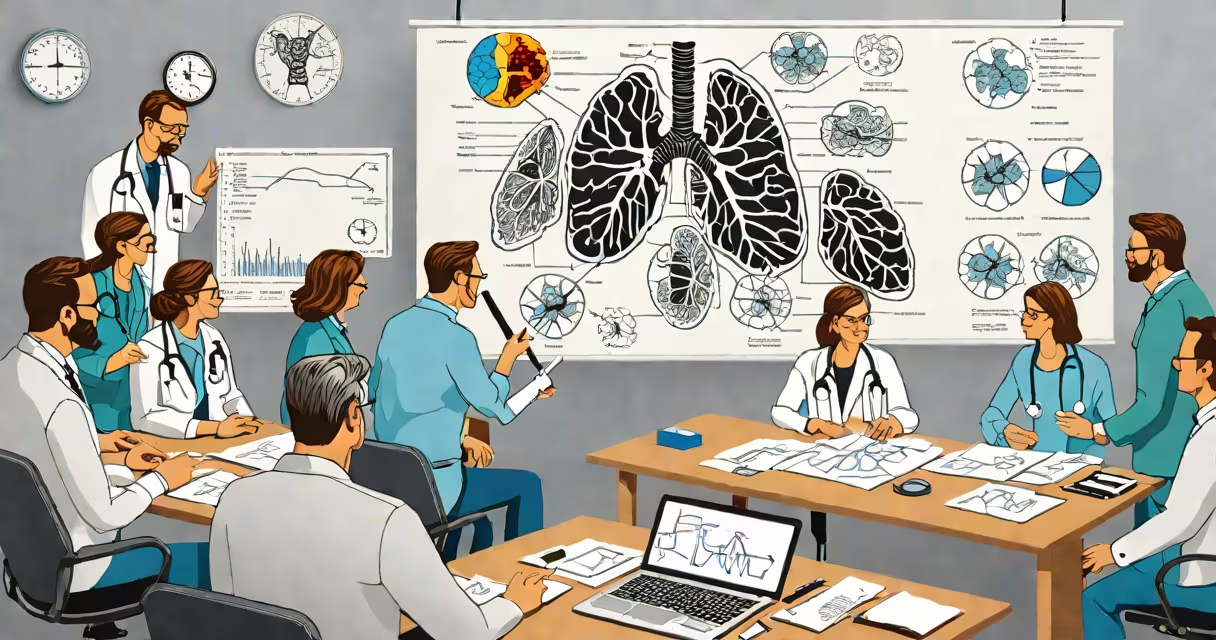
Doctors treat lung cancer using a combination of surgery, radiation, chemotherapy, targeted therapy, and immunotherapy tailored to the cancer's stage, genetic profile, and patient health. Treatment plans are customized based on tumor location, cell type, and molecular markers such as EGFR or ALK mutations.
Lung cancer begins when abnormal cells grow uncontrollably in lung tissue. These cells form tumors that may spread to lymph nodes or distant organs. The primary goal of treatment is to stop or slow cancer growth, relieve symptoms, and extend survival. Decisions depend on whether the cancer is localized, regional, or metastatic.
According to the American Cancer Society, early-stage lung cancer has a five-year survival rate of 60% when detected and treated promptly. For advanced cases, survival drops -only 7% for stage IV. Treatment choices differ drastically between early and late stages, and outcomes improve when care is guided by precise diagnostics.
Physicians begin by staging the disease using imaging scans like CT or PET-CT. A biopsy confirms the histology-whether it's non-small cell lung cancer (NSCLC), which accounts for 85% of cases, or small cell lung cancer (SCLC), which grows faster and spreads earlier. This distinction determines the entire treatment path.
For NSCLC, doctors test tumor tissue for specific gene mutations. About 15% of people with NSCLC have an EGFR mutation, and 5% have an ALK rearrangement. Patients with these alterations respond well to targeted drugs like osimertinib or alectinib, which block abnormal proteins driving cancer growth. Without testing, patients may receive less effective chemotherapy.
Immunotherapy uses drugs like pembrolizumab to activate the immune system against cancer cells. It's most effective in tumors with high PD-L1 expression or high tumor mutational burden. The National Complete Cancer Network (NCCN) recommends immunotherapy as first-line treatment for advanced NSCLC with PD-L1 levels above 50%.
Stage I and II lung cancers are often treated with surgical removal of the affected lobe. After surgery, adjuvant chemotherapy reduces recurrence risk by 10-15%. For patients who can't undergo surgery due to poor lung function, stereotactic body radiation therapy (SBRT) delivers high-dose radiation precisely to the tumor with minimal damage to surrounding tissue.
Stage III NSCLC involves nearby lymph nodes. Treatment combines chemotherapy and radiation (chemoradiation), sometimes followed by maintenance immunotherapy. The PACIFIC trial showed that adding durvalumab after chemoradiation improved progression-free survival by 17 months compared to placebo.
Stage IV lung cancer has spread beyond the lungs. Systemic treatments dominate: chemotherapy, targeted therapy, or immunotherapy. For patients with actionable mutations, targeted therapy offers better outcomes than chemotherapy alone. A 2023 study in *The Lancet Oncology* found that osimertinib extended median survival to 38 months in EGFR-mutant patients versus 22 months with standard chemo.
| Stage | Primary Treatment | Key Considerations |
|---|---|---|
| I-II | Surgery or SBRT | Curative intent; consider patient fitness and lung reserve |
| III | Chemoradiation + durvalumab | High local control rates; manage side effects like pneumonitis |
| IV | Targeted therapy or immunotherapy | Depends on biomarker status; monitor for immune-related adverse events |
Not all lung cancers respond to the same treatment. Genetic profiling identifies mutations that make certain drugs effective. For example, patients with ROS1 rearrangements benefit from crizotinib, while those with BRAF V600E mutations respond to dabrafenib plus trametinib.
Testing is not optional-it's standard of care. The NCCN guidelines state that all patients with non-squamous NSCLC should undergo molecular testing at diagnosis. Delaying testing leads to missed opportunities for targeted therapy. In one study, patients who received testing within 30 days of diagnosis were 30% more likely to start appropriate systemic therapy.
When I reviewed a case last year, a 62-year-old woman with stage IV NSCLC had no known mutations initially. After retesting her tumor sample using new sequencing, we discovered a rare RET fusion. She began selpercatinib and achieved partial remission within four months. This outcome underscores why repeat testing matters-even after initial negative results.
Some assume chemotherapy is the default treatment for all lung cancer. That's incorrect. For patients with driver mutations, chemotherapy is less effective and more toxic than targeted therapy. Using chemotherapy first can delay access to better options.
Another misconception is that immunotherapy works for everyone. It doesn't. Only about 20-30% of NSCLC patients respond to checkpoint inhibitors. High PD-L1 expression increases response likelihood, but even then, some patients don't benefit. Overuse leads to unnecessary side effects and cost.
Finally, many believe palliative care means giving up. In reality, it improves quality of life and survival. A 2010 study in *JAMA* found that early palliative care reduced depression and extended median survival by 2.7 months in metastatic lung cancer patients.
Early detection changes outcomes. The U.S. Preventive Services Task Force recommends annual low-dose CT (LDCT) screening for adults aged 50-80 with a 20-pack-year smoking history and current or former smoking status. LDCT screening reduces lung cancer mortality by 20% compared to chest X-rays.
If you're at high risk, talk to your doctor about LDCT lung cancer screening. Early-stage disease is often asymptomatic, so screening catches tumors before symptoms appear. Most patients diagnosed through screening have stage I or II disease, where curative treatment is possible.
For patients with stage 4A lung cancer, treatment focuses on controlling disease progression and managing symptoms. Survival varies widely depending on molecular status. Those with favorable mutations live longer on targeted therapies than on chemotherapy alone.
What do they do for lung cancer? They assess, stage, test, and tailor treatment to biology and patient goals. No two cases are identical. Precision medicine ensures patients receive the right drug at the right time.