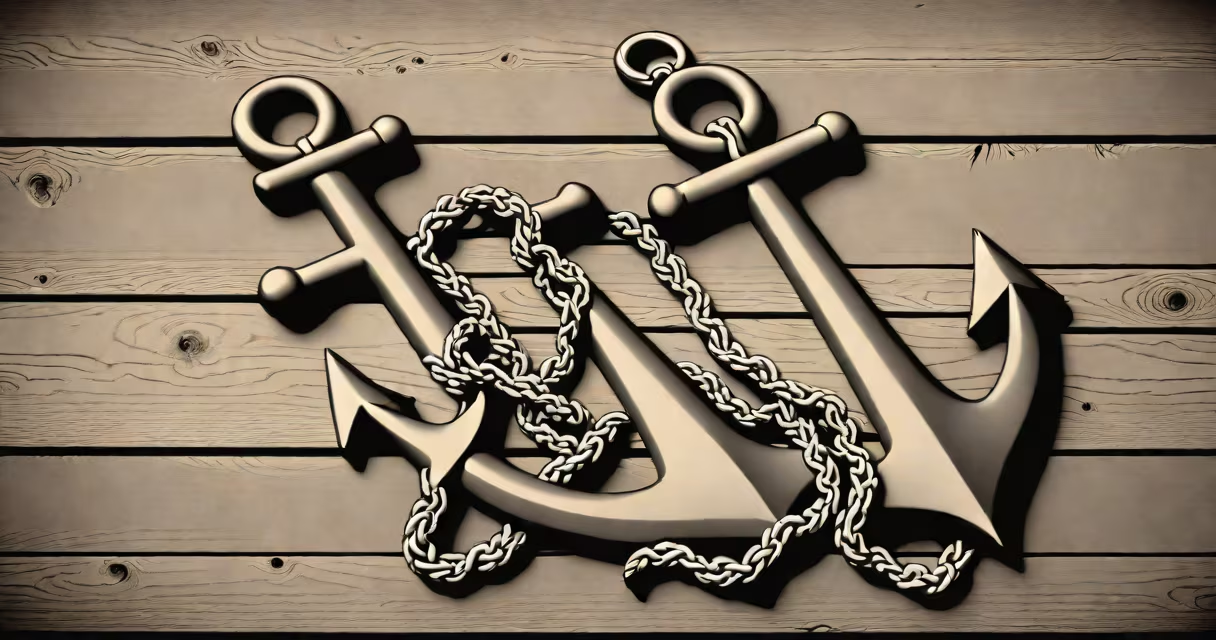
The anchor symbolizes stability, hope, and resilience, rooted in maritime tradition and adopted across religious, cultural, and personal contexts as a sign of enduring strength amid uncertainty.
Historically, anchors were essential tools for ships to remain stationary in rough waters. Their function was practical: to secure vessels against currents and storms. But over time, their physical role evolved into a deeper metaphor. In ancient Rome, the anchor became a symbol of safety and security, often carved into tombstones to represent the soul's safe passage to the afterlife. By the early Christian era, it had taken on spiritual significance as a symbol of steadfast faith.
Today, the anchor appears in tattoos, jewelry, logos, and religious iconography. Its presence in these forms reflects a universal human desire for grounding during turbulent times. A sailor's anchor may represent survival through stormy seas; a person's anchor tattoo might mark a key life event or emotional turning point. The symbol's power lies in its dual nature: it is both a tool of restraint and a promise of return.
The anchor functions as a metaphor because it physically holds something in place while also offering a point of reference. This duality makes it ideal for representing concepts like emotional stability, moral integrity, or long-term goals. In psychology, the term "anchor" describes a mental reference point used to maintain focus during stress or change.
In Christianity, the anchor appears in early Christian art, such as in the Catacombs of Rome. It was used as a coded symbol during periods of persecution. The Book of Hebrews (6:19) explicitly references the anchor: "We have this as a sure and steadfast anchor of the soul." This biblical reference cemented the anchor's role as a symbol of hope and perseverance.
Modern usage extends beyond religion. In business, companies use the anchor in branding to suggest reliability and consistency. For example, the logo of the U.S. Navy includes an anchor to reflect discipline, service, and national defense. In personal expression, people choose anchor designs for piercings or rings to signify overcoming hardship or staying true to values.
While the basic form remains consistent-a shank, crown, flukes, and ring-the design varies based on context and era. Different styles carry distinct connotations:
| Type | Design Features | Common Use |
|---|---|---|
| Ship's Anchor | Four flukes, curved shank, large ring | Nautical tradition, military insignia, tattoos |
| Maltese Cross Anchor | Flukes shaped like a cross, central ring | Christian symbolism, historical emblems |
| Minimalist Anchor | Simplified outline, single line | Modern jewelry, digital icons, branding |
Each variation communicates different nuances. The Maltese cross anchor, for instance, ties the symbol to the Knights Hospitaller and later to the Catholic Church's emphasis on charity and protection. Minimalist versions are often chosen for their subtlety and versatility in design.
People often mistake the anchor for a symbol of stagnation or immobility. This is incorrect. While the anchor prevents movement, its purpose is not to stop progress-it is to allow safe anchoring so that travel can resume later. The act of anchoring enables forward motion, not obstruction.
Another misconception is that the anchor is exclusively a Christian symbol. Though deeply embedded in Christian tradition, its use predates Christianity. Ancient Greeks used the anchor in pottery and coins, associating it with safe harbor and divine favor. In Norse mythology, anchors were not literal objects, but the concept of "holding fast" during sea voyages mirrored the idea of stability.
A lesser-known fact: the anchor was used in Roman funerary art not just as a symbol of hope, but as a marker of social status. Wealthier families commissioned elaborate anchor carvings on tombs, indicating their connection to maritime trade or naval service. This shows the symbol's layered meaning-both spiritual and worldly.
Consider the city of Port-au-Prince, Haiti. The national flag features a blue field with a white star and a gold anchor. The anchor represents the country's reliance on maritime trade and its historical connection to seafaring communities. It also symbolizes the nation's resilience-like a ship holding fast during a hurricane.
On a personal level, I once met a veteran who had a small anchor tattoo on his wrist. He told me it wasn't about the sea, but about surviving deployment in a war zone. "When everything around you is chaos," he said, "you need something to hold onto. That's what the anchor meant-my reason to come back." His story illustrates how the symbol transcends its original context.
The anchor symbolizes more than safety-it embodies the courage to endure, the wisdom to pause, and the trust that stability allows for renewal. Whether carved into stone, worn as a ring, or written in scripture, it remains a useful emblem of grounded hope.