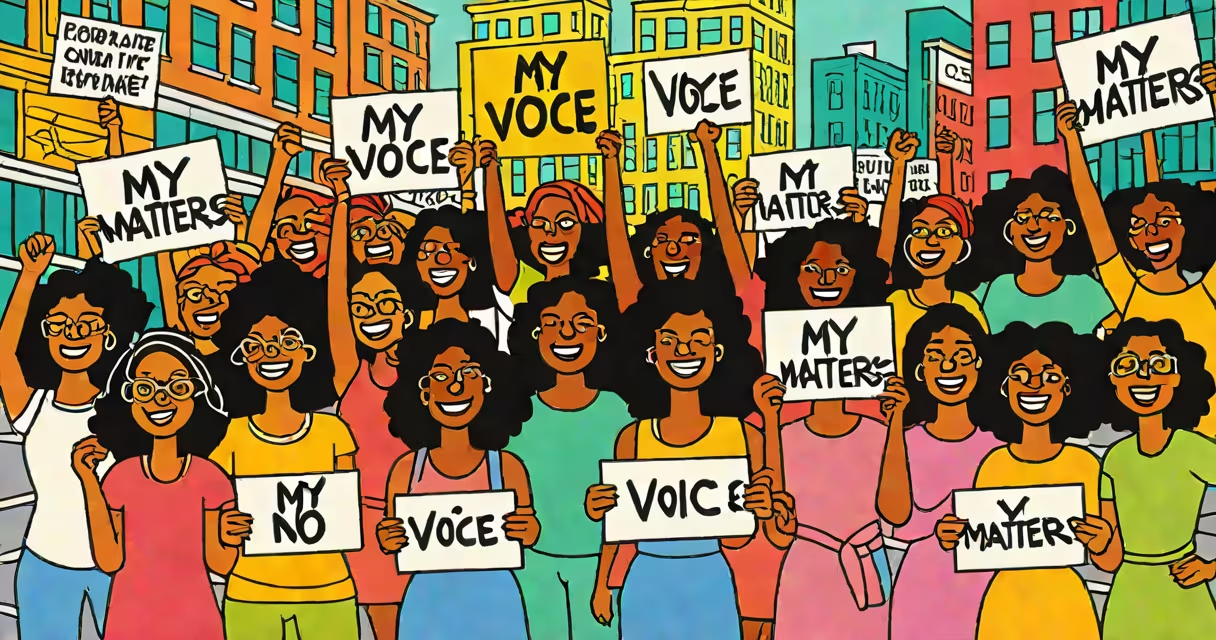
Female empowerment means giving women the tools, opportunities, and autonomy to make decisions about their lives, careers, bodies, and futures without systemic barriers based on gender. It is not about superiority but about equity and access.
At its core, female empowerment involves removing structural obstacles-economic, legal, cultural-that limit women's participation in public and private life. This includes equal pay, reproductive rights, political representation, and protection from violence. It is both a personal and collective process.
The concept emerged in the late 20th century through feminist movements and international policy. UN Women defines it as "the process of increasing the capacity of individuals or groups of women to make choices and change those choices into desired actions and outcomes."
Empowerment happens when systems support women's agency. For example, when a woman in rural Kenya receives a microloan to start a small business, she gains financial independence. That loan doesn't just cover supplies-it changes her status within her household and community.
Education is a foundational lever. A 2021 World Bank study found that each additional year of schooling for girls increases their future earnings by 10-20%. This isn't just economic-it alters family health outcomes, reduces child marriage rates, and strengthens local economies.
Legal protections matter too. In Rwanda, after the 1994 genocide, women were guaranteed 30% of parliamentary seats. Today, Rwanda leads the world in women's political representation-with 61% of parliamentarians being women. This wasn't accidental-it was policy-driven empowerment.
Female empowerment takes different forms depending on context. It ranges from individual acts-like a woman speaking up in a meeting-to large-scale institutional change.
| Type | Description | Example |
|---|---|---|
| Economic | Access to credit, land, and fair wages | A farmer in India receives a government-backed loan to buy seeds and equipment. |
| Political | Representation in decision-making bodies | Women hold 50% of seats in Iceland's parliament. |
| Social | Freedom from violence, stigma, and coercion | A girl in Nigeria attends school instead of being married at 14 due to national anti-child-marriage laws. |
| Cultural | Changing narratives around gender roles | Media campaigns in Brazil feature men as primary caregivers, challenging traditional norms. |
These forms aren't isolated. Economic empowerment often enables political participation. Education opens doors to social freedom. They reinforce one another.
Many people mistake female empowerment for male exclusion. That's incorrect. It's not about replacing men in power-it's about expanding who gets to lead and how decisions are made.
Another myth is that empowerment is only for wealthy or educated women. In reality, grassroots movements focus on marginalized groups. In Bangladesh, the Grameen Bank empowered over 9 million poor women through microfinance-many of whom had never attended school.
There's also confusion between empowerment and charity. Giving a woman a sewing machine isn't empowerment if she can't sell the products due to market restrictions. True empowerment requires systemic change-not just handouts.
In October 2019, over 2 million people in 150 countries participated in marches demanding gender equality. In Nairobi, women organized a sit-in at the National Assembly to push for legislation protecting women from sexual harassment at work. Their demands included mandatory workplace training and independent reporting mechanisms.
Two months later, the Kenyan government passed a draft bill requiring all employers with more than 50 employees to establish internal grievance committees. The movement didn't succeed overnight-but it created measurable pressure for reform.
This event shows how collective action drives structural change. Individual women gained confidence. Public discourse shifted. Policy evolved. That's empowerment in motion.
Female empowerment is not the same as feminism, though they overlap. Feminism is a broad ideology advocating for gender equality. Female empowerment is a practical strategy to achieve that goal.
It's also not synonymous with success. A woman may have a high-paying job but still lack control over her time, healthcare, or safety. Empowerment measures autonomy-not just income or titles.
And it's not a one-time event. A woman receiving a scholarship is not automatically empowered. She must also have mentorship, safe spaces, and ongoing support to thrive.
I once worked with a women's cooperative in Guatemala that produced handmade textiles. The members had skills but no way to reach markets. We helped them create a website and train in digital marketing. Within six months, sales doubled. But the real shift came when one member, Maria, stood up at a regional trade fair and spoke about her work. Her voice-once quiet-was now heard. That moment wasn't about money. It was about dignity.
What does female empowerment mean? It means creating conditions where women can live freely, decide their own paths, and contribute equally to society. It is not a slogan. It is a set of actions-legal, educational, economic, cultural-that dismantle barriers and build opportunity.
When a girl in Afghanistan learns to read despite banned schools, that is empowerment. When a woman in Japan challenges a workplace culture that punishes maternity leave, that is empowerment. When a man supports his daughter's ambition without hesitation, that is empowerment too.
True empowerment is not limited to women. It benefits everyone. As the United Nations states, "Gender equality is not a women's issue-it is a human issue."
For more on related concepts, explore what does i e mean.