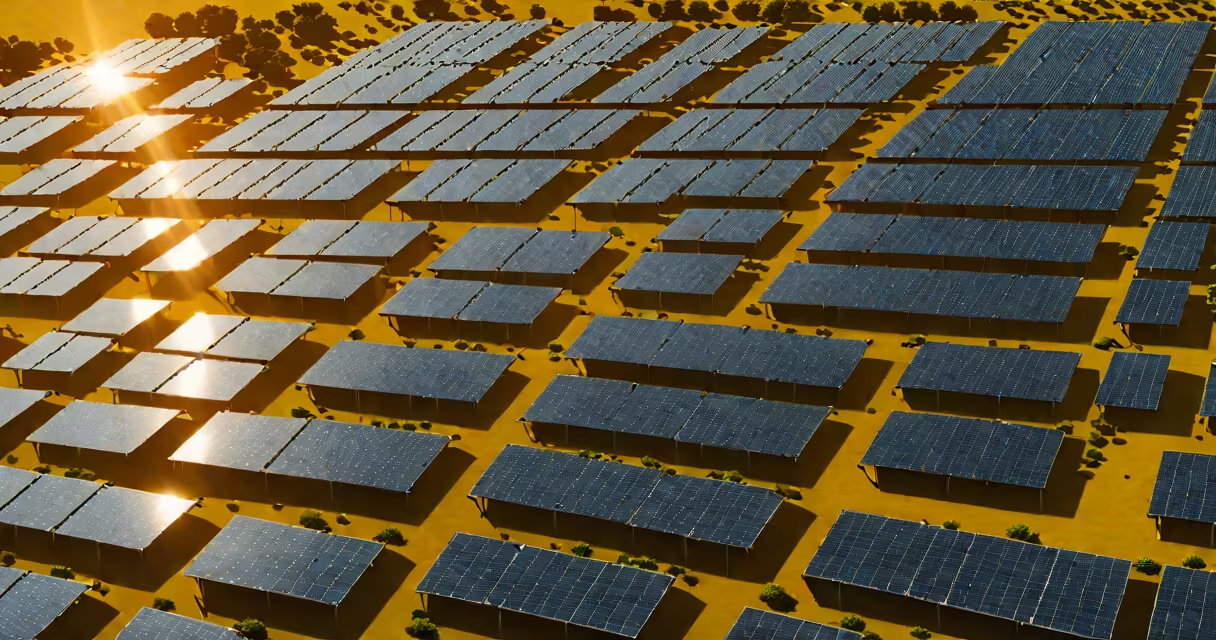
Solar power means generating electricity by capturing sunlight through photovoltaic cells or concentrating solar thermal systems. It converts photons from sunlight directly into electrical current without combustion, emissions, or moving parts during operation.
Photovoltaic (PV) cells are the most common method. They're made of semiconductor materials-usually silicon-that release electrons when exposed to light. This flow of electrons creates direct current (DC) electricity, which inverters convert into alternating current (AC) for home and grid use. Concentrated solar power (CSP) plants use mirrors to focus sunlight onto a receiver, heating fluid to drive turbines and generate electricity.
According to the U.S. Energy Information Administration (EIA), solar power accounted for 4.6% of total U.S. utility-scale electricity generation in 2023, up from 1.5% in 2019. The International Energy Agency (IEA) projects solar will be the largest source of global electricity by 2050, surpassing coal and gas.
When sunlight hits a PV cell, photons transfer energy to electrons in the semiconductor material. This excites electrons, freeing them from atoms and creating electron-hole pairs. Built-in electric fields within the cell-formed by doping silicon layers with phosphorus (n-type) and boron (p-type)-push electrons toward the front contact and holes toward the back, generating a voltage difference.
Multiple cells are wired together into modules, then connected into arrays. Arrays feed DC power into an inverter, which transforms it into AC power compatible with homes and the electrical grid. Modern inverters also monitor system performance and shut down during grid outages for safety.
A residential rooftop system with 20 panels, each rated at 400 watts, produces up to 8 kilowatts (kW) of peak power. On a sunny day, such a system generates roughly 30-40 kWh daily-enough to cover 70-80% of average U.S. household usage, according to the National Renewable Energy Laboratory (NREL).
There are three primary configurations based on connection to the grid and storage:
| Type | Grid Connection | Energy Storage | Best For |
|---|---|---|---|
| Grid-tied | Yes | No (optional) | Homeowners seeking lower bills and reduced carbon footprint |
| Off-grid | No | Required (batteries) | Rural locations without grid access |
| Hybrid | Yes | Yes (batteries) | Users wanting backup power during outages |
Grid-tied systems are the most common. They export excess power to the grid, earning credits via net metering. Off-grid systems rely entirely on batteries and often include backup generators. Hybrid systems combine both, offering resilience and cost savings.
In 2022, over 80% of new U.S. solar installations were grid-tied, per the Solar Energy Industries Association (SEIA). Battery storage adoption grew 40% year-over-year, driven by rising storm frequency and grid instability.
Solar power is not limited to sunny climates. Germany, a country with less annual sunlight than California, generated 12% of its electricity from solar in 2023. Efficiency depends on panel orientation, shading, and temperature-not just sunshine hours.
Another myth: solar panels don't work on cloudy days. They do-just at reduced output. A typical panel produces 10-25% of its rated capacity on overcast days. NREL research shows that solar systems in the Pacific Northwest generate 25% of their annual output during winter months.
Some assume solar power is expensive. The average installed cost of a residential system dropped 70% between 2010 and 2023, from $5.50 per watt to $1.65 per watt, according to SEIA. Federal tax credits cover 30% of installation costs, reducing payback periods to 6-10 years.
Solar power emits no greenhouse gases during operation. Over its lifetime, a typical residential system offsets 100-200 tons of CO₂-equivalent to planting 2,000 trees annually, per EPA calculations.
Manufacturing involves energy-intensive processes, especially silicon purification. However, the energy payback time-the time needed to generate as much energy as was used in production-is now 1-2 years for modern panels. After that, they produce clean energy for 25-30 years.
Recycling is improving. The European Union's Waste Electrical Equipment Directive mandates 85% recycling of solar panels by 2030. U.S. companies like Recycle PV and First Solar now recover 95% of materials-silicon, glass, aluminum-from end-of-life panels.
I installed a 6-kW grid-tied system on my roof in 2021. After the federal tax credit, the net cost was $14,200. My monthly electricity bill dropped from $180 to $15. Over three years, I've saved $5,400 and reduced my household's carbon emissions by 1.8 metric tons annually.
Utility-scale solar farms generate hundreds of megawatts. The Topaz Solar Farm in California spans 9.5 square kilometers and produces 550 MW-enough to power 180,000 homes. It uses single-axis trackers to follow the sun, increasing output by 20% compared to fixed panels.
On smaller scales, solar powers remote weather stations, water pumps in sub-Saharan Africa, and microgrids in disaster zones. In Puerto Rico, solar-plus-storage systems restored power to hospitals within 72 hours after Hurricane Maria in 2017.
Commercial buildings use solar for HVAC and lighting. Walmart stores in Texas have installed rooftop solar across 100 locations, reducing energy costs by 40% and cutting 15,000 tons of CO₂ annually.
Solar power means transforming sunlight into usable electricity with minimal environmental impact. It's not just a technology-it's a shift toward decentralized, resilient, and low-carbon energy systems.