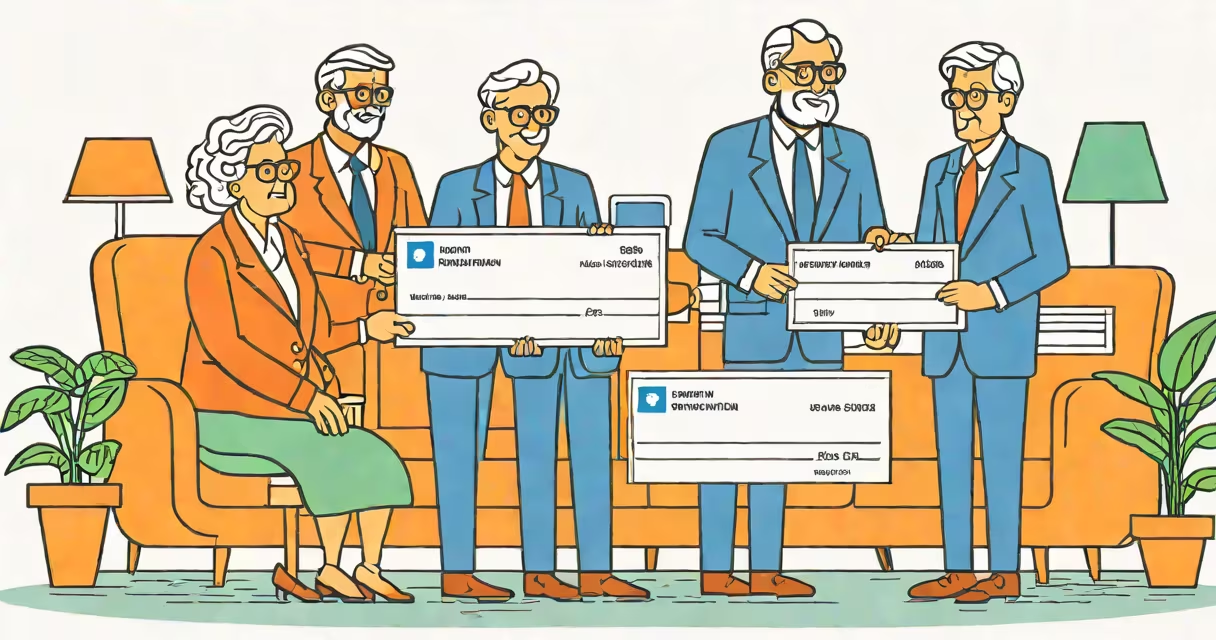
A pension is a retirement plan that provides a guaranteed monthly income after retirement, typically funded and managed by an employer based on an employee's years of service and final average salary. Unlike investment-based plans, pensions promise a specific payout regardless of market performance.
Pensions were once standard in government jobs and large corporations. They're now uncommon in private-sector work in the U.S., but still exist in public sector roles and certain unionized positions. The payment continues for life, often including cost-of-living adjustments.
The term "pension" specifically refers to a defined benefit plan, where the employer bears the investment risk. This contrasts with defined contribution plans like 401(k)s, where employees bear the risk of market fluctuations.
Pensions operate on a formula that calculates benefits using two factors: years of service and final average salary. For example, a common formula is 1.5% of final average pay multiplied by years of service. An employee with 30 years of service and a final average salary of $70,000 would receive:
This $31,500 annual payment continues for life, often adjusted annually for inflation. Employers fund the plan through contributions, not employee payroll deductions. The money is invested in a diversified portfolio managed by professionals.
If the investments underperform, the employer covers the shortfall. If they outperform, the surplus stays in the fund. The employer guarantees the payout, even if the fund runs low.
While most people think of pensions as a single model, there are variations in structure and funding. The two main types are:
| Type | Funding Source | Employer Risk | Common Users |
|---|---|---|---|
| Defined Benefit Plan | Employer-only contributions | High - employer pays the promised amount | Public sector, unions, large corporations |
| Hybrid Plan (Cash Balance) | Employer and employee contributions | Moderate - employer covers shortfalls | Some state and local governments |
Cash balance plans resemble defined benefit plans but are structured like individual accounts. Employees see a hypothetical account balance that grows each year with interest credits and employer contributions. Upon retirement, the balance is converted into a lifetime annuity.
Despite their name, hybrid plans are not a mix of 401(k) and pension. They retain the guarantee of a specific payout, unlike 401(k)s, which depend on investment returns.
Pensions remain in use primarily in federal, state, and local government jobs. According to the U.S. Bureau of Labor Statistics, 62% of public sector workers had access to a pension in 2022, compared to just 13% of private sector employees.
They're also common in unionized industries such as transportation, construction, and manufacturing. The International Brotherhood of Teamsters, for example, maintains multi-employer pension funds covering tens of thousands of members. These funds pool contributions from multiple employers and manage assets collectively.
Employers use pensions to attract and retain long-term talent. A guaranteed income stream reduces employee turnover and supports workforce stability. For retirees, pensions provide predictable income during a time when healthcare costs rise and market volatility can erode savings.
Many people confuse pensions with 401(k)s or IRAs. A pension is not an investment account. You don't choose stocks or bonds. The employer handles all decisions. Your role is to work and earn service credit.
Another myth is that pensions are obsolete. While private-sector adoption has declined since the 1980s, they still exist. The Pension Benefit Guaranty Corporation (PBGC) insures most defined benefit plans. As of 2023, PBGC covered over 1.6 million participants in 11,000 plans.
Pensions do not require employee contributions. In contrast, 401(k)s rely on employee payroll deductions. Some hybrid plans allow employee contributions, but the employer still guarantees the final payout.
One non-obvious fact: pensions are not automatically portable. If you leave a job before vesting (typically 5 years), you may forfeit the entire benefit. Even after vesting, transferring the benefit to a new employer is rare. Most pensions are tied to a single employer.
Consider Maria, a school teacher in California. She worked 30 years in the public school system. Her final average salary was $75,000. Under the California State Teachers' Retirement System (CalSTRS), her pension formula is 2% × years of service × final average salary.
Her calculation:
2% × 30 years × $75,000 = $45,000 per yearShe begins receiving $45,000 annually at age 60, the earliest eligibility. The amount increases each year by the cost-of-living adjustment (COLA), currently averaging 2.5%. After 20 years, her income grows to about $58,000 annually.
Unlike a 401(k), Maria doesn't have to manage investments. She doesn't worry about market crashes. Her income is stable and predictable, even if she lives to 90.
I once met a retired factory worker in Ohio whose pension kept him above the poverty line despite health issues. He said, "I knew exactly what my check would be every month. That peace of mind was worth more than any stock dividend."
Today, only 13% of private-sector workers have access to a pension. The shift began in the 1980s when companies moved to 401(k)s to reduce long-term liabilities. Employers preferred plans where they weren't legally obligated to cover shortfalls.
For those without a pension, alternatives include IRAs, 401(k)s, and annuities. But none offer the same level of guaranteed income. If you're considering retirement planning, understanding what exactly is a pension helps clarify trade-offs between control, predictability, and risk.
Knowing what exactly is a pension reveals a system designed for security, not speculation. It's a legacy structure built on trust, longevity, and employer responsibility-values increasingly rare in modern retirement planning.