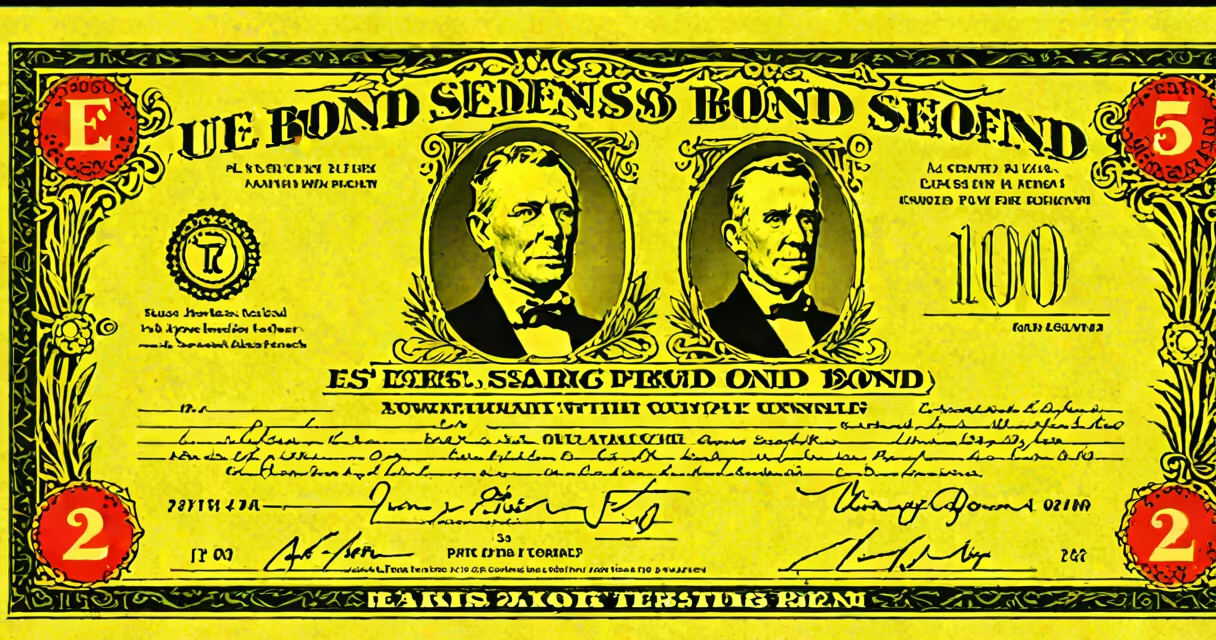
The value of your EE bond is the amount you can redeem it for at any time, based on its original face value, issue date, and accumulated interest. This amount grows monthly and reaches its maximum at 30 years, when the bond matures.
EE bonds are U.S. government-issued savings bonds sold at half their face value. A $50 bond costs $25 and earns interest until it reaches $50 at maturity. The actual value is determined by the Treasury's interest calculation system, which applies a fixed rate for the first five years and a variable rate thereafter.
For example, a Series EE bond issued in January 2020 with a $50 face value had a fixed rate of 0.10% for the first five years. After that, it earned a variable rate of 0.50% for the next six months, then 0.60% for the following six months. By December 2023, its value had grown to $52.14. This growth is not linear-it compounds monthly and is recalculated each month.
The U.S. Department of the Treasury calculates the value of EE bonds using a formula that includes a fixed rate for the first five years and a variable rate for the remainder of the term. The variable rate is set every six months and applies to the entire bond balance, including previously accrued interest.
Interest is compounded semiannually and added to the principal. For instance, a $100 EE bond issued in March 2015 earned 0.10% annually for the first five years. After that, it switched to a variable rate of 0.50% for the next six months, then 0.60% for the next six months. Over time, the balance grows faster due to compounding.
The Treasury publishes updated rates quarterly. You can verify the current rate for your bond's issue period using the official bond value calculator. Always use the most recent rate available-using outdated data leads to incorrect estimates.
Series EE bonds are issued in paper form or electronically through TreasuryDirect. They come in denominations of $50, $75, $100, $200, $500, $1,000, and $5,000. The value increases over time until it reaches maturity at 30 years.
| Issue Date Range | Fixed Rate (First 5 Years) | Variable Rate (After 5 Years) | Maturity Value (30 Years) |
|---|---|---|---|
| May 2000 - April 2002 | 3.00% | 3.00% (fixed) | $100 (for $50 bond) |
| May 2002 - April 2004 | 3.00% | 3.00% (fixed) | $100 (for $50 bond) |
| May 2015 - April 2016 | 0.10% | 0.50% (first 6 months) | $65.45 (for $50 bond) |
| May 2020 - April 2021 | 0.10% | 0.50% (first 6 months) | $67.21 (for $50 bond) |
EE bonds issued between May 2003 and April 2005 were likely to reach double their face value at maturity. This guarantee was discontinued after 2005. Today's bonds do not have this feature unless they were issued before that cutoff.
A common misconception is that EE bonds earn interest at a flat rate throughout their life. In reality, the rate changes every six months after the initial five-year period. Using an old rate in a calculator gives inaccurate results. Always use the latest Treasury rate for the correct calculation.
EE bonds are used primarily for long-term savings goals such as college funding, retirement planning, or emergency reserves. They are backed by the full faith and credit of the U.S. government, making them among the safest investments available.
They offer tax advantages when used for qualified education expenses. Interest is exempt from state and local taxes, and federal income tax can be deferred until redemption. If used for tuition, the interest may be fully excluded from taxable income under IRS Section 135.
I once helped a client redeem a $1,000 EE bond issued in 2008. The bond had matured in 2018, but the client waited until 2023 to cash it in. Because the bond reached its maximum value at 30 years, the redemption amount was $1,250.75-$250.75 in interest. Had the client redeemed it earlier, they would have lost potential earnings.
Many people assume that EE bond value is simply the face value plus a fixed percentage. This is incorrect. The value grows based on compound interest applied every month, not a flat addition.
Another error is assuming that all EE bonds double in value. Only those issued between May 2003 and April 2005 had this guarantee. Bonds issued after that date do not automatically double. The final value depends on the actual interest rates applied during the bond's lifetime.
Some believe that EE bonds lose value if held past 30 years. This is false. The bond stops earning interest at maturity but remains valid indefinitely. You can redeem it at any time after 30 years, though the value won't increase further.
When calculating the value of your EE bond, consider both the issue date and the current interest rate. The Treasury updates rates every six months. A bond issued in June 2020 with a $50 face value had a value of $53.12 in January 2024-up from $50 at issuance. This reflects 3.8% annualized growth over four years, not a flat 1% per year.
The value of your EE bond is not static. It grows monthly, reaches maturity at 30 years, and remains redeemable forever. Knowing how to calculate it correctly ensures you maximize returns and avoid financial loss.