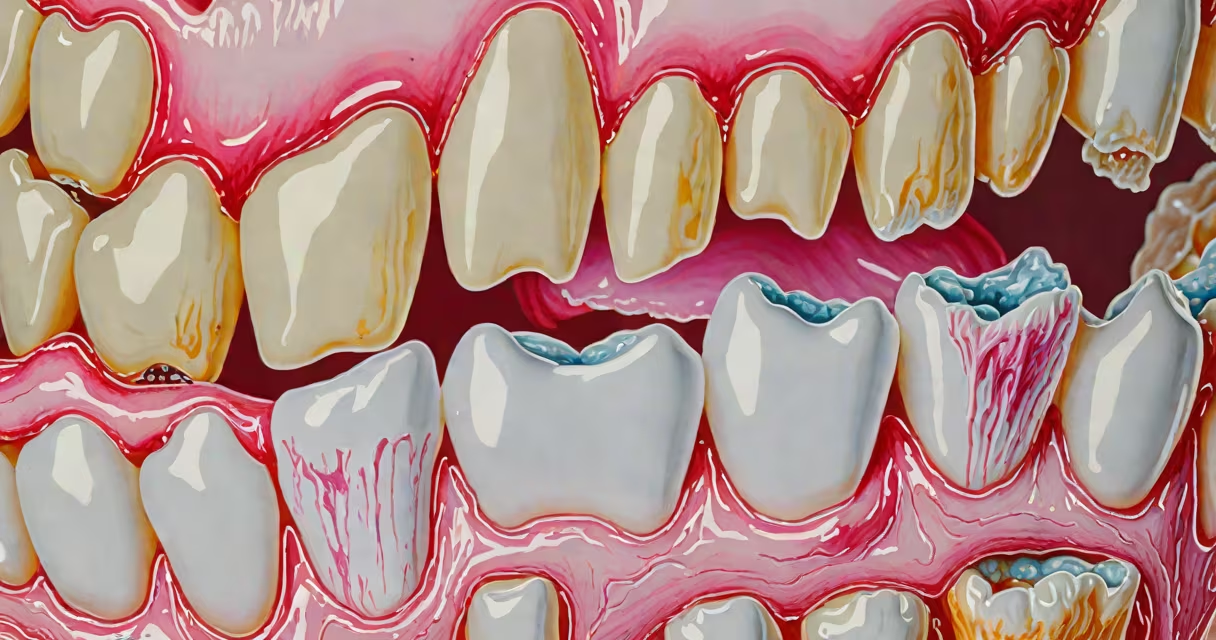
A white scab on gums is a localized area of dead tissue or fibrin buildup that appears as a whitish, sometimes crusty lesion on the gum surface. It often forms over a wound, ulcer, or inflamed site and may indicate trauma, infection, or a reaction to irritation. This condition typically resolves within days if mild, but persistent or painful lesions require evaluation.
White scabs form when epithelial cells die and slough off, leaving behind a layer of protein-rich fluid that dries into a thin, opaque film. This process occurs most commonly after mechanical injury-such as biting the cheek, brushing too hard, or using a sharp toothpick-or following a minor infection. The appearance resembles a scab on skin, though it develops internally and is less visible due to the moist environment of the mouth.
According to the American Dental Association (ADA), approximately 20% of people experience at least one oral ulcer per year, many of which begin as white spots or scabs. These are usually benign and resolve without treatment. However, when a white scab persists beyond 10-14 days, grows larger, bleeds easily, or causes pain during eating, it may signal a more serious issue such as oral lichen planus, leukoplakia, or early-stage oral cancer.
When gum tissue is injured-whether by a sharp food fragment, aggressive flossing, or a dental procedure-the body sends immune cells to the site. As inflammation begins, damaged cells disintegrate and release proteins and cellular debris. This material accumulates and dries into a white or yellowish film that covers the affected area. The scab acts as a temporary barrier while underlying tissue heals.
The composition includes desquamated epithelial cells, fibrin from blood plasma, inflammatory mediators, and possibly bacterial remnants. Unlike skin scabs, oral scabs remain moist and are constantly bathed in saliva, which slows drying and increases risk of secondary infection if the area is not kept clean.
For example, a patient who accidentally bit their inner cheek during a meal may develop a white scab on the adjacent gum within 12 hours. The lesion appears flat, slightly raised, and may feel tender when touched. If left undisturbed and oral hygiene maintained, it typically resolves in 5-7 days.
White scabs on gums fall into several categories based on origin:
| Type | Trigger | Duration | Red Flags |
|---|---|---|---|
| Mechanical injury | Biting, brushing too hard, dental work | 3-7 days | Pain, swelling, bleeding |
| Minor infection | Candida overgrowth, viral ulcers (e.g., herpes) | 7-14 days | Spreading, fever, swollen lymph nodes |
| Chronic conditions | Lichen planus, leukoplakia | Weeks to months | Irregular shape, rough texture, doesn't heal |
One non-obvious distinction: not all white patches are scabs. A true scab is a dried, superficial layer that may flake off. In contrast, conditions like leukoplakia involve thickened, non-flaking mucosa that cannot be wiped away. Misidentifying these can delay diagnosis.
For instance, a 45-year-old smoker developed a white scab on the side of his lower gum. He assumed it was from a sharp piece of popcorn. After two weeks, it hadn't improved. A dentist diagnosed it as early leukoplakia-a precancerous change linked to tobacco use. Biopsy confirmed dysplasia. Early detection prevented progression to invasive cancer.
White scabs commonly appear on the buccal (cheek-facing) surfaces of the gums, especially near molars and along the gumline. These areas are prone to friction from chewing, accidental bites, and poor flossing technique. The presence of salivary glands near the jawbone also contributes to localized dryness in certain regions, increasing scab formation risk.
High-risk groups include smokers, individuals with dry mouth (xerostomia), and those with weakened immunity. The Centers for Disease Control and Prevention (CDC) notes that people with HIV or undergoing chemotherapy have higher rates of oral ulcers and scabbing due to reduced mucosal integrity.
One common mistake is assuming all white patches are infections. In reality, many result from physical trauma. A study published in the Journal of Oral Pathology & Medicine found that 68% of white scabs in a cohort of 120 patients were due to mechanical irritation, not infection or systemic disease.
White scab on gums is frequently mistaken for oral thrush, a fungal infection caused by Candida albicans. Thrush presents as creamy white patches that can be wiped off, revealing red, raw tissue underneath. A scab, however, remains intact and does not peel away easily. Wiping a scab may cause bleeding or expose fresh tissue, but the lesion itself stays in place.
Another confusion is between scabs and early-stage oral cancer. Cancerous lesions often start as flat, white or red patches that don't heal. They may feel firm to the touch and grow slowly. Unlike scabs, they do not shrink over time. The National Institute of Dental and Craniofacial Research (NIDCR) states that persistent white or red patches lasting more than two weeks should be evaluated by a healthcare provider.
I once observed a patient who had a white scab on her upper gum near a wisdom tooth. She thought it was a cold sore. After two weeks, it hadn't changed. A biopsy revealed squamous cell carcinoma. The lesion was small and localized, but early intervention led to complete surgical removal with no recurrence after five years.
Seek professional evaluation if the white scab:
Dentists use visual inspection, gentle probing, and sometimes a biopsy to differentiate between harmless scabs and concerning lesions. If a scab is suspected to be something more serious, referral to an oral pathologist may follow.
For mild cases, rinsing with warm salt water (1/2 tsp in 8 oz water) four times daily can reduce inflammation and speed healing. Avoid spicy, acidic, or crunchy foods that irritate the area. Maintain regular brushing and flossing, but avoid the site until it heals.
Most white scabs on gums are temporary and resolve with basic care. But because they can mask serious conditions, never ignore a lesion that lasts longer than two weeks. Early diagnosis improves outcomes.