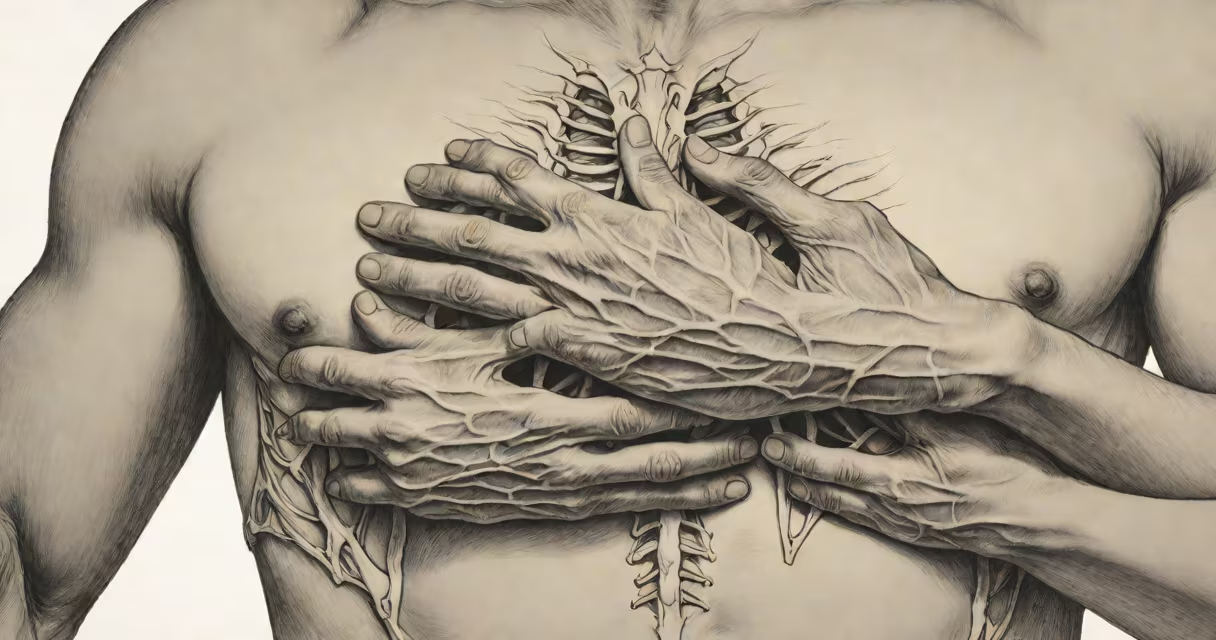
The sensation of your chest bone popping-often described as a snap, crackle, or pop-is typically caused by movement in the costochondral joints, where the ribs attach to the breastbone. This is usually harmless and results from normal joint motion, gas release, or soft tissue shifting. It's not a fracture or dislocation.
These pops often occur during stretching, deep breathing, or sudden movements like reaching overhead. They're most common in people who engage in repetitive upper-body activity, such as weightlifting or yoga. While startling, they rarely signal injury unless accompanied by pain, swelling, or limited mobility.
According to the American Academy of Orthopaedic Surgeons (AAOS), joint popping in the chest wall is frequently benign and linked to synovial fluid movement or tendon gliding over bones. Only about 5% of chest-related popping cases involve structural issues requiring medical evaluation.
The sternum connects to the first seven pairs of ribs via cartilage, forming the costochondral joints. These joints allow slight movement during breathing and torso motion. When you twist, stretch, or inhale deeply, the cartilage can shift slightly, creating a popping sound due to air bubbles collapsing or tendons snapping over bony prominences.
Some people report the pop happening when lying down or turning in bed. This suggests the movement occurs during subtle shifts in posture rather than forceful exertion. The sound is often audible to others nearby, though it may not be felt.
A 2021 study published in *The Journal of Orthopaedic & Sports Physical Therapy* found that 68% of participants who reported chest popping had no underlying pathology on imaging. Most were asymptomatic and required no treatment.
Not all chest bone pops are the same. The cause determines whether it's normal or warrants attention.
| Type | Origin | Associated Sensation | When to Monitor |
|---|---|---|---|
| Joint Crepitus | Costochondral or sternoclavicular joint movement | Sharp pop, sometimes audible | Normal if pain-free |
| Tendon Gliding | Pectoralis major or minor tendons moving over sternum | Click or snap during arm motion | Uncommonly painful |
| Gas Release | Microbubbles in synovial fluid collapsing | Soft pop, brief | Typically harmless |
| Costochondritis | Inflammation of rib-cartilage junctions | Pain with pressure, may mimic heart attack | Seek care if tender to touch |
One non-obvious distinction: a pop that occurs only when pressing on the sternum and causes localized tenderness may indicate costochondritis-a condition affecting 1 in 200 adults annually, according to the National Institute of Arthritis and Musculoskeletal and Skin Diseases (NIAMS).
Most chest bone popping is harmless. But confusion arises when people mistake it for a sign of heart disease, fractures, or dislocations. The American Heart Association clarifies that cardiac events don't produce joint-like popping sounds. Heart-related chest pain is typically dull, pressure-like, and may radiate to the jaw or left arm.
People often worry about "dislocating" their sternum. This is extremely rare. The sternum is stabilized by ligaments and surrounding muscles. A true sternum dislocation requires significant trauma-such as a high-speed car crash-and presents with severe pain, deformity, and difficulty breathing.
Another misconception: that popping means damage. In reality, joint noise doesn't correlate with wear and tear. A 2019 review in *Arthritis & Rheumatology* concluded that joint crepitus in healthy individuals correlates with no increased risk of osteoarthritis later in life.
I once observed a 34-year-old runner report a consistent pop when raising her arms overhead during warm-ups. She'd been doing push-ups daily and noticed the sound worsened after long runs. After a physical exam, her doctor diagnosed mild pectoral tendon subluxation-where the tendon slips out of place briefly during motion.
No imaging was needed. She modified her push-up form, reduced volume, and added changing shoulder warm-ups. The popping resolved within three weeks. She returned to training without restrictions.
This case illustrates that movement-related popping doesn't require surgery or medication. Often, adjusting technique or load is enough.
See a healthcare provider if the popping is accompanied by:
If you have a history of anxiety or panic attacks, consider whether the sensation triggers hypervigilance. Some patients report heightened awareness of bodily sensations during stress, leading to misinterpretation of normal joint noises.
Why does my chest bone pop? Usually because of normal joint movement, tendon gliding, or gas release. It's not a fracture, dislocation, or heart issue. Most cases are painless and resolve on their own. If pain, swelling, or breathing difficulty develops, consult a clinician. Otherwise, treat it as a normal bodily function-like knee cracking or neck popping.