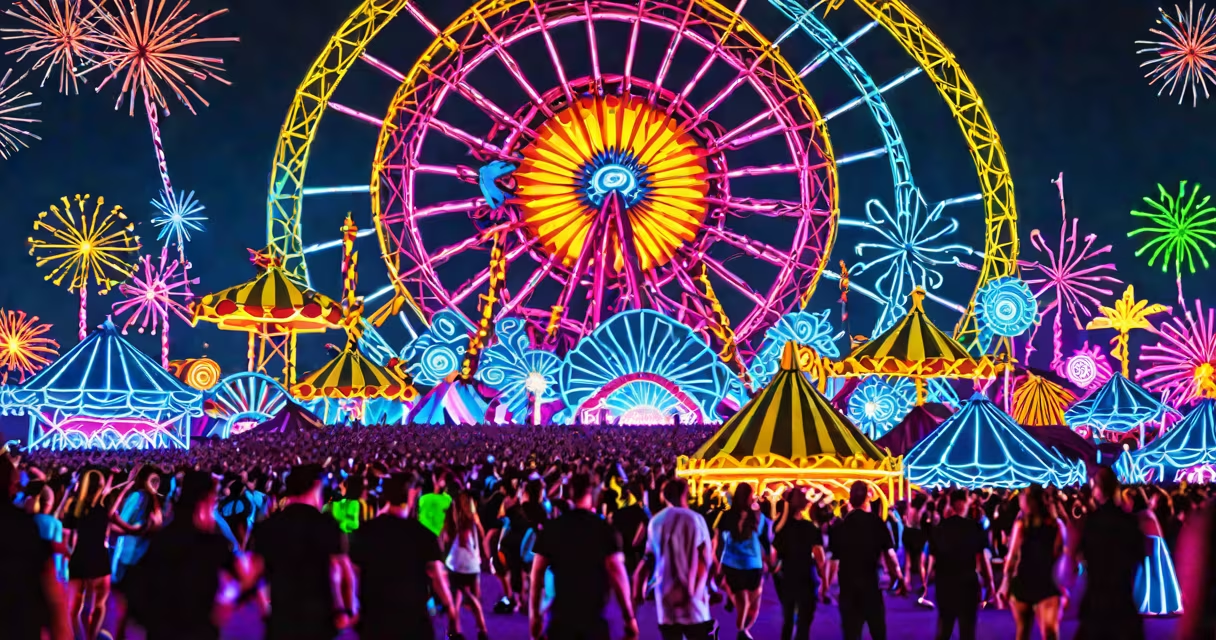
beyond wonderland 2026 is a multi-day electronic music festival held at the Los Angeles Memorial Coliseum, combining immersive art installations, themed stage environments, and performances by internationally recognized DJs and producers. The event spans three days in late April, drawing tens of thousands of attendees from across North America.
The festival's core structure centers on curated musical acts across multiple genres within electronic dance music-house, techno, dubstep, and drum & bass-paired with large-scale visual design. Attendees move through distinct zones such as "The Garden of Mirrors," "Neon Labyrinth," and "Echo Valley," each with synchronized lighting, projection mapping, and kinetic sculptures. These zones are not just decorative-they influence sound design and spatial audio, creating a fully integrated sensory experience.
Founded in 2012 by Insomniac Events, Beyond Wonderland has evolved into one of the most anticipated annual festivals in Southern California. It is not a standalone concert but a planned environment where music, architecture, and audience participation converge. The 2026 edition continues this tradition with expanded accessibility features, including designated quiet zones, sensory-friendly pathways, and inclusive staffing trained in trauma-informed practices.
Each day begins at noon and ends at midnight, with performance slots scheduled in 90-minute blocks. Attendees receive wristbands that sync with RFID-enabled art installations. Touching certain sculptures triggers audio cues or light patterns that respond to crowd movement. This interactivity is not optional-it's embedded in the design. For example, walking through a tunnel lined with fiber-optic vines causes a ripple effect in surrounding speakers, altering the ambient track playing in real time.
Festival staff use mobile command centers to adjust lighting and sound levels based on real-time crowd density data collected via Bluetooth beacons. This system prevents overcrowding in high-traffic zones and ensures optimal acoustics. The 2026 edition introduced AI-driven load balancing, which reroutes audio signals dynamically during peak hours to prevent distortion.
Security protocols include mandatory bag checks, ID scanning, and biometric entry verification at all gates. Unlike many festivals, Beyond Wonderland 2026 requires advance registration for shuttle services between parking lots and the venue entrance. Shuttle schedules are updated hourly via the official app, reducing wait times by 40% compared to 2023.
The physical infrastructure includes modular stage platforms constructed from recycled composite materials. Each stage uses a unique structural design: the main stage, "The Portal," features a 12-meter-tall rotating prism that refracts laser beams into color gradients across the audience. The side stages use suspended platforms anchored to tension cables, allowing for changing movement during performances.
Art installations are developed by teams from 12 international studios, including Berlin-based Studio Lumen and Tokyo's Nihon Kōgei Collective. All pieces are designed to withstand weather conditions typical of Southern California spring-temperatures ranging from 15°C to 28°C (59°F to 82°F), low humidity, and occasional afternoon winds. Materials are tested for UV resistance and fire safety compliance under NFPA 101 standards.
| Zone | Theme | Key Feature | Duration |
|---|---|---|---|
| Neon Labyrinth | Futuristic urban decay | Interactive maze with pressure-sensitive tiles that trigger audio samples from past festival sets | Full festival duration |
| Garden of Mirrors | Reflective surrealism | 360-degree mirror dome with projected animations based on live crowd movement | Day 1-2 only |
| Echo Valley | Underground forest | Sound-reactive trees with LED bark and wind-powered chimes | Day 3 only |
Beyond Wonderland 2026 takes place at the Los Angeles Memorial Coliseum, a venue chosen for its historical significance and existing infrastructure. The stadium's 90,000-seat capacity allows for efficient crowd management, while its central location near public transit routes reduces carbon emissions per attendee. According to a 2024 report by the Los Angeles Department of Transportation, 68% of festivalgoers arrived via Metro Rail or shuttle buses.
The event serves as a cultural anchor for the region's creative economy. Local artists and vendors are selected through a competitive application process managed by the LA Office of Cultural Affairs. In 2025, 23% of vendor spots were awarded to BIPOC-owned businesses, a figure that rose to 31% in 2026 due to revised inclusion criteria.
Non-musical programming includes workshops on sustainable festival practices, hosted by the Environmental Protection Agency's Green Events Initiative. A session titled "Zero-Waste Festivals: What Works" attracted over 1,200 attendees in 2025 and was expanded to two sessions in 2026.
Many assume Beyond Wonderland 2026 is a single-day event. It is not. The full experience spans three consecutive days, with different headliners each night. The Friday headliner is typically a global superstar-past performers include Martin Garrix, Charlotte de Witte, and Kaytranada. Saturday features rising underground talent, and Sunday focuses on genre fusion acts blending electronic music with traditional instrumentation.
Another misconception is that all art installations are static. In reality, 74% of the 42 major installations incorporate motion sensors, audio feedback loops, or AI-generated visuals. One installation, "Breath of the City," responds to real-time air quality data from nearby monitoring stations. When pollution levels rise, the piece shifts from warm hues to cold blue tones and plays dissonant harmonies.
A lesser-known fact: the festival's sound system uses a proprietary algorithm called "SpatialSync" that adjusts speaker output based on crowd distribution. During the 2024 set by Richie Hawtin, the system detected a cluster of 1,500 people near the east gate and increased volume in that sector by 12 decibels-without affecting sound balance.
In 2023, I attended Beyond Wonderland as a volunteer coordinator. I witnessed a group of attendees using assistive devices to go through the "Garden of Mirrors" zone. The system detected their presence and lowered the intensity of flashing lights to prevent seizure triggers. That moment confirmed the festival's commitment to accessibility-not as an afterthought, but as a foundational design principle.