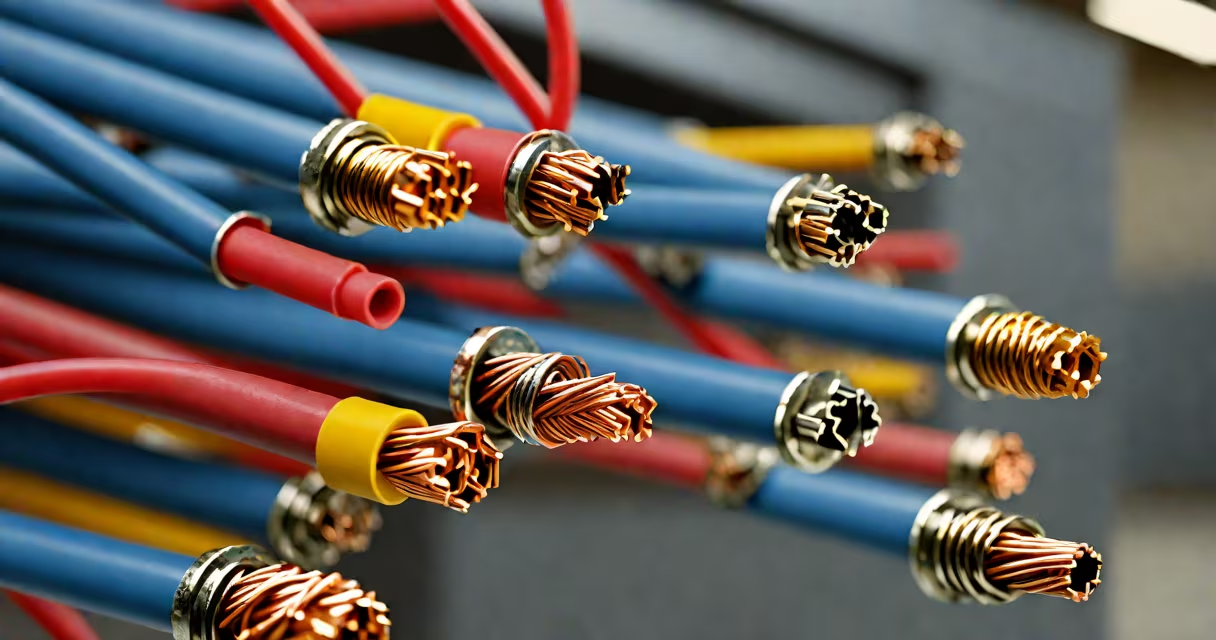
Distributor wire and cable is a standardized electrical conductor system designed to carry power or data between main distribution panels and branch circuits in commercial and industrial facilities. It supports high-current loads and structured data networks using insulated conductors enclosed in durable sheathing.
This system differs from residential branch wiring by using higher-grade insulation, larger gauge conductors, and compliance with National Electrical Code (NEC) Article 334 and Article 770 for data applications. It's typically installed in conduits, raceways, or cable trays rather than through walls or ceilings.
Used in office complexes, data centers, hospitals, and manufacturing plants, distributor wire and cable ensures safe, organized, and code-compliant routing of electricity and network signals. Its design allows for future upgrades and maintenance access without rewiring entire zones.
The system functions by delivering electrical current or digital signals from a central source-like a main electrical panel or network switch-to multiple endpoints such as outlets, lights, or network devices. Conductors are arranged in twisted pairs or single strands based on function: power or data.
For power distribution, conductors are sized according to ampacity requirements. A 6 AWG copper wire, for example, can safely carry 60 amps in free air per NEC Table 310.16. For data, Category 5e or Cat 6 cables use four twisted pairs to reduce crosstalk and support speeds up to 1 Gbps.
Each cable is labeled with voltage rating, conductor count, insulation type, and fire resistance class. A typical label might read "THHN/THWN-2 6/2 AWG Copper," indicating it's suitable for 600V service, thermoplastic insulation, and wet/dry location use.
Distributor wire and cable comes in several forms based on application, environment, and load. The most common types include:
| Type | Use Case | Conductor Size | Insulation Type | Fire Rating |
|---|---|---|---|---|
| THHN/THWN-2 | Power circuits in dry/wet locations | 14-6 AWG | Thermoplastic | Not flame-retardant |
| RHH/RHW-2 | Underground or direct burial | 10-2 AWG | Heat-resistant rubber | Flame-retardant |
| CM/CMG | Interior building runs (non-plenum) | 22-18 AWG | Polyvinyl chloride (PVC) | Low smoke, flame-retardant |
| Plenum-rated (CMP) | Between floors or above drop ceilings | 24-18 AWG | Flame-resistant polymer | Meets NFPA 90A plenum standards |
For data transmission, distributor cable often uses shielded twisted pair (STP) or unshielded twisted pair (UTP) configurations. Cat 5e and Cat 6 cable are standard for Ethernet networks, supporting 100 Mbps to 1 Gbps over distances up to 100 meters.
A key distinction many overlook: THHN is not a cable-it's a single insulated conductor. True distributor wire and cable includes multiple conductors in a single jacket. Using THHN alone in a raceway violates NEC Article 334.10, which requires conductors to be grouped in a cable assembly for protection.
Distributor wire and cable is essential in large-scale installations where safety, organization, and code compliance are critical. It's deployed in commercial buildings to route power to HVAC systems, lighting banks, and security panels.
In data centers, Cat 5 and Cat 6 cable form the core of network infrastructure. A single rack may contain 200+ cables routed through vertical raceways. Proper labeling and color coding prevent signal interference and simplify troubleshooting.
An example: a 10-story office building uses 12 AWG THHN for 208V branch circuits feeding floor-mounted outlets. These wires run through steel conduit from the main panel on the ground floor to junction boxes on each level. The conduit is grounded via bonding jumpers, and each circuit is protected by a 20A breaker. This setup meets NEC Article 300.4 and Article 310.15(B)(16).
Another example: a hospital's emergency lighting system uses 14 AWG NM-B cable (non-metallic sheathed) in corridors. The cable is rated for 600V and contains two hot conductors, a neutral, and a grounding wire-all within a flame-retardant PVC jacket. This configuration complies with NFPA 70E and ensures life safety during outages.
Many assume distributor wire and cable is interchangeable with household wiring. That's incorrect. Residential Romex (NM cable) lacks the mechanical strength and fire resistance required for commercial environments. NM cable is not rated for conduit installation and cannot be used in plenum spaces.
Another error: treating Cat 5 and Cat 6 cable as optional. In structured cabling, these are mandatory for compliant network performance. Using unshielded or damaged cables leads to signal degradation. A single bent pin in a patch panel can cause a 30% reduction in throughput, per IEEE 802.3an standards.
I once observed a contractor install Cat 5e cable in a ceiling space without proper strain relief. After a month, vibrations from nearby HVAC units caused connector failure. Replacing the cable cost $1,200 in labor and materials. The fix required removing drywall and rerouting through a new raceway.
Finally, some believe distributor wire can be cut and spliced freely. NEC Article 334.10 prohibits splicing in raceways unless using approved connectors. Field splices must be enclosed in junction boxes and tested for continuity and insulation resistance.
When selecting distributor wire and cable, always verify the manufacturer's listing with UL or CSA. Look for the "UL Listed" mark and the applicable standard number (e.g., UL 444 for power cables). This ensures compliance with national safety benchmarks.