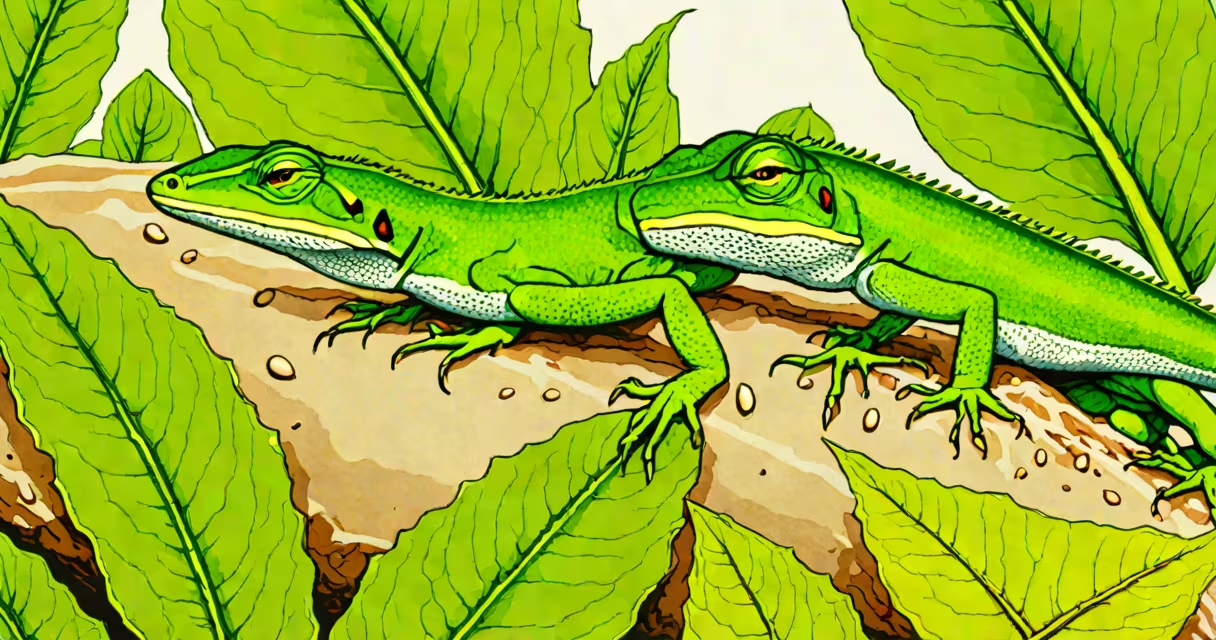
Yes, most lizards lay eggs. This reproductive strategy, known as oviparity, involves internal fertilization followed by the deposition of shelled eggs outside the body, where they develop and hatch independently.
Lizards belong to the class Reptilia, which includes animals that lay amniotic eggs-eggs with protective membranes and a shell that allow development in dry environments. This adaptation enabled reptiles to colonize land millions of years ago, long before mammals evolved.
While nearly all lizards reproduce by laying eggs, a small number of species-such as certain skinks and geckos-have evolved viviparity, giving birth to live young. However, this is rare and limited to specific lineages, not the group as a whole.
Fertilization in lizards occurs internally. Males possess hemipenes, paired reproductive organs used during mating. After mating, the female's reproductive tract forms a shell around each developing embryo using calcium and proteins from her diet.
Egg development takes place over several weeks. The duration varies by species and environment. For example, a common house gecko (Hemidactylus frenatus) typically lays eggs in 12 to 16 days after mating, while a desert iguana (Dipsosaurus dorsalis) may take 40 to 60 days.
Once laid, eggs require warmth and humidity to survive. Most wild lizards bury their eggs in soil, sand, or leaf litter to maintain stable conditions. The mother provides no further care after laying.
Although oviparity dominates, reproduction strategies differ across species. The table below outlines the primary methods:
| Reproductive Type | Definition | Examples | Prevalence |
|---|---|---|---|
| Oviparity | Lays shelled eggs externally; embryos develop outside the mother's body. | Green anole, bearded dragon, leopard gecko | ~95% of lizard species |
| Viviparity | Bears live young; embryos develop inside the mother's body and receive nutrients via placenta-like structures. | Some skinks (e.g., *Plestiodon skiltonianus*), certain geckos | Less than 5% |
| Ovoviviparity | Eggs develop internally but hatch inside the mother's body; young emerge alive. | Some whiptail lizards (*Cnemidophorus* spp.) | Rare; less than 1% of species |
A notable exception is the Australian skink *Niveoscincus ocellatus*, which gives birth to live young despite being closely related to egg-laying relatives. This shift evolved due to cold climates limiting egg survival in the ground.
Research from the University of California, Berkeley, shows that viviparity in lizards often arises in colder regions where egg incubation fails due to low temperatures. This supports the idea that environmental pressure drives reproductive change.
Many assume all lizards lay eggs because of their reptilian classification. While accurate for the majority, the existence of live-bearing species leads to confusion. A single species, such as the *Sceloporus jarrovii* (desert spiny lizard), may lay eggs, while its close relative *S. scalaris* gives birth to live young-demonstrating that reproductive mode is not consistent across genera.
Another misconception is that lizards abandon their eggs entirely. While most do not provide parental care, some species show subtle behaviors. Female green anoles (*Anolis carolinensis*) have been observed returning to nesting sites to adjust soil moisture or defend against predators, though they do not brood the eggs.
Egg-laying does not imply low intelligence or lack of investment. A study published in *Behavioral Ecology and Sociobiology* (2019) found that female lizards choose nesting sites based on temperature gradients, increasing offspring survival rates by up to 30% compared to random placement.
The leopard gecko (*Eublepharis macularius*) is a popular pet species native to arid regions of Asia. It exhibits typical oviparous reproduction.
After mating, the female lays a clutch of 1-2 eggs approximately 14 days later. She selects a warm, moist substrate-often a plastic container lined with damp paper towels-and buries the eggs. The eggs remain there for 40 to 60 days before hatching.
Temperature during incubation determines sex. Eggs incubated above 30°C (86°F) produce mostly females; below 28°C (82.4°F), mostly males. This phenomenon, called temperature-dependent sex determination (TSD), is common in reptiles but absent in mammals.
For breeders, this allows control over sex ratios. A breeder aiming for balanced sexes sets incubators between 28°C and 30°C. This practical application shows how understanding egg-laying biology enables real-world outcomes.
No. While the vast majority do, exceptions exist. Viviparity has evolved independently in multiple lizard families, including Scincidae (skinks), Gekkonidae (geckos), and Teiidae (whiptails).
These live-bearing species still reproduce sexually and develop embryos internally. The shift from egg-laying to live birth is not a reversal but an evolutionary adaptation to environmental challenges. Cold climates, high predation, or unstable substrates favor internal development.
Despite this variation, the term "do lizards lay eggs" remains accurate as a general rule. Only about 4% of known lizard species are viviparous, and most of those are confined to specific geographic zones.
Understanding that lizards lay eggs clarifies their role in ecosystems and informs conservation efforts. Protecting nesting habitats ensures successful reproduction, especially for species vulnerable to climate change and habitat loss.