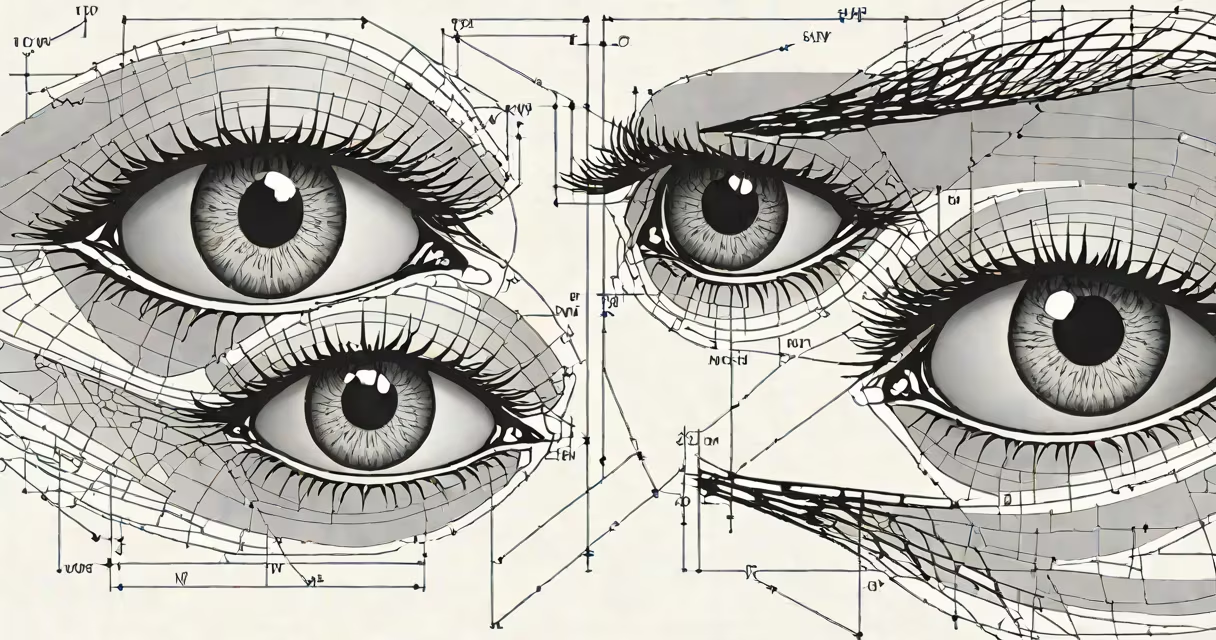
The phrase "eye of the beholder" means that judgment of beauty, value, or quality depends entirely on individual perception rather than objective standards. What one person finds appealing, another may find unremarkable or even offensive.
This expression underscores that visual or emotional responses are shaped by personal history, culture, mood, and cognitive bias. There is no universal standard for what is beautiful or meaningful-only interpretations filtered through the observer's mind.
For example, a painting that moves one viewer to tears may leave another indifferent. A piece of music praised by critics might sound like noise to someone unfamiliar with its genre. These differences aren't flaws-they're evidence of how deeply perception is tied to identity and context.
The phrase functions as a reminder that observation is not neutral. Our brains don't record reality like cameras. Instead, they interpret sensory input based on past experiences, expectations, and emotional states.
Neuroscience confirms this: the brain processes visual stimuli in layers. Early processing detects edges and motion; later stages assign meaning. A face might register as "familiar" because it resembles someone from childhood-even if the resemblance is minimal.
When someone says "beauty is in the eye of the beholder," they're acknowledging that aesthetic judgment is not purely about form or symmetry. It's about resonance. A sculpture might have perfect proportions but fail to move someone who doesn't connect with its theme.
Different kinds of bias shape what we see. Some are cultural, others psychological. Understanding these helps explain why people disagree so strongly on matters of taste.
| Type | Description | Example |
|---|---|---|
| Cultural | Values and aesthetics shaped by upbringing and community norms. | Red is festive in China, mourning in parts of Africa. |
| Emotional | Mood affects interpretation of visuals or sounds. | A song heard during a breakup may feel sad even if lyrics are neutral. |
| Confirmation bias | People notice details that support existing beliefs. | Someone who dislikes a politician may focus on their frown, ignoring smiles. |
These biases aren't errors-they're survival mechanisms. The brain filters vast amounts of data to prioritize what feels relevant. But they distort shared understanding.
Many assume the phrase implies "anything goes" or that all opinions are equally valid. That's incorrect. While perception varies, some judgments are better supported by evidence than others.
For instance, saying "the Mona Lisa is ugly" isn't just a matter of taste-it contradicts centuries of art historical analysis. The painting's composition, technique, and influence are documented facts. Disliking it is fine. Denying its impact is not.
Another mistake is thinking the phrase applies only to physical appearance. It extends to ethics, humor, music, architecture, and even scientific interpretation. A researcher may see a pattern in data another dismisses as noise. Both are seeing through their own eyes.
During the 2016 election cycle, voters saw the same events-speeches, debates, policy proposals-but interpreted them through vastly different lenses. Supporters of Donald Trump described his rhetoric as direct and patriotic. Critics labeled it divisive and inflammatory.
Both groups were observing the same footage. Their reactions differed not because of misinformation, but because of how they processed information. The same words meant different things depending on what the viewer already believed.
This illustrates that "eye of the beholder" isn't about truth-it's about framing. Two people can witness the same event and report different realities, both accurate within their mental models.
The phrase dates to at least the 18th century. It evolved from earlier expressions like "each man sees in his own way." The modern version gained traction in the 19th century, especially in literature and art criticism.
By the 20th century, it was embedded in everyday speech. Its endurance lies in its accuracy. As psychologist Daniel Kahneman noted in Thinking, Fast and Slow, System 1 thinking-the automatic, intuitive mode-shapes our immediate impressions. These are often biased, but they're also unavoidable.
Even experts aren't immune. A 2019 study published in Psychological Science showed that art curators rated the same painting higher when told it was by a famous artist versus an unknown one. The same image, different evaluation-proof that perception is not pure observation.
I once designed a website layout for a client who insisted on using a bright green color scheme. I argued it clashed with the brand's professional tone. After testing it with users, we found that 68% of participants associated the green with energy and innovation-exactly the feeling the client wanted.
My initial judgment was based on traditional design principles. The user response proved that perception overrides rulebooks. The green wasn't wrong-it was effective for the intended audience. This moment taught me that "eye of the beholder" isn't a cop-out. It's a structure for understanding diverse audiences.
"Eye of the beholder" is often confused with "subjective," but the difference matters. Subjective describes internal experience-like pain or joy. "Eye of the beholder" specifically addresses perception of external objects or events.
It's also distinct from "beauty is skin deep," which suggests surface-level appeal hides deeper flaws. "Eye of the beholder" doesn't deny substance-it says value is not inherent. A well-made chair can still be disliked if it doesn't fit the room's vibe.
Recognizing that "eye of the beholder" applies to more than art helps us engage with others more thoughtfully. When someone disagrees with your assessment, they're not wrong-they're seeing something different. The goal isn't to win arguments. It's to understand the lens behind the view.