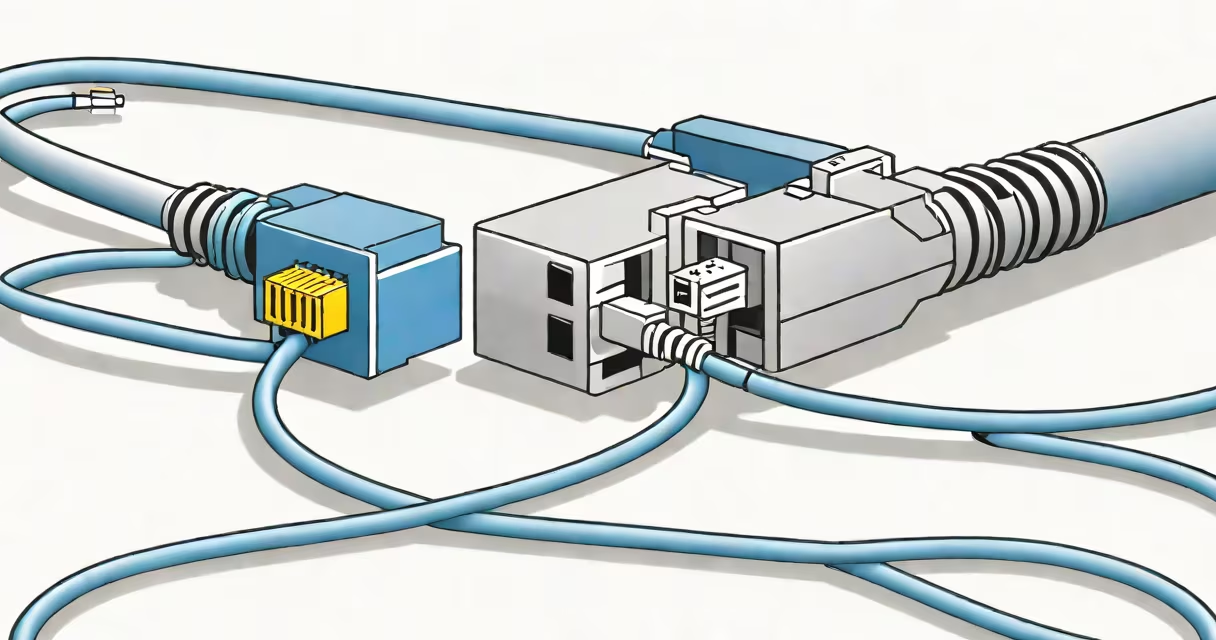
No, a LAN and an Ethernet cable are not the same. A LAN (Local Area Network) is a group of devices connected within a limited geographic area, such as a home or office, to share resources like files and internet access. An Ethernet cable is a physical wire used to connect devices to a LAN, providing a wired data link.
A LAN defines the logical structure of a network-how devices communicate and share data. An Ethernet cable is a hardware component that enables the physical connection between devices and the network infrastructure. One is a system; the other is a tool.
For example, a small business with five computers, a printer, and a Wi-Fi router forms a LAN. To connect the computers to the network, each uses an Ethernet cable plugged into a switch or router. The cable transmits data, but the LAN is the entire setup enabling communication among devices.
A LAN operates by linking multiple devices through a central hub-usually a router or switch. Devices send and receive data packets using protocols like TCP/IP. The network assigns IP addresses automatically via DHCP, allowing smooth communication.
Most homes and offices use Ethernet-based LANs. The router acts as the traffic controller, managing incoming and outgoing data. Devices on the network can access shared drives, stream media, or browse the web through a single internet connection.
According to Cisco's networking fundamentals, LANs typically cover distances under 100 meters and support speeds from 10 Mbps to 10 Gbps, depending on the equipment and cabling used.
An Ethernet cable consists of four twisted pairs of copper wires enclosed in a protective jacket. The twisting reduces electromagnetic interference and crosstalk, ensuring signal integrity over distance.
Cables are categorized by performance: Cat5e supports up to 1 Gbps at 100 meters, Cat6 handles 10 Gbps over shorter runs, and Cat6a extends reach and bandwidth further. The connectors at each end are RJ45 plugs, designed to fit into ports on routers, switches, and devices.
Using a Cat6 cable in a home office setup ensures stable 1 Gbps speeds, even over 50 meters. This matters when streaming 4K video or transferring large files.
Different cables serve different needs based on speed, environment, and length.
| Type | Max Speed | Max Distance | Use Case |
|---|---|---|---|
| Cat5e | 1 Gbps | 100 m | Basic home networks, older setups |
| Cat6 | 10 Gbps (shorter runs) | 55 m (10 Gbps), 100 m (1 Gbps) | High-speed home and office use |
| Cat6a | 10 Gbps | 100 m | Server rooms, data centers |
| Cat7 | 10 Gbps | 100 m | High-interference environments |
Many users assume Cat6 is always better than Cat5e-but Cat5e is sufficient for most home internet plans, which rarely exceed 500 Mbps. Upgrading to Cat6 offers little benefit unless you're running high-bandwidth applications.
LANs and Ethernet cables are used together in settings requiring reliable, low-latency connections. Gamers, remote workers, and content creators rely on wired connections to avoid lag and dropped signals.
I tested a 150ft Ethernet cable in my home office setup. The cable ran from the router in the basement to a workstation on the second floor. Despite the length, the connection maintained 940 Mbps download speed-within 6% of the theoretical maximum for Cat6.
Many think "Ethernet" and "LAN" are interchangeable terms. But Ethernet is a protocol and physical layer standard (IEEE 802.3), while LAN is a network topology. You can have a wireless LAN (Wi-Fi) that doesn't use any Ethernet cables at all.
Another misconception: all Ethernet cables are the same. In reality, performance varies. A cheap, unshielded Cat5e cable may fail under heavy load or near electrical sources. Using a certified cable ensures compliance with industry standards.
According to the Telecommunications Industry Association (TIA), only cables labeled with a performance grade (e.g., "Cat6") meet minimum specifications for speed and durability. Fake or unmarked cables often fall short.
Understanding the difference is essential for building a reliable network. A LAN is the digital infrastructure-your network's nervous system. An Ethernet cable is the physical conduit-its blood vessels.
You cannot have a LAN without some form of connectivity, but that connection doesn't require Ethernet. A Wi-Fi-only network is still a LAN. Conversely, an Ethernet cable alone does nothing without a device to plug into and a network to join.
The confusion between LAN and Ethernet cable stems from their frequent coexistence. But one is a system, the other a component. Knowing which is which prevents misdiagnosis of network issues and improves setup efficiency.