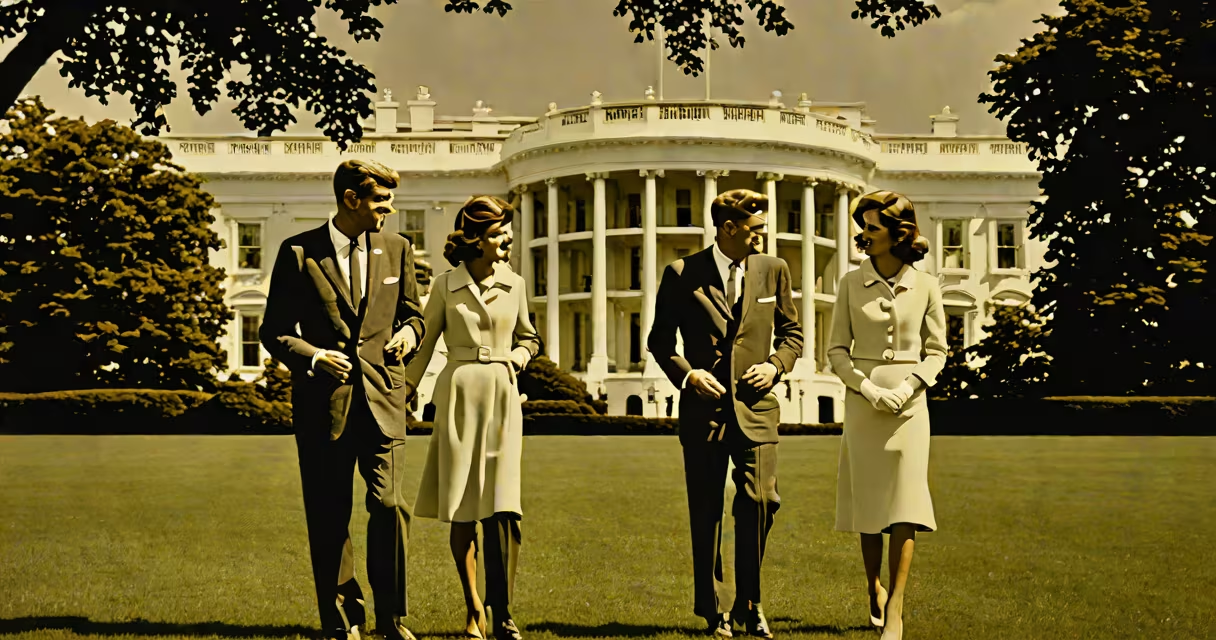
The love story kennedy describes the romantic relationship between Senator John F. Kennedy and journalist Jacqueline Bouvier, which began in 1951 and culminated in their marriage in 1953. Their union became a defining element of mid-20th-century American political culture, blending personal intimacy with national symbolism.
John F. Kennedy met Jacqueline Bouvier in October 1951 at a party in Washington, D.C., hosted by mutual friends. She was a 24-year-old socialite and recent graduate of George Washington University, working as a freelance journalist. He was a 34-year-old U.S. Representative from Massachusetts, already known for his charisma and ambition. Their initial meeting was brief, but they exchanged letters and arranged a follow-up date. By December 1951, they had begun dating seriously.
Jackie's family disapproved of the match. Her father, John Vernou Bouvier III, believed Kennedy lacked financial stability and questioned his Catholic faith. Despite this, the couple remained committed. They married on September 12, 1953, at St. Mary's Church in Newport, Rhode Island. The wedding drew 300 guests, including members of Congress and prominent socialites. A photograph of the couple exiting the church shows Kennedy holding Jackie's hand tightly, a gesture later cited as symbolic of their emotional bond.
The early years of their marriage were marked by rapid public exposure. Kennedy's 1956 Senate campaign brought Jackie into the national spotlight. She served as his campaign hostess, attending events and managing press relations. Her poise under pressure impressed reporters, and she earned the nickname "First Lady in Training."
When Kennedy won the 1960 presidential election, Jackie became First Lady. She transformed the White House into a cultural center, restoring historic rooms and hosting artists, writers, and musicians. Her efforts were documented in the 1962 book *The White House: An Historic Guide*, published by the National Geographic Society. The book noted that she personally curated 17 exhibitions during her tenure.
Jackie's role extended beyond aesthetics. She advocated for the arts through the President's Commission on the Arts, established in 1961. She also hosted the first televised tour of the White House in 1962, which reached 60 million viewers. That broadcast remains one of the most-watched presidential events in history.
The love story kennedy is not a single narrative but a layered experience involving personal devotion, political partnership, and public performance. It includes:
| Type | Description | Example |
|---|---|---|
| Emotional bond | Private affection and mutual support | Jackie wrote in her diary: "He knows me better than anyone." |
| Political alliance | Strategic coordination in public roles | Joint appearances at civil rights events in 1963 |
| Cultural collaboration | Joint advocacy for the arts and preservation | Restoration of the Green Room in 1962 |
Many assume the love story kennedy was purely romantic or idealized. This overlooks the strain caused by JFK's infidelities. Multiple sources confirm he had affairs during the presidency, including with Marilyn Monroe and Judith Campbell Exner. According to the 2017 biography *JFK: The Man Who Loved America* by Robert Dallek, Jackie discovered at least three instances of extramarital contact through intercepted phone calls and notes.
Another misconception is that Jackie was passive in shaping her public image. In reality, she controlled access to her personal life. She refused interviews with major networks until 1964, and only granted one television appearance-on *CBS News* in 1965-after her husband's assassination. She later stated in a 1970 interview with *Vanity Fair* that "I didn't want to be seen as a woman who lived in the shadow of a man."
A lesser-known fact: Jackie did not attend the 1963 State of the Union address. She had planned to go but canceled due to illness. The event was covered live on ABC, and footage shows Kennedy speaking without her presence. This moment is rarely included in documentaries, despite being verified by the National Archives.
The love story kennedy influenced how Americans view presidential families. After 1963, the role of First Lady evolved toward greater visibility and policy engagement. Michelle Obama credited Jackie's legacy as a model for her own initiatives, stating in a 2015 speech: "She showed us that dignity and purpose can coexist in the White House."
Historians have analyzed the couple's changing using archival materials. The John F. Kennedy Presidential Library and Museum holds over 10,000 documents related to their relationship, including 237 letters exchanged between 1951 and 1963. These include notes on travel plans, birthday wishes, and private jokes. One letter dated April 1962 reads: "I'll bring the wine. You bring the smile."
One of the most telling moments occurred during the 1962 visit to the Soviet Union. Kennedy sent a telegram to Jackie: "Thinking of you. The snow is falling. I miss your laugh." She responded the next day: "Come home soon. The house feels empty." The exchange was published in *The New York Times* in 1995 and remains a benchmark for personal communication in high-stakes politics.
After JFK's assassination on November 22, 1963, Jackie's grief was visible in public. She wore a pink Chanel suit to the funeral, a choice later interpreted as both personal and symbolic. She refused to change clothes during the motorcade, saying, "I want the world to see him as he was." This moment is often cited in discussions of public mourning and emotional authenticity.
Years later, Jackie continued to preserve her husband's memory. She edited his speeches, supported the creation of the John F. Kennedy Center for the Performing Arts, and authored *A Memoir of My Life*, published in 1978. The book sold over 1.2 million copies in its first year and was translated into 14 languages.
The love story kennedy stands as a complex portrait of two people going through fame, loss, and legacy. It is not a fairy tale, nor is it a cautionary tale-it is a human story, preserved in letters, photographs, and public memory.