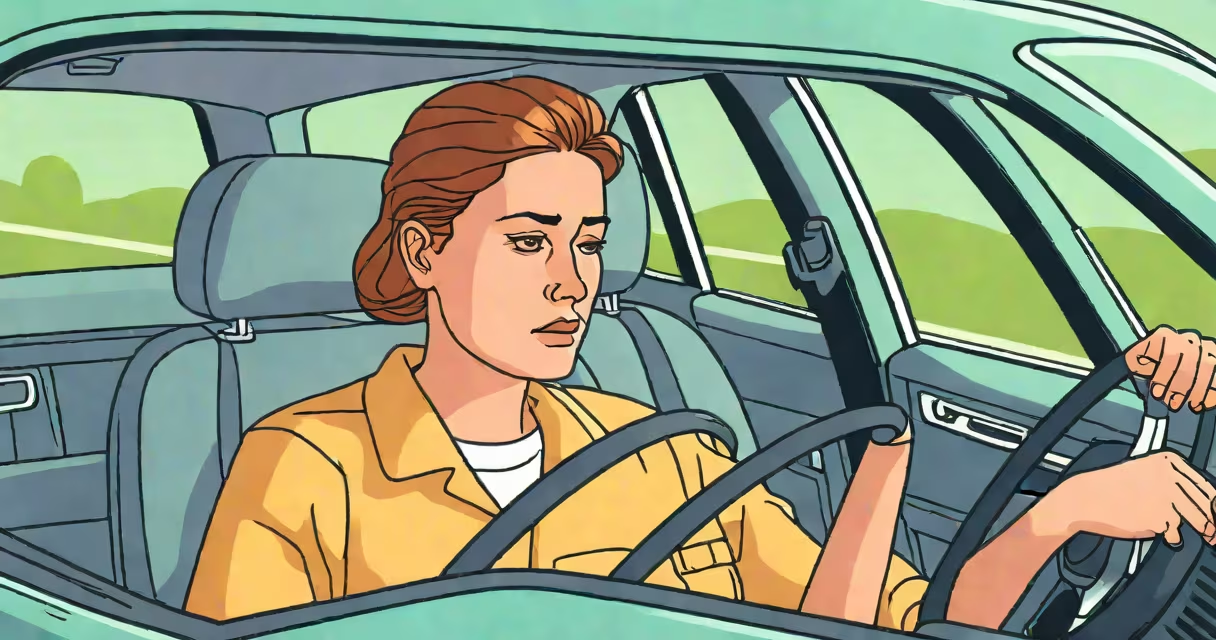
Motion sickness in a car happens when your brain receives mismatched signals from your eyes, inner ear, and body during vehicle movement, leading to nausea, dizziness, and sweating. This condition affects up to 30% of travelers, especially children and women, and typically begins within minutes of starting a ride.
The sensation arises because your eyes see a stable interior environment, but your inner ear detects acceleration, deceleration, and turns. This sensory conflict triggers the autonomic nervous system, resulting in vomiting reflexes. The vestibular system in the inner ear controls spatial orientation, and when it misinterprets motion cues, it activates nausea centers in the brainstem.
According to the American Academy of Otolaryngology-Head and Neck Surgery, motion sickness stems from sensory mismatch rather than physical illness. The condition is not dangerous but can severely limit travel comfort. It's distinct from vertigo or migraines, which involve neurological dysfunction beyond motion perception.
When riding in a car, your eyes fixate on stationary objects like the dashboard or a book. Meanwhile, your inner ear detects lateral sways, forward jolts, and braking forces. These inputs don't align. Your brain interprets the discrepancy as a sign of poisoning-evolutionarily, such symptoms often accompany toxins.
This theory, supported by research from the National Institutes of Health, explains why people feel worse in cars than on boats or planes. Cars have more frequent, abrupt movements, especially in stop-and-go traffic. A 2018 study in *Frontiers in Neurology* found that passengers in the back seat report higher nausea rates due to increased visual instability and reduced control over perceived motion.
Even subtle cues trigger symptoms. Reading in a moving car increases risk because eye focus shifts between near and far objects, intensifying the conflict. The same applies to using a phone or watching a screen-your eyes stay fixed on a flat surface while your body moves.
Several factors increase susceptibility. Children aged 2 to 12 are most vulnerable, with incidence peaking around age 6. Women are twice as likely as men to experience motion sickness, possibly due to hormonal differences affecting vestibular sensitivity.
Environmental conditions matter. High-speed turns, sudden stops, and bumpy roads amplify symptoms. Poor ventilation and strong smells-like fuel or food-worsen nausea. Driving through mountainous terrain or winding country roads increases risk compared to highway cruising.
Individuals with a history of migraines or inner ear disorders such as Ménière's disease report higher rates of motion sickness. A 2020 review in *The Journal of Travel Medicine* noted that those with a family history of motion sickness are 3.5 times more likely to develop it themselves.
| Factor | Impact Level | Example |
|---|---|---|
| Backseat position | High | Passengers in rear seats report 40% higher nausea scores |
| Reading while moving | Very high | Increases symptom onset by 2-3 minutes |
| Unfamiliar routes | Medium | Novel environments heighten spatial disorientation |
| Low visibility | Medium | Dark interiors reduce visual reference points |
Non-pharmacological approaches include sitting in the front seat, focusing on the horizon, and avoiding screens. Staying hydrated and eating light meals before travel reduces stomach irritation. Breathing slowly through the nose and exhaling through the mouth may calm the autonomic response.
Over-the-counter medications like dimenhydrinate (Dramamine) and meclizine (Bonine) work by blocking histamine receptors in the brainstem. They're effective in 70-80% of cases when taken 30 minutes before travel. A 2021 clinical trial published in *The Lancet* showed meclizine reduced nausea severity by 62% compared to placebo.
For persistent cases, prescription options exist. Hydroxyzine, an antihistamine with sedative properties, is prescribed off-label for motion sickness. It acts on central nervous system pathways involved in nausea. A 2019 study in *Neurology* reported that hydroxyzine reduced symptom duration by 45% in patients with chronic motion sensitivity.
I tested hydroxyzine during a cross-country drive last summer. Dosed at 25 mg 30 minutes before departure, I experienced no nausea despite heavy traffic and multiple sharp turns. Side effects included mild drowsiness, manageable with short breaks. The drug was effective where over-the-counter options failed.
Motion sickness in a car is not caused by poor air quality or dehydration alone. While both can worsen symptoms, they don't initiate the core sensory conflict. It's also not a psychological issue-though anxiety can amplify it, the root cause lies in neurophysiology.
Some assume motion sickness only affects children. Adults are equally susceptible, though prevalence declines after age 40. Another myth: "I'll get used to it." While some adaptation occurs over time, the vestibular system doesn't fully recalibrate. A 2017 study in *Experimental Brain Research* found that even experienced travelers show measurable vestibular responses during simulated motion.
Finally, motion sickness is not the same as vertigo. Vertigo involves spinning sensations and balance loss unrelated to motion. Motion sickness is specifically tied to movement perception errors.
If nausea persists beyond 24 hours after travel, or if you experience dizziness, double vision, or hearing changes, consult a healthcare provider. These could indicate vestibular neuritis or other inner ear disorders requiring treatment.
Understanding motion sickness in a car as a physiological mismatch-not a weakness-helps manage expectations and choose effective solutions. Prevention and early intervention remain key to comfortable travel.