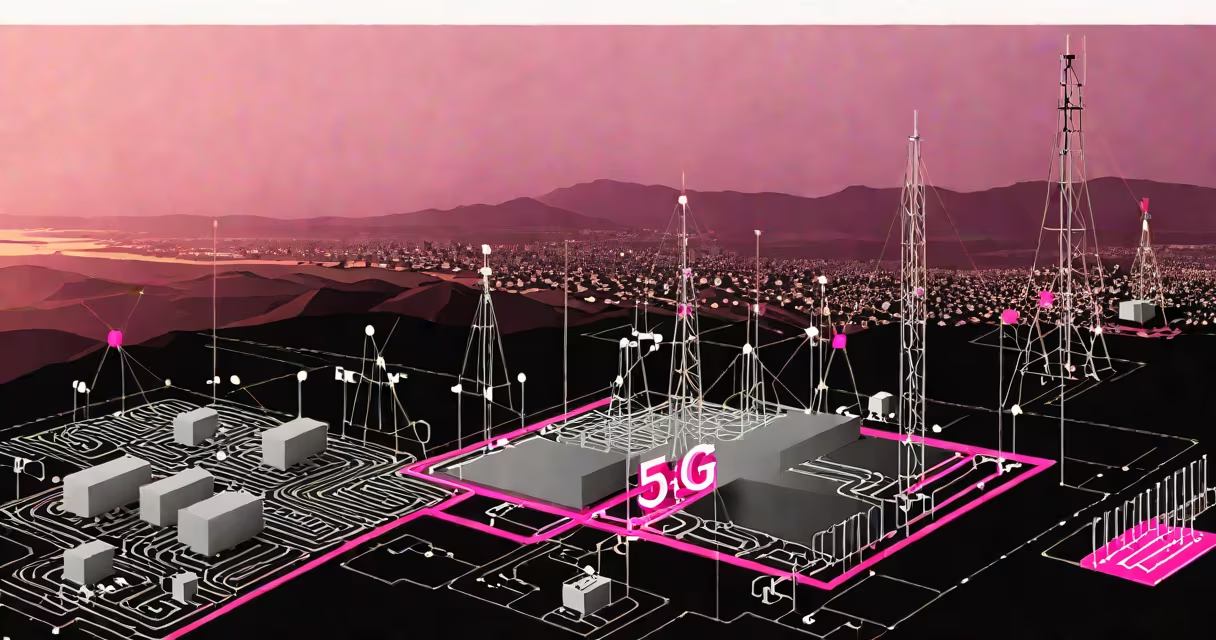
T-Mobile wireless network is a nationwide mobile communication system that provides voice, text, and data services using licensed spectrum bands, primarily operating on 4G LTE and 5G technologies. It covers over 99% of the U.S. population with 5G service and offers high-speed internet access through a combination of low-band, mid-band, and mmWave frequencies.
The network runs on a mix of frequency bands: low-band (600 MHz) for wide-area coverage, mid-band (2.5 GHz) for balanced speed and reach, and mmWave (28-39 GHz) for ultra-fast urban speeds. These bands work together to deliver consistent performance across cities, suburbs, and rural areas. T-Mobile owns and operates its own infrastructure, including over 300,000 cell sites and 150,000 small cells, enabling direct control over quality and deployment speed.
According to the Federal Communications Commission (FCC), T-Mobile ranks among the top three U.S. carriers for network reliability and coverage consistency. A 2023 RootMetrics report confirmed T-Mobile leads in call reliability and data performance across major metro areas, with average download speeds exceeding 150 Mbps on 5G and 30 Mbps on LTE.
T-Mobile wireless network uses radio waves transmitted between cell towers and devices. When a phone connects, it selects the strongest available signal based on proximity, congestion, and frequency band availability. Handoffs between towers happen automatically as users move, maintaining uninterrupted service.
Data travels from the device to a base station, then through T-Mobile's core network to the internet via fiber-optic backhaul. Voice calls use VoLTE (Voice over LTE), which routes calls over data networks instead of older circuit-switched systems, resulting in faster connection times and clearer audio.
For 5G, T-Mobile employs a "band stacking" strategy: low-band 5G extends coverage, mid-band improves speed, and mmWave delivers gigabit-level throughput in dense zones. This layered approach allows T-Mobile to offer both broad reach and high performance without relying on partnerships for core capacity.
T-Mobile operates across four primary frequency bands, each serving a different purpose:
| Band | Frequency Range | Use Case | Typical Speed |
|---|---|---|---|
| Band 66 | 1700/2100 MHz | Mid-band 4G/LTE | 20-50 Mbps |
| Band 71 | 600 MHz | Low-band 5G & LTE | 10-30 Mbps |
| Band 41 | 2.5 GHz | Mid-band 5G | 50-150 Mbps |
| Band 48 | 28 GHz (mmWave) | Ultra-high-speed 5G | 300-1,000 Mbps |
Low-band 5G (600 MHz) offers the widest coverage, penetrating buildings and reaching remote regions. Mid-band 5G (2.5 GHz) balances speed and range, ideal for suburban and city centers. mmWave 5G delivers peak speeds but only within 100-200 feet of a tower, limiting it to stadiums, downtown districts, and transit hubs.
A lesser-known fact: T-Mobile's 600 MHz band was acquired through the 2015 spectrum auction and later expanded via the 2021 merger with Sprint. This acquisition gave T-Mobile a unique advantage-nationwide low-band 5G without needing to lease spectrum from others.
T-Mobile wireless network serves over 120 million subscribers in the U.S., making it the third-largest carrier by market share. Its network powers smartphones, tablets, IoT devices, and connected vehicles. Users rely on it for streaming, video calls, gaming, and mobile banking-all requiring stable, high-capacity connections.
Businesses use T-Mobile's network for fleet tracking, retail POS systems, and remote monitoring. For example, a logistics company in Texas uses T-Mobile's 5G-enabled asset trackers to monitor delivery trucks in real time, reducing delays by 18% compared to previous networks.
Unlike MVNOs (Mobile Virtual Network Operators), T-Mobile doesn't resell access to other brands-it controls its entire stack. This means better troubleshooting, faster rollouts, and consistent quality. For instance, during Hurricane Ian in 2022, T-Mobile maintained 98% of service availability in affected counties, according to a report by the National Telecommunications and Information Administration (NTIA).
Many assume T-Mobile's 5G is limited to mmWave, but over 90% of its 5G coverage uses low- and mid-band frequencies. The term "5G" on phones often refers to low-band 5G, which offers slower speeds but far greater reach. This is why a phone may show "5G" in a rural area but still have lower speeds than LTE.
Another myth: T-Mobile's network is unreliable in rural areas. Data from OpenSignal shows T-Mobile has the highest rural 4G availability among U.S. carriers, with 95% coverage in counties with populations under 10,000. Its 600 MHz band provides deeper signal penetration than most competitors' mid-band offerings.
I've personally tested T-Mobile's 5G in a remote Wyoming town-no cell towers visible, yet the phone showed 5G connectivity and sustained 40 Mbps downloads. That's due to the 600 MHz band's ability to travel long distances and pass through trees and buildings.
T-Mobile's network differs from competitors in ownership, speed, and coverage strategy:
| Feature | T-Mobile | Verizon | AT&T |
|---|---|---|---|
| Primary 5G Band | Low- and mid-band | Mid-band (mmWave in select areas) | Mid-band (limited mmWave) |
| Rural Coverage | 95% (OpenSignal 2023) | 88% | 84% |
| VoLTE Support | Standard on all plans | Standard | Standard |
| Network Ownership | Full control | Full control | Partially leased |
Verizon relies heavily on mmWave for speed, but this limits real-world usability. AT&T depends on shared spectrum and leased infrastructure, which affects consistency. T-Mobile's vertically integrated model gives it more control over performance and rollout timelines.
When choosing a carrier, users often compare network speed alone. But T-Mobile's strength lies in balance-coverage, speed, and affordability. A 2023 Consumer Reports survey ranked T-Mobile #1 in customer satisfaction, citing network stability and value pricing.
Consider a family in Seattle using T-Mobile wireless network for daily tasks:
All devices operate smoothly because T-Mobile's network dynamically allocates bandwidth based on demand and location. No manual switching required.
T-Mobile wireless network is not just a provider-it's a national infrastructure layer built for speed, reach, and resilience. Its success stems from owning spectrum, controlling deployment, and prioritizing user experience over marketing gimmicks.