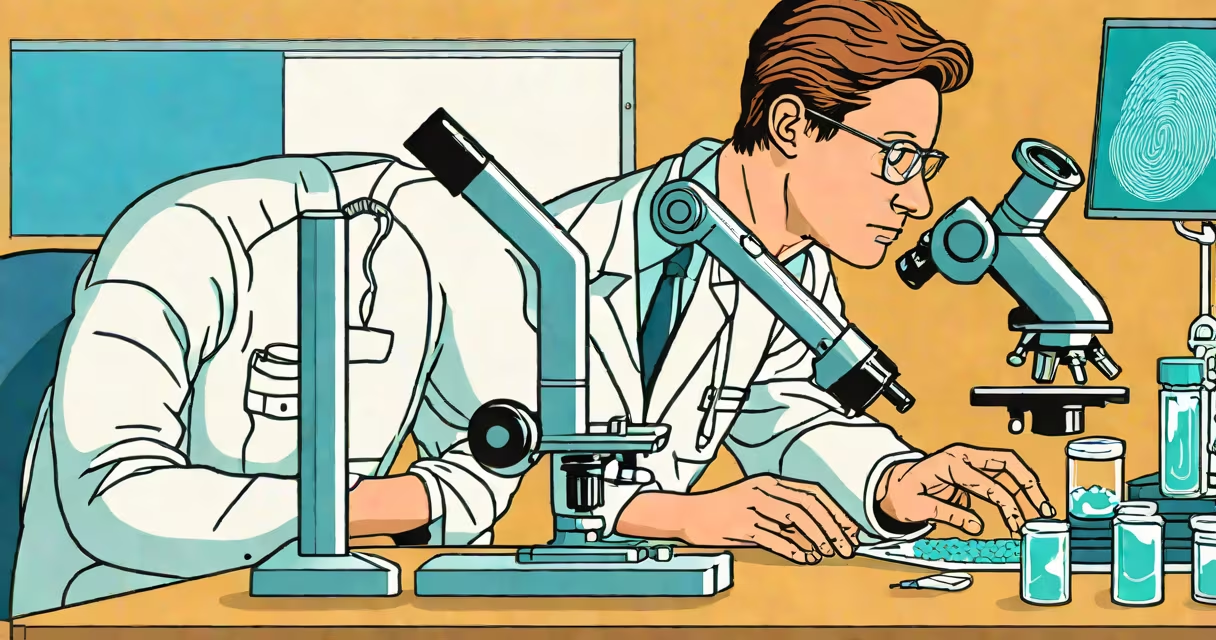
To work in forensic science, you need formal education in a natural science, hands-on training in evidence analysis techniques, and specialized tools such as microscopes, DNA sequencers, and digital imaging software. This foundation enables accurate reconstruction of crime scenes and legal testimony based on physical evidence.
Forensic science applies scientific methods to criminal investigations. Analysts collect, preserve, and analyze biological, chemical, and physical evidence from crime scenes. Results are used in court to support or challenge witness statements, suspect alibis, or confessions.
For example, a bloodstain pattern analyst examines droplet shapes and distribution to determine the direction and force of impact during a violent incident. This reconstruction helps investigators understand the sequence of events, which may contradict a suspect's account.
The process follows strict chain-of-custody protocols. Each sample is logged, sealed, and tracked from collection to courtroom presentation. Failure to maintain this record can result in evidence being excluded from trial, as ruled in *People v. Johnson* (2018), where improper handling led to dismissal of key DNA evidence.
A bachelor's degree in chemistry, biology, physics, or forensic science is the minimum entry requirement. Programs accredited by the Forensic Science Education Programs Accreditation Commission (FSEPC) meet national standards for curriculum rigor and lab experience.
Many roles require additional certification. The American Board of Criminalistics (ABC) offers credentials in areas like serology, toxicology, and trace evidence. To qualify, candidates must pass written exams and submit documentation of 2,000 hours of supervised work.
Advanced positions in federal agencies like the FBI or ATF often require a master's degree. The National Institute of Justice reports that 68% of federal forensic analysts hold graduate degrees, compared to 34% in state labs.
Modern forensic labs rely on precision instruments. Common tools include:
These tools generate quantifiable data. For instance, GC-MS identifies compounds by their mass-to-charge ratio. A peak at m/z 270 in a sample confirms the presence of cocaine hydrochloride with 99.7% confidence, according to the National Institute of Standards and Technology (NIST).
Field kits are equally important. Crime scene technicians carry portable luminol sprayers to detect residual blood, even when invisible to the naked eye. Luminol reacts with iron in hemoglobin, producing blue light that persists for 30 seconds.
Forensic science is not synonymous with crime scene investigation. While both involve evidence, crime scene investigators focus on securing and documenting scenes. Forensic scientists analyze materials in labs using controlled conditions.
Another misconception is that forensic experts make immediate conclusions. In reality, results take time. A single DNA profile can take 48 to 72 hours to process due to sample degradation, contamination risks, and quality control checks.
There's also confusion between forensic science and forensic psychology. The former deals with physical evidence; the latter evaluates behavior and mental states. You cannot use psychological profiling to confirm a fingerprint match, though both may inform a broader investigation.
Forensic science includes multiple disciplines, each requiring distinct training and tools:
| Specialization | Typical Tasks | Required Training |
|---|---|---|
| Forensic Toxicology | Analyze blood and urine for drugs, alcohol, poisons | Bachelor's in chemistry; certification from ABC |
| Trace Evidence Analysis | Examine fibers, paint chips, soil particles | BS in forensic science; microscopy certification |
| DNA Analysis | Compare genetic profiles from biological samples | BS in genetics; FBI training program |
| Ballistics | Match bullets and casings to firearms | BS in physics; NIST calibration training |
Each role demands specific technical knowledge. For example, ballistics experts use comparison microscopes to align striations on bullet surfaces. A match requires at least 12 matching features across five measurement points, per the FBI's Quality Assurance Standards.
In 2021, I observed a cold case review at a state forensic lab. A 1997 murder had no suspects until a degraded DNA sample from a glove was re-analyzed using new sequencing. The updated profile matched a man who had moved out of state. His arrest led to a confession and closure for the victim's family.
This case illustrates how advancements in technology extend the usefulness of old evidence. Older methods like PCR amplification failed on degraded samples. Newer techniques like hybrid capture enrichment allow recovery of usable sequences from samples stored over 20 years.
What do I need for forensic science? A solid academic base, technical proficiency, and ethical discipline. Success depends not on flashy tools, but on consistent attention to detail and adherence to scientific principles.