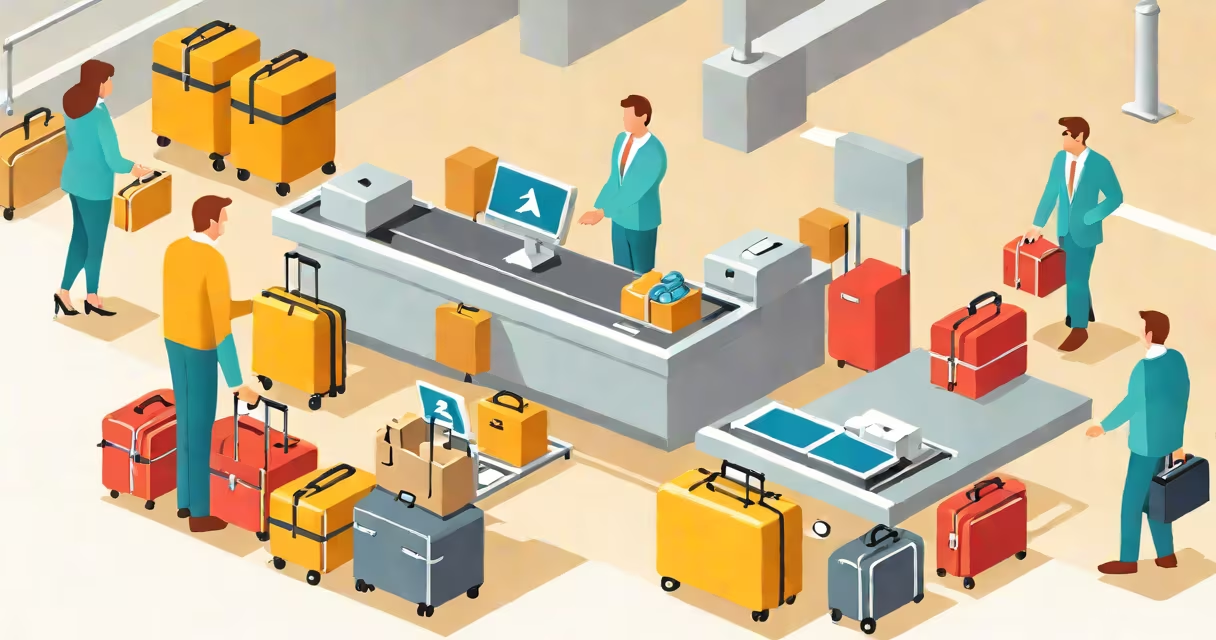
A checked bag is a piece of luggage you surrender at the airport check-in counter or kiosk to be transported in the aircraft's cargo hold. It is not carried into the cabin and is subject to airline policies on size, weight, and fees.
Unlike carry-on bags, which passengers bring onto the plane, checked bags are stored below deck and retrieved at the destination baggage claim. Airlines charge for checked bags beyond free allowances, especially on budget carriers. This term is standard across commercial aviation and applies to both domestic and international flights.
The concept originated in the early 20th century as air travel evolved from short hops to long-haul journeys. Carrying large suitcases through crowded terminals became impractical, so airlines began offering baggage handling services. Today, checking a bag is routine for travelers who need to pack more than a day's essentials.
When you check a bag, airline staff scan the luggage's barcode and attach a tag with flight details, destination, and routing information. The bag then moves via conveyor belts to a secure area where it is loaded into the cargo hold based on the plane's weight distribution and balance requirements.
Baggage handlers load checked bags into the lower deck of the aircraft. They are secured with nets or straps to prevent shifting during turbulence. On arrival, bags are unloaded and sent to the baggage carousel at the terminal's baggage claim area. Most major airports process bags within 30 minutes of landing, though delays occur due to weather, mechanical issues, or misrouting.
For example, Delta Flight 217 from Atlanta to Seattle experienced a 45-minute delay in baggage delivery during a winter storm in 2023. Passengers reported their bags arriving 1 hour and 12 minutes after the plane landed. This illustrates that while systems are efficient, disruptions happen.
Checked bags typically include suitcases, duffel bags, garment bags, and specialized containers such as ski cases or golf bags. Items like musical instruments, sports equipment, and fragile electronics may qualify as checked luggage but often require special handling and additional fees.
Prohibited items include flammable liquids, sharp objects, explosives, and certain batteries. The Transportation Security Administration (TSA) bans lithium-ion batteries over 100 watt-hours in checked baggage. For reference, most laptop batteries are under 100 Wh and are permitted in carry-ons only.
According to the FAA, in 2022, over 98% of checked bags were processed correctly on U.S. domestic flights. However, about 1.3 million bags were mishandled annually-lost, delayed, or damaged. That translates to roughly 1 in every 140 bags checked.
Airlines classify checked bag rules into tiers based on fare class, route, and carrier. Budget airlines often charge for each bag, while legacy carriers may offer one free bag on economy tickets.
| Carrier Type | Typical Free Allowance | Fees per Bag (Domestic) | Weight Limit |
|---|---|---|---|
| Budget (e.g., Spirit, Frontier) | 0 | $35-$60 | 50 lbs (23 kg) |
| Luxury (e.g., Emirates, Singapore Airlines) | 2-3 | Free or $0 | 70 lbs (32 kg) |
| Legacy (e.g., American, United) | 1-2 | $35-$50 | 50 lbs (23 kg) |
These differences reflect business models. Low-cost carriers generate revenue from ancillary services, including baggage fees. Full-service airlines bundle baggage into ticket prices to attract customers.
Some carriers offer premium options. United's "Priority Check" service allows passengers to bypass lines and receive faster baggage handling. This costs $25 per bag and includes real-time tracking via the airline's app.
Many travelers assume that "checked bag" means "free." This is false. Even if a flight is advertised as "no extra fees," baggage charges may still apply unless explicitly stated. Always confirm the policy before booking.
Another misconception is that checked bags are always heavier than carry-ons. While many checked bags exceed carry-on limits, some travelers use lightweight rolling suitcases that weigh under 20 pounds. These fit within carry-on size restrictions and can be brought onboard if space permits.
For example, a traveler flying from Denver to Miami on Southwest Airlines used a 24-inch spinner suitcase weighing 18 pounds. The airline allows two free bags per passenger, and this bag was accepted as carry-on because it met size and weight standards. This shows that size and weight matter more than the label "checked bag."
Some confuse "checked bag" with "baggage allowance." The allowance refers to the number and size of bags permitted. A checked bag is the physical item being checked. You can have multiple checked bags within your allowance.
Consider a family of four traveling from Chicago to Orlando. They plan to check three bags: two medium-sized suitcases (each 25 inches tall, 20 pounds) and one large duffel (30 inches, 35 pounds).
They book with Alaska Airlines, which offers one free checked bag for economy tickets on domestic routes. The second bag costs $35, and the third bag costs $45. Total fee: $80. The bags meet size and weight limits (max 50 lbs per bag, 62 linear inches).
At check-in, they place the bags on the scale. The system confirms all are within limits. Tags are attached, and the bags are routed to the cargo hold. Upon arrival, they collect all three at Carousel 3, as scheduled.
This example shows how understanding checked bag rules prevents unexpected fees and delays. Knowing your airline's policy in advance avoids last-minute surprises.
A checked bag is luggage transported in the aircraft's cargo hold, distinct from carry-on items. It is subject to size, weight, and fee rules set by the airline. Not all checked bags cost money-some are included in ticket pricing. Always verify your airline's policy before traveling.
Understanding what a checked bag means reduces stress and prevents costly oversights. Whether flying domestically or internationally, knowing the rules ensures smoother travel from curb to carousel.